The Moon
The Moon is where you should start. Not just because it’s the easiest target to find - though it is - but because it’s the most rewarding object you’ll observe with any telescope.
Forget everything you’ve heard about the Moon being “boring” or “just for beginners.” The Moon has more visible detail than any other object in the sky. More craters, mountains, valleys, and features than you could explore in a lifetime of observing. Every night the lighting changes, revealing different details along the terminator - the line between light and dark where shadows are longest and craters pop into dramatic relief.
The Moon is also forgiving. It’s big, bright, and impossible to miss. When you’re learning to point a telescope or use a finder scope, the Moon is your training ground. You’ll fumble, lose it in the field of view, struggle with focusing - and that’s fine. The Moon is patient. It’ll still be there when you figure it out.
What You Can See
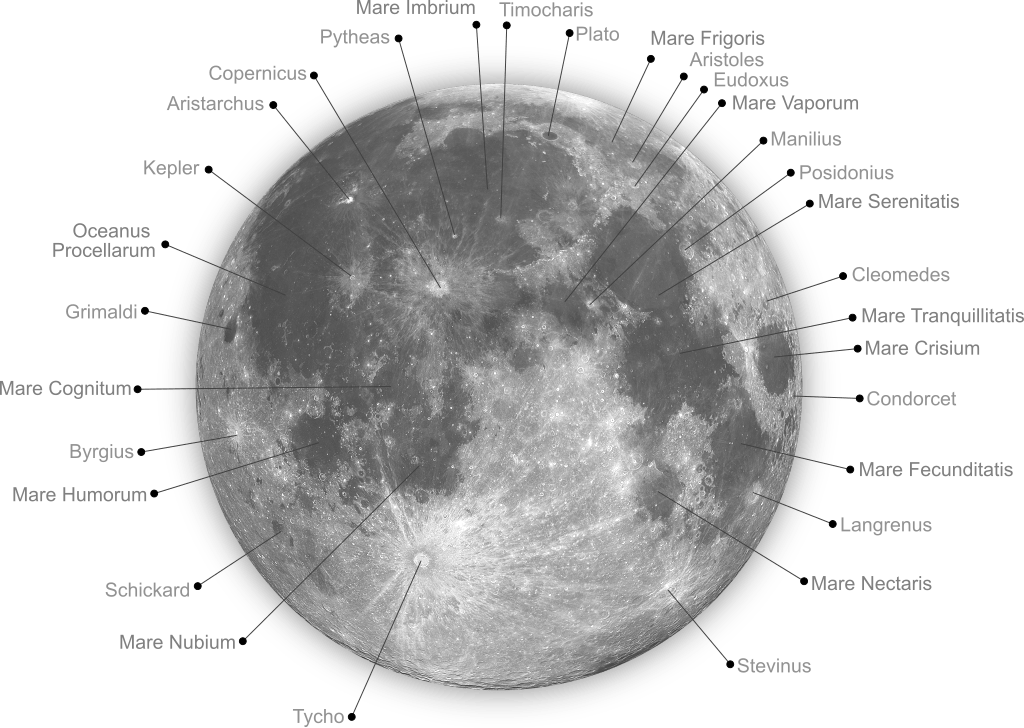
With naked eye: you can see the major maria - the dark “seas” that ancient astronomers mistook for actual oceans. These are vast lava plains formed billions of years ago. You can also see some of the brighter craters and ray systems spreading from impact sites.
With binoculars, the Moon transforms. Craters become obvious. Mountain ranges appear along the terminator. The maria show texture and variation. You can start tracking features and learning their names. A simple pair of 10x50 binoculars reveals hundreds of craters and gives you a real sense of the Moon’s three-dimensional surface.
With a small telescope (60-80mm), detail explodes. Craters within craters. Mountain peaks catching sunlight while valleys remain in shadow. Rilles - collapsed lava tubes snaking across the surface. You can spend an entire night just exploring one region of the Moon and never see everything.
With a larger telescope (150mm+), you’re seeing lunar geography at a level that feels almost like being there. Terraced crater walls. Central peaks inside impact craters. Boulder fields. The sheer depth and complexity of the surface becomes overwhelming in the best possible way.
The Moon rewards aperture, but it rewards patience and good seeing even more. A steady atmosphere and careful observation reveal more detail than simply throwing aperture at it.
When to Observe
Here’s a secret most beginners don’t know: full moon is the worst time to observe the Moon. At full phase, the Sun is directly behind us, lighting the Moon from straight on. There are no shadows. Everything looks flat and washed out. Details disappear.
The best time to observe is along the terminator during crescent, quarter, or gibbous phases. That’s where shadows are long, craters look deep, and mountains cast dramatic relief. The terminator moves slowly across the Moon’s surface over the course of each month, revealing different features in optimal lighting each night.
If you observe the same crater over several nights as the terminator passes, you’ll see it change from a sharp-shadowed pit to a flat, barely visible circle. This teaches you more about lighting and three-dimensional form than any book can.
Getting Started
Start with low magnification. Find the Moon in your finder scope or binoculars, center it in the eyepiece, and just look. Don’t worry about naming features yet. Just observe. Notice the terminator. That’s where the action is. Pick a crater near the terminator and watch how the shadow inside it changes as the nights go by. See how the lighting reveals different details.
Once you’re comfortable at low power, increase magnification. The Moon is bright enough to handle high magnification better than almost any other object. 100x, 150x, even 200x or more if seeing conditions allow. The Moon can take it.
Filters Help
The Moon is bright. Sometimes uncomfortably bright, especially through larger telescopes. A neutral density filter or variable polarizing filter cuts the glare without affecting detail. Your eyes will thank you. Some observers swear by colored filters to enhance contrast on subtle features. A light green filter can make certain details pop. Experiment if you want, but a simple neutral density filter is usually enough.
The Moon Never Gets Old
You’ll hear people say they’ve “seen the Moon already” and move on to other targets. That’s a mistake. The Moon changes every night. Different lighting. Different features highlighted. Different regions near the terminator. Professional astronomers spent decades mapping the Moon before we sent probes there. Amateurs still discover subtle details - transient phenomena, unusual lighting effects, features that only appear under specific angles.
The Moon is not a checkbox to tick off. It’s a world. Treat it like one, and you’ll never run out of things to see.