The Language of the Sky
The Basics
A lot of people think you need expensive equipment to start stargazing. Telescopes, star charts, apps, GPS coordinates, fancy mounts - the whole setup. You don’t. Here’s what you actually need to begin: your eyes, a dark spot, and knowing which direction you’re facing. That’s it! Everything else - telescopes, binoculars, apps, planispheres - comes later. Right now, you just need to look up and start recognizing patterns. The sky isn’t as complicated as it seems. Once you know a handful of bright stars and a few key constellations, everything else falls into place.
But first, you need to orient yourself. And that starts with knowing your directions. Why does direction matter? Because star maps and apps always show you the sky based on which way you’re facing. If a map says “Leo is in the east,” you need to know where east actually is. Without that reference point, the map is useless. You’ll be spinning in circles trying to match what’s on your screen to what’s above your head. Once you know your cardinal directions - north, south, east, west - you can use any star chart or app effectively. You can track how stars move across the sky. You can predict what will be visible at different times of the year.
Direction is your anchor
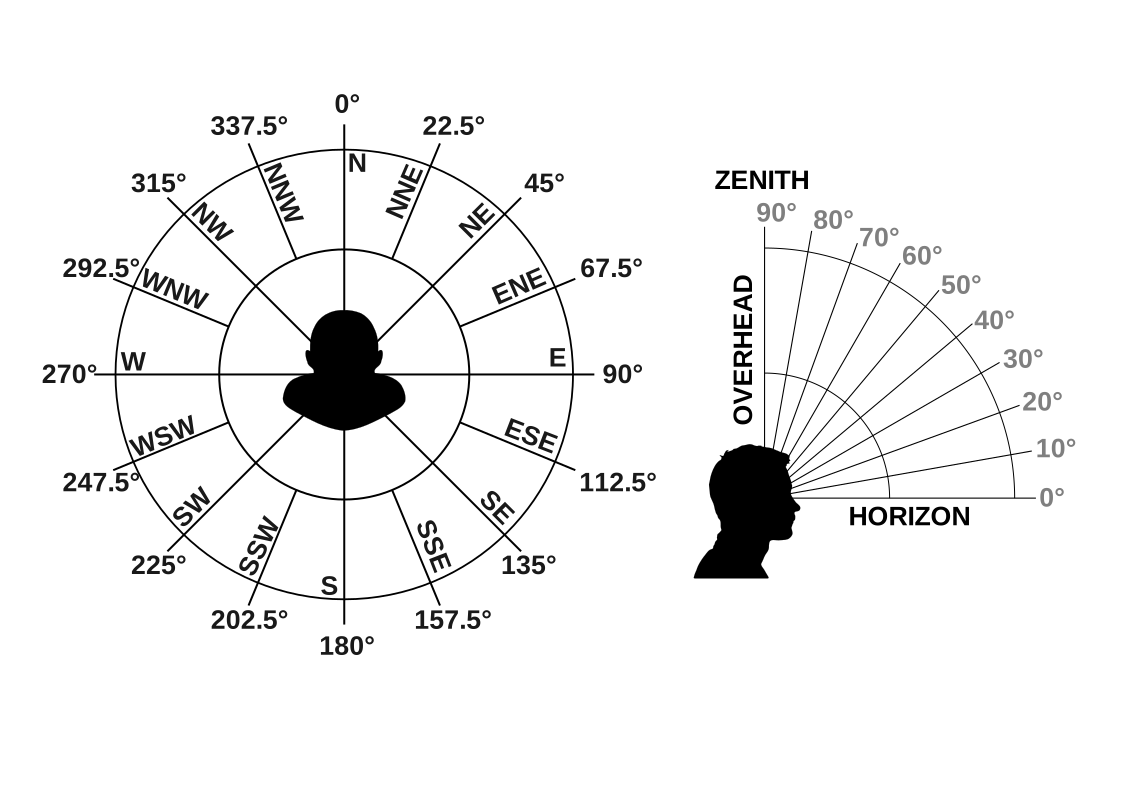
Finding your cardinal directions without any tools is surprisingly simple. If you are not living in the high latitudes the Sun rises roughly in the east and sets roughly in the west - if you know where the Sun set that evening, you know where west is. Stand facing west, and north is to your right, south to your left, east behind you. That’s your starting point. But all practical purposes, a basic compass app on your phone is a must have for stargazing. It gives you accurate directions instantly, no matter where you are. If you don’t have a smartphone, a traditional magnetic compass works too. You will be able to find them in outdoor or camping stores for very cheap.
Once you get comfortable with the basics, we’ll layer in tools and techniques. But for now? Let’s keep it simple. Look up. Get your bearings. Start exploring.
Measuring Angles in the Sky
When navigating the night sky, we often need to measure distances between stars or constellations. Unlike on Earth, where we use miles or kilometers, astronomers use angular measurements. The two most common units are degrees and arcminutes. This sounds technical but it is not. You already use degrees every day without thinking about it. When you turn around completely, you’ve rotated 360°. When you do an about-face, that’s 180°. A right angle? 90°. That’s all a degree is - a unit for measuring angles.
Now here’s where it gets useful for astronomy: the sky is a dome above you, and we measure positions and distances across that dome using degrees. From the horizon to the point directly overhead (called the zenith), that’s 90°. From one horizon to the opposite horizon, going straight overhead, that’s 180°. All the way around the horizon in a circle? 360°.
But sometimes degrees are too big. The Moon, for example, is only about half a degree wide. So we break degrees down into smaller units: arcminutes and arcseconds. One degree contains 60 arcminutes. One arcminute contains 60 arcseconds. Think of it like time: one hour has 60 minutes, one minute has 60 seconds. Same logic, different measurement. We use the symbols ° for degrees, ’ for arcminutes, and ” for arcseconds. So if you see something listed as 2° 30’ 15”, that means 2 degrees, 30 arcminutes, and 15 arcseconds. And in decimal form, that would be 2.5042° (since 30 arcminutes is 0.5 degrees and 15 arcseconds is 0.0042 degrees). Decimal form is never used in casual stargazing, but it’s common in scientific contexts and programming
Using your hand to measure angles
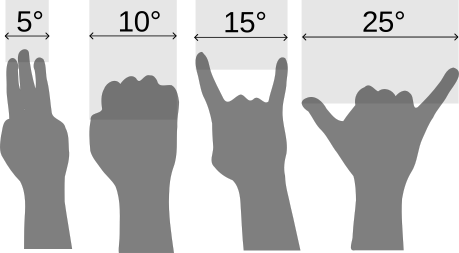
Your hand makes a simple measuring tool for the sky. Hold it out at arm’s length, and you can estimate angles. Your fist covers about 10°. Your thumb spans roughly 2°. Three fingers held together? About 5°. These measurements work reasonably well for everyone because the ratio between your hand size and your arm length stays fairly consistent. It’s not perfectly accurate, but it’s close enough for finding your way around the sky. And your hand is always with you. Now you can start measuring things in the sky. The distance between two stars? Hold up your hand and estimate. “Those two stars are about three fist-widths apart” translates to roughly 30°. Suddenly, when someone says “Jupiter is 45° above the horizon,” you know exactly where to look - about halfway between the horizon and the zenith, or roughly four-and-a-half fist-widths up.
Angular measurements matter when using star charts and apps. When a map says “the Andromeda Galaxy spans 3°,” you now know that’s wider than your thumb at arm’s length - which means it’s actually pretty big in the sky, even though it looks faint. When someone tells you “Saturn is 15 arcminutes wide through this telescope,” you know that’s half the Moon’s width - tiny, but visible.
Degrees and arcminutes aren’t abstract math. They’re just a way to describe what you’re seeing up there. Once you get the hang of it, navigating the sky becomes much easier.
And the best part? Your hand is always with you. Free measuring tool, no batteries required.
The Celestial Sphere
When you look up at the night sky, stars appear to be stuck on the inside of a giant dome above you. Some stars seem close, others seem far away, but they all look like they’re painted on the same curved surface. Of course, this isn’t real. Stars are scattered throughout space at vastly different distances - some are dozens of light-years away, others are thousands. But from our perspective on Earth, they all appear to sit on the same imaginary sphere surrounding us.
Ancient astronomers formalized this idea into what we now call the celestial sphere - an imaginary ball of infinite radius with Earth at the center. Every star, planet, galaxy, and celestial object gets projected onto this sphere, giving each one a specific position we can measure and record.
Is this scientifically accurate? No. We know the universe doesn’t actually have a giant sphere with stars glued to it. But is it useful? Absolutely. The celestial sphere gives us a simple framework for mapping the sky, predicting where objects will appear, and navigating from one star to another. Think of it like this: when you use Google Maps, you’re looking at a flat projection of a round Earth. The map isn’t “real” - the Earth isn’t actually flat - but the projection is incredibly useful for navigation. The celestial sphere works the same way. It’s a model, not reality, but it makes understanding and using the sky far simpler.
How It Works
Imagine you’re standing on Earth, and someone wraps a gigantic transparent ball around the entire planet with you inside. Every star in the universe gets projected onto the inner surface of this ball based on the direction you’d look to see it. A star directly overhead gets projected to the top of the sphere. A star near the horizon gets projected near the sphere’s edge.
Now, extend Earth’s equator outward until it intersects this imaginary sphere. That line of intersection is called the celestial equator - it divides the celestial sphere into northern and southern hemispheres, just like Earth’s equator divides our planet.
Extend Earth’s north and south poles outward until they touch the sphere. Those points are called the north celestial pole and south celestial pole. These are the two fixed points around which the entire sky appears to rotate as Earth spins.
From the Northern Hemisphere, the north celestial pole sits almost exactly where Polaris (the North Star) is located. From the Southern Hemisphere, there’s no bright star marking the south celestial pole, but that’s where the southern sky rotates around.
Coordinates on the Sphere
Just like we use latitude and longitude to pinpoint locations on Earth, we use coordinates to pinpoint positions on the celestial sphere. These coordinates are called Right Ascension (RA) and Declination (Dec). Declination is straightforward - it works exactly like latitude. It measures how far north or south an object is from the celestial equator. The celestial equator is 0°. The north celestial pole is +90°. The south celestial pole is -90°. Right Ascension is trickier. It works like longitude, but instead of measuring in degrees, we measure in hours, minutes, and seconds. Why? Because the sky rotates. As Earth spins, the celestial sphere appears to rotate overhead, completing one full rotation every 24 hours (actually 23 hours and 56 minutes, but close enough). We divided the celestial equator into 24 hours of RA to match this rotation. Each hour of RA equals 15 degrees of arc (since 360° ÷ 24 = 15°).
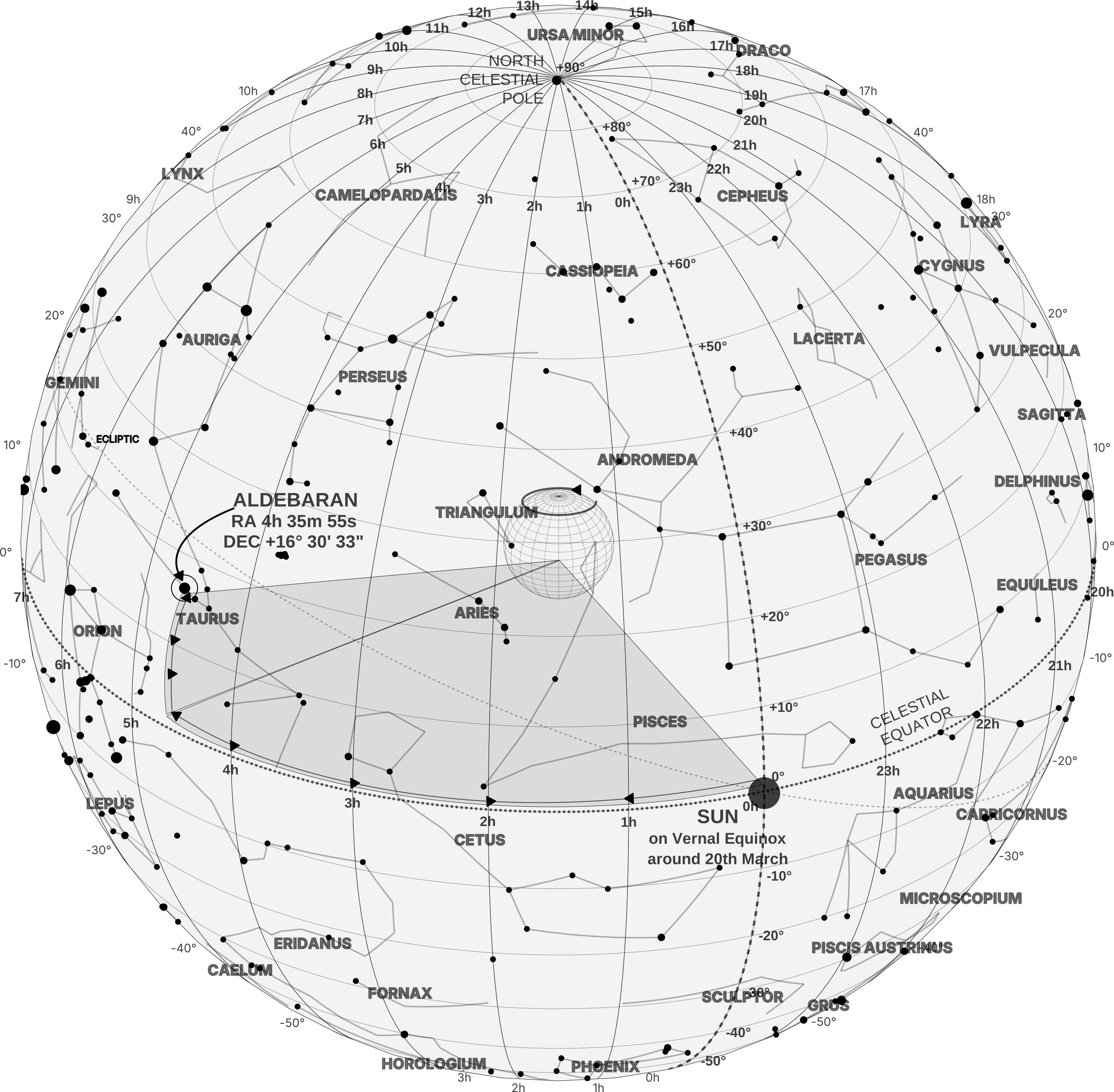
The longitude zero point (0°) for Earth is the Prime Meridian in Greenwich, England. For the celestial sphere, RA starts at a reference point called the vernal equinox - the point where the Sun crosses the celestial equator moving northward in March each year. From there, RA increases as you move eastward around the sky: 0h, 1h, 2h… up to 23h 59m 59s, then back to 0h. In the figure above the RA values look like they are increasing counter-clockwise. This is because we are looking at the celestial sphere “from outside”. If you were standing on Earth looking up, RA would increase clockwise.
With RA and Dec, you can specify any object’s position on the celestial sphere with precision. Betelgeuse? RA 5h 55m, Dec +7° 24’. Andromeda Galaxy? RA 0h 43m, Dec +41° 16’. These coordinates don’t change (well, they do very slowly over centuries due to precession, but that’s another topic). An object’s position on the celestial sphere is fixed, even though Earth’s rotation makes it appear to move across our sky each night.
An example of using celestial coordinates (refer to the figure): Lets’s say you want to find the star Aldebaran in the constellation Taurus. Its coordinates are approximately RA 4h 35m, Dec +16° 30’. First, you locate the celestial equator on your star chart. First, you find the RA of 4h 35m by moving eastward along the celestial equator. Next, you find the declination of +16° 30’ by moving north from the celestial equator. Where these two measurements intersect is where Aldebaran is located on the celestial sphere.
Why This Matters
The celestial sphere solves a practical problem: how do you describe where something is in the sky in a way that works for everyone, everywhere, at any time? If I just said “look northeast at a 45-degree angle,” that’s only useful if you’re standing in the same location I am, at the same time of night, on the same date. But if I give you RA and Dec coordinates, you can find that object from anywhere on Earth (assuming it’s above your horizon). The celestial sphere creates a universal reference frame.
It also explains why the sky appears to rotate. Earth spins on its axis once every 24 hours. As we rotate, different parts of the celestial sphere come into view. Stars rise in the east, arc across the sky, and set in the west - not because they’re moving, but because we are. The celestial sphere itself stays fixed (from our perspective), and Earth rotates inside it.
This is why stars near the celestial poles barely move - they’re close to the rotation axis. Polaris, sitting almost exactly at the north celestial pole, appears nearly stationary all night. Meanwhile, stars near the celestial equator trace large arcs across the sky as Earth spins.
The Model Has Limits
The celestial sphere is a brilliant tool, but it has limits. It treats all objects as if they’re infinitely far away, which works fine for stars but breaks down for nearby objects like planets, the Moon, or satellites. These objects are close enough that their position shifts slightly depending on where you’re standing on Earth - an effect called parallax.
The model also doesn’t account for the fact that stars are actually moving through space. Over human timescales, this motion is negligible. Orion looks the same today as it did to ancient Greeks. But over thousands of years, constellations slowly change shape as stars drift. The celestial sphere assumes a static sky, which isn’t quite true.
Still, for practical astronomy - finding objects, mapping the sky, predicting positions - the celestial sphere works perfectly. It’s a fiction, but a useful one.
The Bottom Line
When you look up at the night sky, you’re not really seeing a sphere. You’re seeing stars scattered across vast distances in three-dimensional space. But pretending they’re all projected onto a single sphere makes everything simpler. The celestial sphere gives us a coordinate system. It explains why stars rise and set. It lets us create star charts that work anywhere on Earth. It’s the foundation of how we navigate the sky.
So yes, it’s imaginary. But it’s also one of the most useful ideas in astronomy.
Advanced: Sidereal Time and Local Sidereal Time
This section covers sidereal time and local sidereal time (LST). It’s more technical than the rest of the chapter, so feel free to skip it. But if you’re interested in understanding the underlying math used by telescope mounts and astronomy software, it’s worth reading. It will also make you understand why the sky keeps shifting over weeks and months. Why new constellations seem to popup at different times of the year. And why planning observations requires knowing when objects cross your meridian.
Sidereal Time and Local Sidereal Time
Most people never need to think about sidereal time. If you’re using an app or a computerized telescope mount, it handles all of this in the background. But if you want to understand why certain objects are visible at certain times, or if you’re manually setting up an equatorial mount, sidereal time becomes essential. It’s different way of measuring time - one that’s synced to the stars instead of the Sun.
What Is Sidereal Time?
We normally measure time using the Sun. A solar day, the time it takes for the Sun to return to the same position in the sky is 24 hours. That’s what our clocks track. But Earth doesn’t just rotate. It also orbits the Sun. Each day, as Earth spins once on its axis, it also moves a little bit along its orbit. This means Earth has to rotate slightly more than 360° for the Sun to return to the same spot in the sky. That extra rotation takes about 4 minutes.
A sidereal day ignores the Sun and measures one full 360° rotation of Earth relative to the distant stars. It’s shorter than a solar day - roughly 23 hours, 56 minutes, and 4 seconds. Why does this matter? Because if you’re tracking stars instead of the Sun, sidereal time is more accurate. Stars return to the same position in the sky every sidereal day, not every solar day.
What Is Local Sidereal Time (LST)?
Local Sidereal Time (LST) tells you which Right Ascension is currently crossing your meridian - the imaginary line running from north to south through the point directly overhead (the zenith). Here’s the key insight: your Local Sidereal Time equals the Right Ascension currently on your meridian.
If your LST is 6:30, then objects with RA 6h 30m are crossing your meridian right now. Objects with RA 3h 30m crossed your meridian three hours ago and are now in the western sky. Objects with RA 9h 30m will cross your meridian in three hours and are currently rising in the east. This gives you an instant snapshot of what’s visible and where it is in the sky.
Why This Is Useful
LST tells you when an object is at its highest point in the sky - its best viewing position. Atmospheric distortion is worst near the horizon and best near the zenith. If you want the clearest view of a galaxy or planet, you observe it when it’s close to the meridian. LST also helps with planning. If you want to observe the Andromeda Galaxy (RA 0h 43m), you check when your LST will be around 0h 43m. That’s when Andromeda crosses your meridian and reaches optimal viewing height.
All astronomical software and computerized telescope mounts calculate LST automatically once you input your location and time. You rarely need to calculate it by hand. But understanding what LST represents - which RA is currently on your meridian - makes reading sky charts easier and helps you predict when objects will be in optimal viewing positions.
A Practical Example
Let’s say you want to observe the Orion Nebula (M42), which has an RA of roughly 5h 35m. You check your LST and see it’s currently 3:00. This means that:
- Objects with RA 3h 00m are on your meridian right now.
- Objects with RA 9h 00m (3h 00m + 6h) are rising in the east.
- Objects with RA 21h 00m (3h 00m - 6h) are setting in the west.
- Since M42 has an RA of 5h 35m, it’s risen and is about 2.5 hours away from crossing your meridian.
LST and Visibility
Here’s another useful rule: an object is generally visible (above the horizon) when your LST is within about 6 hours before or after the object’s RA. If an object has RA 10h, it’s visible when your LST is roughly between 4h and 16h. Outside that window, it’s below the horizon. This isn’t a perfect rule - your latitude affects what’s visible - but it’s a decent approximation for planning observations.
Tools That Do the Work for You
Most modern astronomy software calculates LST automatically. Apps like SkySafari, Stellarium, and planetarium programs display LST in real time. Computerized telescope mounts calculate it internally once you input your location and time. You rarely need to calculate LST by hand anymore. But understanding what it represents - which RA is currently on your meridian - makes reading sky charts easier and helps you predict when objects will be in optimal viewing positions.
Sidereal time is just a clock synced to the stars instead of the Sun. Local Sidereal Time tells you which Right Ascension is crossing your meridian at any moment. This is useful for planning observations, aligning telescope mounts, and understanding why certain objects are visible at certain times. You don’t need to master sidereal time to enjoy stargazing.