The Observer’s Toolkit
A lot of beginners think astronomy requires a telescope. It doesn’t. Your eyes are already incredibly sophisticated optical instruments. They’ve been observing the universe for as long as humans have existed. Before telescopes, before binoculars, before any optical aid whatsoever, ancient astronomers mapped the sky, tracked planets, predicted eclipses, and built calendars - all with naked-eye observation.
Your eyes are where every stargazer starts. And honestly? They’re where a lot of experienced observers still spend most of their time. But eyes have limits. They can’t gather much light. They can’t magnify distant objects. They can’t resolve fine details. That’s where optical aids come in - not to replace your eyes, but to extend what they can do.
This chapter covers the three tools you’ll use most in astronomy: your eyes, binoculars, and telescopes.
We’ll start with your eyes because understanding how they work - and more importantly, how to use them properly - makes you a better observer with any equipment. Things like dark adaptation, averted vision, and why you see better after 20 minutes in the dark aren’t just trivia. They’re practical skills that directly affect what you can see.
Then we’ll move to binoculars. A lot of people skip binoculars and jump straight to telescopes, which is a mistake. Binoculars are often the best tool for beginners - easier to use, more portable, cheaper, and surprisingly capable. You can see craters on the Moon, the moons of Jupiter, star clusters, and even some galaxies with a decent pair of binoculars. They give you a wide field of view that makes finding objects simple, and they don’t require setup or alignment. Just point and look.
Finally, we’ll talk about telescopes. Not which brand to buy or which model is best - that depends on your budget and goals. Instead, we’ll focus on how telescopes actually work, what the specifications mean, and what you can realistically expect to see through one. We’ll also cover the common mistakes beginners make when choosing their first telescope, because a bad first telescope kills more interest in astronomy than anything else.
The goal isn’t to convince you to buy expensive equipment. The goal is to help you understand what each tool does well, what its limitations are, and how to use it effectively. Because here’s the truth: \textbf A cheap pair of binoculars that you take outside every clear night will show you more of the universe than an expensive telescope that sits in your closet because it’s too complicated to set up, to heavy to carry, or too frustrating to use.
Start simple. Build your skills. Add equipment as you need it, not because you think you’re supposed to. Let’s begin with the tool you already own: your eyes.
Our Eyes
Every piece of astronomical equipment you’ll ever use - binoculars, telescopes, cameras - exists to feed better information to your eyes. Your eyes are the primary instrument. Everything else is just support. But most people don’t know how their eyes actually work, especially in the dark. Understanding a few basic principles about your vision makes you a dramatically better observer, regardless of what equipment you’re using.
Dark Adaptation: The 20-Minute Rule
Your eyes need time to adjust to darkness. This isn’t just about your pupils dilating - though that’s part of it. The real change happens in the chemistry of your retina. In bright light, your eyes use cells called cones for detailed, color vision. In dim light, different cells called rods take over. Rods are far more light-sensitive than cones, but they take time to activate. Full dark adaptation takes about 20 to 30 minutes.
Here’s what that means practically: if you walk outside and immediately start observing, you’re seeing maybe 10% of what’s actually visible. After 20 minutes in complete darkness, your eyes become vastly more sensitive. Faint stars that were invisible suddenly appear. Nebulae emerge from the background. The Milky Way becomes obvious.
And here’s the frustrating part: one glance at a bright light - your phone, a flashlight, even a distant streetlight - can undo 20 minutes of adaptation instantly. Your rods shut down, and you’re back to square one. This is why serious observers use red lights. Red light doesn’t trigger the same adaptation loss as white or blue light. A red flashlight or red-tinted headlamp lets you read star charts or adjust equipment without destroying your night vision.
Averted Vision: Looking Without Looking
Here’s a strange trick that makes faint objects suddenly visible: don’t look directly at them. Your eye has a blind spot of sorts for dim objects. The center of your retina - the fovea - is packed with cones for sharp, detailed vision. But cones are terrible in low light. The rods, which handle dim light, are concentrated around the edges of your retina, not the center.
If you stare directly at a faint galaxy or nebula, you’re using your cones, and the object disappears. But if you look slightly to the side - a technique called averted vision - you’re using your rods, and the object becomes visible. It feels backward at first. You’re trying to see something by not looking at it. But with practice, averted vision becomes natural. You learn to hold faint objects at the edge of your vision where your rods can detect them. This technique works with any equipment - naked eye, binoculars, telescopes. It’s one of the most useful skills in astronomy, and it costs nothing to learn.
Light-Gathering: The Fundamental Limit
Here’s the biggest limitation your eyes have: they’re too small to gather much light. Your pupil dilates to about 7 millimeters in complete darkness. That’s the aperture through which light enters your eye. It sounds reasonable until you compare it to optical instruments. A modest pair of binoculars might have 50-millimeter lenses. A small telescope might have a 150-millimeter aperture. That telescope is over 20 times wider than your pupil, which means it gathers about 450 times more light. Remember, light-gathering power scales with the area of the aperture, which goes as the square of the diameter.
Why does this matter? Because in astronomy, light is everything. The universe is full of incredibly faint objects - distant galaxies, dim nebulae, star clusters at the edge of visibility.
Your eyes simply can’t collect enough photons from these objects to see them. They’re there, but they’re too dim. This is the real reason we use telescopes and binoculars. Most people think it’s about magnification - making things look bigger. That’s part of it, especially for planets and the Moon. But the primary advantage is light-gathering power. More aperture means more light. More light means you can see fainter objects that are completely invisible to the naked eye.
You can magnify all you want, but without enough light, you’re just making a dim smudge look like a bigger dim smudge. Light-gathering is what unlocks the universe. And your eyes, as sophisticated as they are, simply don’t have enough aperture to gather light from most deep-sky objects. This is why aperture - the diameter of the lens or mirror - is the single most important specification in any optical instrument. Bigger aperture equals more light. More light equals more to see.
What You Can See With Your Eyes Alone
Despite their limitations, your naked eyes can see a surprising amount. On a clear, dark night far from city lights, you can see about 2,000 to 2,500 stars at any given time. You can see the Milky Way stretching across the sky like a river of faint light. You can spot the Andromeda Galaxy as a faint smudge - the most distant object visible to the naked eye at 2.5 million light-years away.
You can watch planets move against the background stars over weeks and months. You can see meteor showers, the occasional comet, satellites crossing the sky, and the International Space Station when it passes overhead. You can learn constellations, track the Moon’s phases, notice how the Sun’s path changes with the seasons, and understand why certain stars are only visible at certain times of year. All of this without any equipment. Just your eyes, the sky, and patience.
Taking Care of Your Night Vision
A few practical tips for maximizing what your eyes can see: Give yourself time. Don’t rush. Spend at least 20 minutes in darkness before expecting to see faint objects. Use red lights only. If you need light for reading charts or adjusting equipment, use a red flashlight or cover a regular flashlight with red cellophane. Never use white light. Avoid screens. Your phone, tablet, or laptop screen will destroy your night vision instantly. If you must use a device, set it to the dimmest red mode possible, or better yet, print your charts and leave the phone inside. Let your eyes wander. Don’t stare at one spot. Let your gaze drift around the sky. Your peripheral vision is better at detecting faint objects than your central vision. Be patient with faint objects. Sometimes it takes 30 seconds of steady looking (using averted vision) before a dim nebula or galaxy becomes visible. Your brain needs time to process the faint signal.
The Bottom Line
Your eyes are remarkable instruments. They’re portable, they never need batteries, and they give you the widest possible field of view. Every astronomer, no matter how advanced, spends time observing with just their eyes. But they have limits. Small aperture means limited light-gathering. No magnification means limited detail on distant objects. These limits aren’t flaws - they’re just physics. Understanding them helps you know when optical aids will actually help and when they won’t. Start with your eyes. Learn the sky. Master dark adaptation and averted vision. Once you’re comfortable with naked-eye observation, binoculars and telescopes become tools that extend what you already know how to do, rather than mysterious black boxes you don’t understand. Your eyes are where astronomy begins. Treat them well, and they’ll show you more than you expect.
Binoculars
Binoculars are the most underrated tool in amateur astronomy. A lot of beginners skip them completely and jump straight to telescopes, which is a mistake. For many observers - especially beginners - binoculars are actually the better choice. Here’s why: binoculars are simple. You pick them up, point them at the sky, and look. No assembly. No alignment. No complicated mounts or tracking systems. They’re portable, relatively cheap, and surprisingly capable. You can see craters on the Moon, Jupiter’s moons, the Andromeda Galaxy, the Orion Nebula, and countless star clusters - all with a decent pair of binoculars.
Most importantly, binoculars give you a wide field of view. This makes finding objects easy. With a telescope’s narrow view, you’re searching for a needle in a haystack. With binoculars, you see enough sky at once that locating objects becomes straightforward. You can star-hop from one bright star to another until you reach your target.
If you’re new to stargazing and thinking about buying equipment, start with binoculars. You’ll use them more than you think.
Understanding Binocular Specifications
Binoculars are labeled with two numbers: 10x50, 7x35, 15x70, and so on. These numbers tell you everything you need to know about how the binoculars perform. The first number is magnification. 10x means 10 times magnification. An object appears 10 times closer than it does to your naked eye. The second number is aperture - the diameter of each front lens in millimeters. This is the light-gathering power. Bigger aperture means more light, which means you can see fainter objects. So 10x50 binoculars magnify 10 times and have 50mm lenses. 7x35 binoculars magnify 7 times and have 35mm lenses.
Here’s the important part: aperture matters more than magnification for astronomy. A 7x50 pair will show you more faint stars and nebulae than a 10x35 pair because the larger aperture gathers more light. Yes, the magnification is lower, but you’re seeing more objects overall.
Exit Pupil: Matching Your Eye
There’s another specification that matters: exit pupil. This is the diameter of the beam of light that comes out of the eyepiece and enters your eye. You calculate exit pupil by dividing aperture by magnification.
For 10x50 binoculars: 50 ÷ 10 = 5mm exit pupil
For 7x50 binoculars: 50 ÷ 7 = 7mm exit pupil
Why does this matter? Because your eye’s pupil dilates to about 7mm in the dark (less as you age - older observers might only dilate to 5mm). If the exit pupil of your binoculars is larger than your eye’s pupil, you’re wasting light. If it’s smaller, you’re not using your eye’s full light-gathering potential. For astronomy, an exit pupil between 5mm and 7mm is ideal. This means binoculars like 7x50, 8x56, or 10x70 work well because they deliver a large exit pupil that matches your dark-adapted eye. Daytime binoculars often have smaller exit pupils (like 10x25), which is fine for bright conditions but limits what you can see at night.
Common Binocular Sizes for Astronomy
7x50 or 8x50 - These are the classic astronomy binoculars. Wide field of view, good light-gathering, and low enough magnification that you can hand-hold them without too much shake. They’re great for scanning the Milky Way, finding star clusters, and general sky exploration. Most people can hold these steady for short periods.
10x50 - Slightly more magnification, same aperture. These show more detail on the Moon and planets but are harder to hold steady by hand. You’ll start to notice hand shake affecting the view. Still a solid choice for astronomy.
15x70 or 20x80 - Larger, heavier, more powerful. These gather significantly more light and show fainter objects, but you absolutely need a tripod or mount. Hand-holding these is nearly impossible - the shake makes them unusable. If you’re willing to deal with a tripod, these are excellent for deep-sky observing.
Image-stabilized binoculars - Some binoculars have built-in stabilization that compensates for hand shake. They’re expensive but allow you to use higher magnifications (12x, 15x, even 18x) without a tripod. If your budget allows, these are fantastic for astronomy.
What You Can See With Binoculars
Binoculars won’t show you the detail a telescope can, but they’re surprisingly capable.
The Moon - Craters, maria (the dark plains), mountain ranges. You won’t see tiny details, but the major features are obvious and beautiful.
Planets - Jupiter’s four largest moons (the Galilean moons) are easily visible as tiny dots on either side of the planet. You won’t see Jupiter’s cloud bands or Saturn’s rings clearly, but you can track the moons’ positions as they orbit. Venus shows phases, just like the Moon.
Star clusters - The Pleiades, the Beehive Cluster, the Double Cluster in Perseus - all of these look spectacular in binoculars. Telescopes often magnify too much and lose the cluster’s overall beauty. Binoculars hit the sweet spot.
The Milky Way - Binoculars reveal thousands of stars packed into the Milky Way’s bright regions. Sweeping along the Milky Way with binoculars is one of the most rewarding experiences in astronomy.
Galaxies and nebulae - The Andromeda Galaxy, the Orion Nebula, the Lagoon Nebula, and several other bright deep-sky objects are visible as faint smudges. You won’t see the color or detail from long-exposure photos, but you’ll see them with your own eyes in real time.
Comets - When a bright comet appears, binoculars are often the best way to see it. Telescopes magnify too much and lose the comet’s tail. Binoculars show the whole thing in context.
Hand-Holding vs. Tripod
Anything below 10x magnification can usually be hand-held, at least for short periods. Your arms will get tired after a few minutes, but it’s manageable. At 10x and above, hand shake becomes a problem. Stars blur into streaks. Fine details disappear. You’ll want some kind of support - a tripod, a monopod, or even just bracing your elbows against something solid.
For 15x and higher magnifications, a tripod is mandatory. You can’t hold these steady enough by hand to see anything useful. Most binoculars don’t come with tripod mounts, but you can buy an adapter that attaches to the central hinge and screws onto a standard camera tripod. This is cheap and makes a huge difference for stability.
Porro Prism vs. Roof Prism
There are two main binocular designs: porro prism and roof prism. Porro prism binoculars have the classic Z-shaped design where the objective lenses are wider apart than the eyepieces. These tend to be bulkier but offer better image quality for the price. Most astronomy binoculars are porro prism. Roof prism binoculars are sleeker and more compact, with the eyepieces and objective lenses in a straight line. They’re lighter and easier to carry but generally more expensive for equivalent optical quality. For astronomy, porro prism is usually the better choice unless portability is your top priority.
Quality Matters
Cheap binoculars are frustrating. Blurry edges, poor color correction, misaligned optics - all of these problems make observing unpleasant. You don’t need to spend a fortune, but avoid the bottom-of-the-barrel options. A decent pair of astronomy binoculars costs somewhere between $100 and $300. Brand names like Celestron, Orion, Nikon, and Bushnell make solid mid-range models. If you’re spending over $500, you’re getting into premium territory with better coatings, sharper optics, and superior build quality. These are nice but not necessary for beginners.
The Bottom Line
Binoculars are one of the best investments you can make in astronomy. They’re versatile, easy to use, and show you a surprising amount of the sky. They’re also useful outside of astronomy - wildlife watching, concerts, sports events. If you’re deciding between cheap binoculars and a cheap telescope, get the binoculars every time. A good pair of 7x50 or 10x50 binoculars will serve you for years and show you far more than a poorly made telescope. Start here. Learn the sky with binoculars. Then, when you’re ready for a telescope, you’ll have the experience and knowledge to choose one wisely.
Telescopes
Telescopes are what most people think of when they think of astronomy. They’re also where most beginners make expensive mistakes. Here’s the truth: a telescope is just a tool. It’s not magic. It won’t show you Hubble-quality images of galaxies. It won’t automatically find objects for you (unless you buy a very expensive computerized model). And if you buy the wrong telescope for your needs, it’ll sit unused in your closet while you wonder why you wasted the money.
The goal of this section isn’t to tell you which telescope to buy - that depends on your budget, your interests, and where you live. The goal is to help you understand how telescopes work, what the specifications actually mean, and what you can realistically expect to see. Armed with that knowledge, you can make an informed decision instead of an expensive mistake.
The Two Main Jobs of a Telescope
Telescopes do two things: they gather light and they magnify.
Light-gathering is the primary function. A telescope’s aperture - the diameter of its main lens or mirror - determines how much light it collects. Bigger aperture means more light. More light means you can see fainter objects. This is why serious deep-sky observers obsess over aperture. A 200mm telescope gathers four times more light than a 100mm telescope, which means it shows fainter stars, nebulae, and galaxies.
Magnification is secondary. Yes, telescopes magnify, and that’s useful for seeing details on the Moon and planets. But magnification without enough light just gives you a bigger, dimmer view. You can magnify anything to any level - but at some point, you’re just magnifying blur and atmospheric distortion.
Aperture is king. Everything else is a trade-off.
The Three Main Telescope Types
There are three basic telescope designs: refractors, reflectors, and compound telescopes. Each has strengths and weaknesses.
Refractors
Refractors use lenses to gather and focus light. They’re the classic “pirate telescope” design - a long tube with a lens at the front and an eyepiece at the back.
Strengths: Sharp, high-contrast images. Sealed tube means no dust or air currents affecting the view. Low maintenance - nothing to align or adjust. Great for planets and the Moon.
Weaknesses: Expensive for large apertures. An 80mm refractor might cost $300, but a 150mm refractor could cost $2,000 or more. Larger refractors are also long and heavy, making them awkward to transport and mount.
Best for: Planetary observation, lunar observation, double stars. If you want crisp, sharp views and aren’t worried about faint deep-sky objects, refractors are excellent.
Reflectors
Reflectors use mirrors instead of lenses. Light enters the tube, bounces off a curved primary mirror at the bottom, reflects off a smaller secondary mirror near the top, and exits through an eyepiece on the side of the tube.
Strengths: Cheap aperture. You can get a 150mm reflector for $300 - a fraction of what a similar-sized refractor would cost. Bigger aperture means more light, which is perfect for faint galaxies and nebulae.
Weaknesses: Open tube design means dust, air currents, and dew can affect the image. Mirrors need occasional alignment (collimation), which intimidates beginners but isn’t actually that hard. Reflectors also suffer from coma - stars near the edge of the view look like little comets instead of sharp points.
Best for: Deep-sky observation on a budget. If you want to see faint galaxies, nebulae, and star clusters without spending a fortune, reflectors are the way to go.
The most common reflector design for beginners is the Dobsonian - a simple Newtonian reflector on a basic alt-azimuth mount. Dobsonians offer huge aperture for the price. A 200mm Dobsonian costs less than a 100mm refractor and gathers four times more light.
Compound Telescopes (Catadioptrics)
Compound telescopes use both lenses and mirrors to fold the light path, creating a compact design. The two most common types are Schmidt-Cassegrain (SCT) and Maksutov-Cassegrain (MAK).
Strengths: Compact and portable despite large aperture. A 200mm SCT fits in a backpack, whereas a 200mm refractor would be over a meter long. Versatile - good for both planets and deep-sky objects. Closed tube design protects optics.
Weaknesses: Expensive. A 200mm SCT costs significantly more than a 200mm Dobsonian. Slower cool-down time because of the closed tube - thermal currents inside the tube can blur the image until it equalizes with outside temperature.
Best for: Observers who want portability and versatility and don’t mind paying extra for it.
Understanding Specifications**
When you look at a telescope’s specs, here’s what actually matters:
Aperture
This is the diameter of the main lens or mirror, usually given in millimeters. Bigger is better. Aperture determines light-gathering power and resolving power (the ability to see fine details). A 100mm telescope is a decent beginner scope. A 150mm telescope is noticeably better. A 200mm telescope is excellent for most amateur needs. Anything over 250mm is serious enthusiast territory. Don’t be fooled by claims like “575x magnification!” on cheap department store telescopes. Magnification is irrelevant if the aperture is tiny. A 60mm telescope with “500x magnification” will show you nothing useful - just a blurry, dim mess.
Focal Length
This is the distance light travels from the objective lens or mirror to the point where it comes to focus. It’s measured in millimeters. Focal length determines two things: the telescope’s magnification potential and its field of view.
Long focal length (f/10 and above): Narrow field of view, better for planets and lunar observation. Higher magnification potential.
Short focal length (f/5 and below): Wide field of view, better for deep-sky objects like nebulae and star clusters. Lower magnification but brighter images.
Focal length alone doesn’t tell you much. What matters is the focal ratio.
Focal Ratio (f-number)
This is the focal length divided by the aperture. A telescope with 1000mm focal length and 200mm aperture has a focal ratio of f/5 (1000 ÷ 200 = 5).
Fast scopes (f/4 to f/6): Wide field, bright images, good for deep-sky. Harder to achieve sharp focus, more sensitive to cheap eyepieces.
Slow scopes (f/10 to f/15): Narrow field, easier to focus, better for planets and Moon. Dimmer images of extended objects like galaxies.
Neither is better - it depends on what you want to observe.
Magnification
Magnification isn’t a fixed property of the telescope - it depends on which eyepiece you use. You calculate magnification by dividing the telescope’s focal length by the eyepiece’s focal length. A telescope with 1000mm focal length using a 10mm eyepiece gives 100x magnification (1000 ÷ 10 = 100). The same telescope with a 25mm eyepiece gives 40x magnification (1000 ÷ 25 = 40).
You can change magnification by swapping eyepieces. This is why eyepieces matter. Maximum useful magnification is about 50x per inch of aperture, or roughly 2x the aperture in millimeters. A 100mm telescope maxes out around 200x. A 200mm telescope maxes out around 400x. Beyond that, you’re just magnifying atmospheric turbulence and optical imperfections.
Most observing happens at much lower magnifications - 50x to 150x for most objects.
Mounts Matter as Much as Optics
A great telescope on a terrible mount is useless. The mount needs to hold the telescope steady and allow smooth, precise movement. A wobbly mount turns every adjustment into a frustrating fight.
There are two main mount types:
Alt-Azimuth (Alt-Az)
These move up-down and left-right, like a camera tripod. Simple, intuitive, and cheap. Dobsonian telescopes use alt-az mounts.
Strengths: Easy to use. No alignment or setup. Just point and look.
Weaknesses: As objects move across the sky (due to Earth’s rotation), you have to adjust both axes constantly to keep them in view. This makes long-exposure photography with these mounts nearly impossible.
Equatorial
These are aligned with Earth’s rotation axis. Once aligned, you only turn one axis to track objects as they move across the sky.
Strengths: Perfect for astrophotography. One-axis tracking means you can follow objects smoothly or attach a motor for automatic tracking.
Weaknesses: More complex. Requires polar alignment (pointing the mount’s axis at the celestial pole). Heavier and bulkier than alt-az mounts. For visual observation, alt-az is fine. For photography, equatorial is almost mandatory unless you have a computerized alt-az mount with tracking.
What You Can Actually See
Let’s set realistic expectations.
Solar System Objects
The Moon: Spectacular. Craters, mountains, valleys, maria (dark plains), rays from impact craters - all visible in stunning detail even with a small telescope. The Moon is bright, close, and full of features. It never gets boring.
Jupiter: Cloud bands, the Great Red Spot (if conditions are good), and the four Galilean moons. With steady seeing and good optics, you can watch the moons cast shadows on Jupiter’s surface.
Saturn: The rings are obvious and beautiful even in a small telescope. With larger aperture and good seeing, you can see the Cassini Division (the gap in the rings) and cloud bands on Saturn itself.
Mars: Disappointing most of the time. Mars is small and far away except during close approaches every two years. Even then, you’ll see a tiny orange disk with maybe a polar ice cap or dark surface features if seeing is excellent.
Venus: Shows phases like the Moon, but no surface detail - Venus is covered in clouds. Planets require high magnification, steady atmosphere, and patience. They’re tiny, and even at 200x, they’re still small.
Deep-Sky Objects (Galaxies, Nebulae, Star Clusters)
Forget the Hubble photos. You won’t see color. You won’t see intricate detail. What you’ll see are faint, gray smudges - but they’re real, and you’re seeing them with your own eyes in real time.
The Orion Nebula (M42): A cloudy patch with hints of structure. Larger telescopes reveal more detail and faint wisps of nebulosity.
The Andromeda Galaxy (M31): An oval smudge. The core is bright, but the spiral arms are faint. Large aperture helps.
Star clusters: These look great. The Pleiades, Hercules Cluster (M13), and countless others resolve into dozens or hundreds of individual stars. Deep-sky objects need aperture and dark skies. Light pollution kills them. A 200mm telescope under dark skies shows far more than a 300mm telescope in a city.
Common Beginner Mistakes
Buying based on magnification claims. “525x magnification!” means nothing if the aperture is 60mm. Ignore marketing hype. Focus on aperture.
Buying a cheap department store telescope. These are almost always garbage - poor optics, wobbly mounts, frustrating to use. They kill interest in astronomy faster than anything else. Save up for a decent scope or stick with binoculars.
Starting with something too complicated. A computerized goto mount sounds great, but if you don’t know the sky, you won’t know if it’s pointing at the right object. Learn manually first.
Underestimating the mount. A $500 telescope on a $50 mount is a waste. Spend as much on the mount as you do on the optics.
Ignoring portability. A massive 300mm Dobsonian shows incredible views - but if it’s too heavy to move, you won’t use it. The best telescope is the one you’ll actually take outside.
The Bottom Line
Telescopes are powerful tools, but they’re not magic. They gather light and magnify, and they do it within the limits of physics and atmospheric conditions. Aperture matters most. Mount stability matters second. Everything else is personal preference and budget. If you’re buying your first telescope, consider these priorities:
Aperture - Get as much as you can afford and are willing to carry.
Mount stability - Don’t cheap out here.
Simplicity - Start with something easy to use. Complexity kills enthusiasm.
And remember: a good pair of binoculars will show you more than a bad telescope. Don’t rush into buying a scope until you’ve spent time learning the sky with your eyes and binoculars. Once you know what you want to observe, choosing the right telescope becomes much easier. The best telescope is the one you’ll actually use. Keep that in mind, and you’ll make the right choice.
Telescope Mounts
A telescope is only as good as the mount it sits on. You can have the finest optics in the world, but if your mount is wobbly, shaky, or difficult to move smoothly, observing becomes frustrating. The mount has two jobs: hold the telescope steady and allow you to point it accurately. There are two main types of mounts, each with different strengths and weaknesses: Altitude-Azimuth (Alt-Az) and Equatorial (EQ). Understanding the difference helps you choose the right mount for your needs - and saves you from making expensive mistakes.
Altitude-Azimuth (Alt-Az) Mounts
Alt-Az mounts move in two perpendicular directions: up-down (altitude) and left-right (azimuth). Think of it like a camera tripod. Tilt up to increase altitude. Swivel left or right to change azimuth. This is the simplest, most intuitive mount design. You point the telescope where you want to look, and you’re done. No alignment procedure, no complicated setup, no need to understand celestial coordinates.
Types of Alt-Az Mounts
Dobsonian mounts are the most common Alt-Az design in amateur astronomy. These are simple wooden or plastic rockers that hold large Newtonian reflectors. You literally push the telescope tube to aim it. Friction or Teflon pads provide smooth motion while keeping the scope stable. Dobsonians are cheap, mechanically simple, and offer huge aperture for the price. A 200mm Dobsonian costs less than half what a similar-aperture telescope on an equatorial mount would cost. For visual deep-sky observing, Dobsonians are hard to beat.
Fork mounts use a two-pronged fork to cradle the telescope. Many computerized telescopes use fork mounts in Alt-Az mode. These are more compact than Dobsonians but tend to be heavier and more expensive. Tripod-based Alt-Az mounts look like camera tripods with slow-motion controls. These are common on smaller refractors and spotting scopes. Cheap ones are frustratingly wobbly. Good ones are smooth and stable but expensive.
Advantages of Alt-Az
Simple to use. No polar alignment required. No confusing axes or coordinate systems to understand. Point and look.
Mechanically straightforward. Fewer moving parts means less to break. Dobsonians especially are almost indestructible.
Cheaper. For a given aperture, Alt-Az mounts cost significantly less than equatorial mounts. You get more telescope for your money.
Compact and portable. Alt-Az mounts, especially Dobsonians, pack down smaller and weigh less than equatorial mounts of similar capacity.
Disadvantages of Alt-Az
Tracking requires constant adjustment on both axes. As Earth rotates, objects move in curved arcs across the sky. To keep an object centered, you have to adjust both altitude and azimuth continuously. The adjustments aren’t uniform - sometimes you move more in azimuth, sometimes more in altitude. Near the zenith (directly overhead), this becomes especially awkward.
Manual tracking is tedious. At high magnification, objects drift out of view in seconds. You’re constantly nudging the telescope to recenter them. This gets old fast, especially when sharing views with others or sketching what you see.
Field rotation. Even if you track an object perfectly, the field of view slowly rotates. This doesn’t matter for visual observing, but it ruins long-exposure astrophotography. Stars trace arcs instead of staying put.
Computerized Alt-Az mounts exist and can track objects automatically by calculating the required movements on both axes. These work well for visual observing and even short-exposure photography, but they’re more complex and expensive than simple manual Alt-Az mounts.
Best For
Alt-Az mounts are ideal for visual observing, especially deep-sky work where you’re hopping from object to object rather than staring at one target for long periods. Dobsonians excel at this - big aperture, easy to use, no fuss. If you’re not interested in astrophotography and just want to see galaxies, nebulae, and star clusters, Alt-Az is usually the better choice. You get more aperture for your money and spend less time on setup.
Equatorial (EQ) Mounts
Equatorial mounts are aligned with Earth’s rotation axis. One axis - the Right Ascension (RA) axis - points toward the celestial pole (Polaris in the Northern Hemisphere). The other axis - the Declination (Dec) axis - is perpendicular to it. Once aligned, you only need to turn the RA axis to track objects as they move across the sky. Earth rotates, the stars appear to move westward, and the mount compensates by rotating at the same rate in the opposite direction.
This sounds complicated, and honestly, it is - at least compared to Alt-Az. But for certain tasks, equatorial mounts are far superior.
Types of Equatorial Mounts
German Equatorial Mounts (GEM) are the most common. The telescope sits on one side of the mount, and a counterweight hangs on the other side to balance it. GEMs look awkward - all that metal and counterweights hanging off-balance - but they’re mechanically efficient and versatile.
Fork mounts in equatorial mode use the same fork design as Alt-Az fork mounts but tilt the base so one axis aligns with the celestial pole. Some computerized telescopes can switch between Alt-Az and equatorial modes depending on what you’re doing.
Equatorial platforms are hybrids. You put a Dobsonian on a motorized platform that slowly rotates to compensate for Earth’s rotation. This gives you Dobsonian simplicity with equatorial tracking for visual observing. These are niche products but useful if you want the best of both worlds.
Advantages of Equatorial Mounts
One-axis tracking. Once polar-aligned, you only adjust the RA axis to follow objects. The Dec axis stays fixed. This makes manual tracking far easier than Alt-Az, especially at high magnification.
Motor drives are simple. A motor on the RA axis rotates at the sidereal rate (the rate stars appear to move), keeping objects perfectly centered without any manual adjustment. You can observe in comfort while the mount does the work.
No field rotation. Because the mount tracks along the same curved path objects follow, the field of view doesn’t rotate. This is critical for astrophotography. Stars stay in the same position relative to the frame, allowing long exposures without trailing.
Astrophotography-ready. Equatorial mounts are essentially mandatory for serious astrophotography. You can attach a camera, open the shutter for minutes or hours, and the mount tracks perfectly (assuming good polar alignment and guiding).
Disadvantages of Equatorial Mounts
Polar alignment is required. Before you can use an equatorial mount effectively, you have to align the RA axis with the celestial pole. This takes time and precision. Rough alignment for visual work is quick - just point roughly at Polaris and you’re close enough. But precise alignment for astrophotography can take 15-30 minutes and requires either a polar scope or software-assisted alignment.
Heavier and bulkier. Equatorial mounts need counterweights to balance the telescope. A German equatorial mount for a 200mm telescope might weigh 15-20 kg just for the mount, not including the telescope itself. Transporting and setting up this gear is a workout.
More expensive. For a given load capacity, equatorial mounts cost significantly more than Alt-Az mounts. You’re paying for precision machining, gears, and mechanical complexity.
Confusing orientation. When polar-aligned, an equatorial mount sits at an odd angle. The axes don’t line up with up-down or left-right, which confuses beginners. Moving the RA axis swings the telescope in a curved arc. Moving the Dec axis swings it in a different curve. It’s not intuitive until you get used to it.
Meridian flips. When an object crosses the meridian (the imaginary line running from north to south through the zenith), a German equatorial mount often requires a “meridian flip” - physically rotating the telescope to the other side of the mount to avoid hitting the tripod legs or pier. This interrupts observing and, if you’re doing photography, requires re-centering and re-focusing.
Best For
Equatorial mounts are essential for astrophotography. If you plan to take long-exposure images of galaxies, nebulae, or planets, you need an equatorial mount - period. They’re also nice for visual observing if you don’t mind the extra weight and setup time. Motor-driven tracking means you can relax and watch objects drift slowly through the field of view without constantly nudging the telescope. This is especially useful for public outreach events where you’re showing objects to groups of people.
If you’re primarily interested in visual observing and portability matters, equatorial mounts are probably overkill. But if photography is your goal, they’re non-negotiable.
Computerized (GoTo) Mounts
Both Alt-Az and equatorial mounts can be computerized. A GoTo mount has motors on both axes and a hand controller with a database of objects. You tell it what you want to see, and it slews the telescope automatically to that target.
Advantages of GoTo
Fast object location. Instead of star-hopping manually, you select an object from the database and press “Go To.” The mount points the telescope, and you’re looking at your target in seconds. Great for beginners who don’t know the sky. If you can’t identify constellations or navigate with a star chart, GoTo removes that barrier. You can start observing interesting objects immediately. Useful for public outreach. When showing the sky to groups of people, GoTo speeds things up. You’re not fumbling around trying to find objects while everyone waits.
Disadvantages of GoTo
Expensive. Computerized mounts cost significantly more than manual mounts. For the price of a basic GoTo setup, you could buy a much larger aperture Dobsonian with better optics.
Requires alignment. GoTo mounts need to be aligned before they work. This usually involves pointing at two or three known stars so the computer can figure out where it’s pointing. If alignment is off, the mount points to the wrong locations. For Alt-Az GoTo, you also need to level the mount carefully.
Batteries and electronics. GoTo mounts need power - either batteries or an external power supply. Batteries die. Electronics fail. Connections get loose. Manual mounts never have these problems.
You don’t learn the sky. If you rely on GoTo exclusively, you never learn to navigate manually. When the power fails - you’re lost. It’s better to learn the sky first with a manual mount, then add GoTo as a convenience later.
GoTo: Alt-Az or Equatorial?
GoTo works with both Alt-Az and equatorial mounts, but there are trade-offs. Alt-Az GoTo is simpler to set up. You level the mount, align on a couple of stars, and you’re done. No need to polar-align. But Alt-Az GoTo still suffers from field rotation, making it unsuitable for long-exposure photography. Equatorial GoTo requires polar alignment, which takes longer. But once aligned, it tracks smoothly along one axis and doesn’t suffer from field rotation. This makes it better for astrophotography.
For visual observing, Alt-Az GoTo is usually the better choice - easier setup, less weight. For photography, equatorial GoTo is almost mandatory.
Which Mount Should You Choose?
Here’s the short version:
If you want big aperture for visual deep-sky observing on a budget: Get a Dobsonian (manual Alt-Az). You’ll see more for your money than any other option.
If you want ease of use and don’t mind smaller aperture: Get an Alt-Az mount with a refractor or small reflector. Simple, portable, no fuss.
If you want to do astrophotography: Get a solid equatorial mount. Skip the cheap ones - astrophotography demands precision, and cheap EQ mounts are frustratingly inaccurate. Save up for a good one or don’t bother.
If you want motor tracking for visual observing but don’t care about photography: Either get an equatorial mount with a motor drive or an Alt-Az GoTo. Both work, but equatorial tracking is smoother.
If you’re a beginner and unsure: Start with a simple manual Alt-Az mount (ideally a Dobsonian). Learn the sky. Figure out what you actually enjoy observing. Then, if you decide you want tracking or photography capability, upgrade to an equatorial mount with that knowledge in hand.
The Bottom Line
Mounts matter as much as optics. A great telescope on a terrible mount is a frustrating waste of money. A decent telescope on a solid mount is a pleasure to use. Alt-Az mounts are simple, cheap, and perfect for visual observing. Equatorial mounts are complex, expensive, and necessary for astrophotography. Don’t skimp on the mount. If your budget is tight, buy a smaller telescope on a good mount rather than a larger telescope on a shaky one. The best mount is the one that matches what you actually want to do - and the one you’ll actually set up and use.
Polar alignment
If you own an equatorial mount, you’ll hear about polar alignment constantly. It sounds intimidating. It’s actually straightforward once you understand what you’re doing and why. Polar alignment is the process of pointing your mount’s Right Ascension axis at the celestial pole - the point in the sky where Earth’s rotation axis points. In the Northern Hemisphere, that’s very close to Polaris. In the Southern Hemisphere, there’s no bright star marking the pole, but the process is the same. \textit
Polar alignment is essential for equatorial mounts. Without it, tracking and astrophotography are nearly impossible. If you using a dobsonian or alt-az mount, you can skip this section.
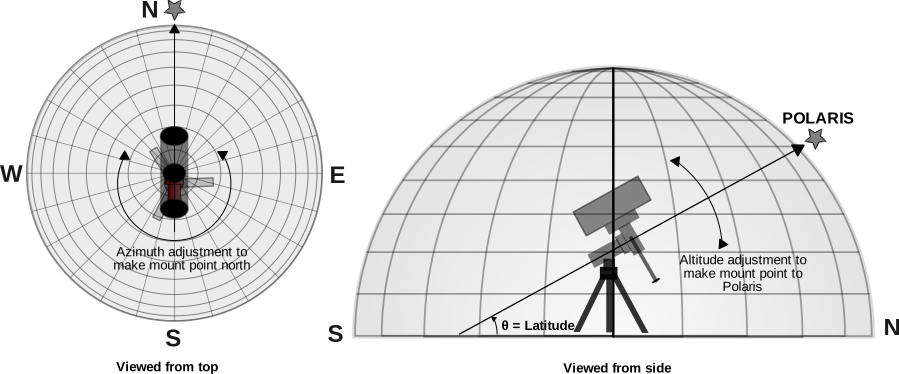
Why does this matter? Because once your mount is polar-aligned, turning just the RA axis makes the telescope track objects perfectly as they move across the sky. The mount rotates at the same rate Earth does, but in the opposite direction, keeping objects centered in your view. Without polar alignment, your equatorial mount is just an awkward Alt-Az mount. With good polar alignment, it becomes a precision tracking instrument.
How precise you need to be depends on what you’re doing. For casual visual observing, “close enough” works fine - rough alignment takes 2 minutes and gives you decent tracking. For astrophotography, you need much better precision - that takes 15-30 minutes and requires tools or software.
Let’s start with the basics.
What Polar Alignment Actually Means
Earth rotates on an axis that runs from the north pole to the south pole. If you extend that axis out into space, it points at the north celestial pole (NCP) and south celestial pole (SCP).
The entire sky appears to rotate around these celestial poles as Earth spins. Stars near the poles trace small circles. Stars near the celestial equator trace large arcs. But the poles themselves stay fixed.
Your equatorial mount has an RA axis - a rod or shaft that the telescope rotates around. When you polar-align, you’re tilting and rotating the mount so that RA axis points directly at the celestial pole.
Once aligned, the RA axis is parallel to Earth’s rotation axis. Turn the RA axis, and the telescope moves along the same curved path that stars follow across the sky. You’re essentially “undoing” Earth’s rotation by rotating the telescope in the opposite direction.
Rough Polar Alignment (For Visual Observing)
If you just want to track objects manually or use a motor drive for visual observing, rough alignment is good enough. This takes about 2 minutes.
Step 1: Level the Mount Set up your tripod or mount base on reasonably level ground. It doesn’t have to be perfect, but wildly uneven surfaces make everything harder.
Step 2: Point the RA Axis North (or South) The RA axis has a pointer or marking indicating which direction it’s aimed. Rotate the entire mount (not the telescope - the mount itself) so this axis points roughly toward north if you’re in the Northern Hemisphere, or south if you’re in the Southern Hemisphere. Use a compass, a phone compass app, or just your knowledge of cardinal directions. You don’t need pinpoint accuracy yet - “roughly north” is fine.
Step 3: Set the Latitude Angle The mount has an adjustment that tilts the RA axis up or down. This is usually marked with a latitude scale. Set this angle to match your latitude. If you’re at 13° North latitude (Chennai), tilt the RA axis so it’s pointing 13 degrees above the northern horizon. If you’re at 40° North (New York), tilt it 40 degrees up. Your latitude determines how high the celestial pole appears above the horizon. At the north pole (90° latitude), the celestial pole is directly overhead. At the equator (0° latitude), it’s on the horizon. In between, it’s somewhere in the middle. Most mounts have a scale and adjustment bolt for setting latitude. Loosen the bolt, tilt the mount to your latitude, and tighten the bolt.
Step 4: Refine Using Polaris (Northern Hemisphere) If you’re in the Northern Hemisphere, Polaris is very close to the north celestial pole - less than 1 degree away. It’s not exactly at the pole, but it’s close enough for rough alignment. Look through the mount’s polar scope (if it has one) or just eyeball it. Adjust the mount’s azimuth (left-right rotation) and altitude (up-down tilt) until Polaris is centered in the polar scope or roughly aligned with the RA axis.
That’s it. You’re polar-aligned well enough for visual observing and basic motor tracking.
Southern Hemisphere Rough Alignment
Polaris isn’t visible from the Southern Hemisphere. You have to use other stars to estimate the south celestial pole’s position. I personally do not have experience observing from the Southern Hemisphere, so I recommend consulting local astronomy resources or star charts specific to your location for guidance on locating the south celestial pole.
In the Southern Hemisphere, there’s no bright pole star. The closest naked-eye star to the south celestial pole is Sigma Octantis, but it’s faint (magnitude 5.5) and hard to locate. Instead, use the Southern Cross and two nearby stars (Alpha and Beta Centauri) to estimate the pole’s position:
- Find the Southern Cross.
- Draw an imaginary line along the long axis of the cross and extend it about 4.5 times the length of the cross.
- Draw another imaginary line perpendicular to the line connecting Alpha and Beta Centauri, roughly halfway between them.
- Where these two lines intersect is approximately the south celestial pole.
Aim your RA axis at that point. It’s less precise than using Polaris, but it works for rough alignment.
Precise Polar Alignment (For Astrophotography)
If you’re doing long-exposure astrophotography, rough alignment isn’t good enough. Even small errors cause stars to trail into streaks over minutes-long exposures. Precise alignment requires either a polar scope with reticle markings or software-assisted alignment methods like drift alignment or plate solving.
Using a Polar Scope
Many equatorial mounts come with a polar scope - a small telescope built into the RA axis with crosshair markings or a reticle showing where Polaris should be positioned relative to the actual pole.
Polaris orbits the north celestial pole in a small circle. The polar scope’s reticle shows where Polaris should be at different times of the year or night. You use a smartphone app or printed chart to determine Polaris’s current position, then adjust the mount until Polaris sits in the correct spot on the reticle.
This method is faster than drift alignment and accurate enough for most astrophotography. It typically gets you within 5-10 arcminutes of perfect alignment, which is good enough for exposures of several minutes.
Drift Alignment Method
Drift alignment is the most accurate method but also the most tedious. It involves pointing your telescope at specific stars near the celestial equator and meridian, then watching how they drift in the field of view. The direction and speed of drift tell you which adjustments to make. This process takes 20-30 minutes, sometimes longer. But when done correctly, it achieves alignment accurate to within a few arcminutes - good enough for unguided exposures of 5-10 minutes or longer.
The explaination of the process is beyond the scope of this book. There are many detailed guides online.
Software-Assisted Alignment
Modern astrophotography software can use plate solving to assist with polar alignment. You take an image, the software compares it to a star database to determine exactly where the telescope is pointing, then tells you which adjustments to make. Programs like PHD2 and others offer polar alignment routines that guide you through the process step-by-step. These methods are faster and easier than drift alignment and just as accurate.
If you’re serious about astrophotography, invest in software that supports polar alignment assistance. It saves enormous amounts of time and frustration.
How Accurate Do You Need to Be?
It depends on what you’re doing:
Visual observing with manual tracking: Rough alignment is fine. As long as you’re within a few degrees of the pole, you can track objects reasonably well by turning the RA axis.
Visual observing with a motor drive: Rough alignment works, but better alignment means objects stay centered longer without manual correction.
Short-exposure astrophotography (30 seconds to 2 minutes): Polar scope alignment is usually sufficient. Aim for within 10 arcminutes.
Long-exposure astrophotography (5+ minutes): Drift alignment or software-assisted alignment is necessary. Aim for within 2-5 arcminutes.
Autoguiding: If you’re using an autoguider (a second camera that watches a guide star and sends correction signals to the mount), polar alignment is less critical. The autoguider compensates for small errors. But better polar alignment means less correction and smoother tracking.
Common Mistakes
Not leveling the mount base. If your tripod is tilted, everything downstream gets harder. Take 30 seconds to level it properly.
Confusing the RA axis with the Dec axis. The RA axis is the one you’re aligning. The Dec axis is perpendicular to it and doesn’t matter for polar alignment. Make sure you’re adjusting the right axis.
Adjusting the telescope instead of the mount. When polar-aligning, you adjust the mount’s azimuth and altitude, not the telescope’s position. The telescope can point anywhere - you’re aligning the mount’s RA axis, not the telescope tube.
Giving up too early. Drift alignment is tedious. Stars drift slowly. You’ll feel like nothing is happening. Be patient. Make small adjustments and wait. It works, but it takes time.
Not rechecking after movement. If you move your mount - even a few meters - polar alignment is lost. You need to realign every time you set up in a new location.
The Bottom Line
Polar alignment isn’t optional for equatorial mounts. Without it, you’re just using an awkward, heavy Alt-Az mount. For visual observing, rough alignment is quick and good enough. Point roughly north, set your latitude, center Polaris, and you’re done. For astrophotography, you need precision. Use a polar scope, drift alignment, or software assistance to get within a few arcminutes of the pole. It’s tedious the first few times. But once you’ve done it a dozen times, it becomes routine. And the payoff - smooth tracking, centered objects, long exposures without trailing - makes it worth the effort.
Align once. Observe all night. That’s the deal.