NGC 7023
4-8 inch Telescope • Reflection Nebulae
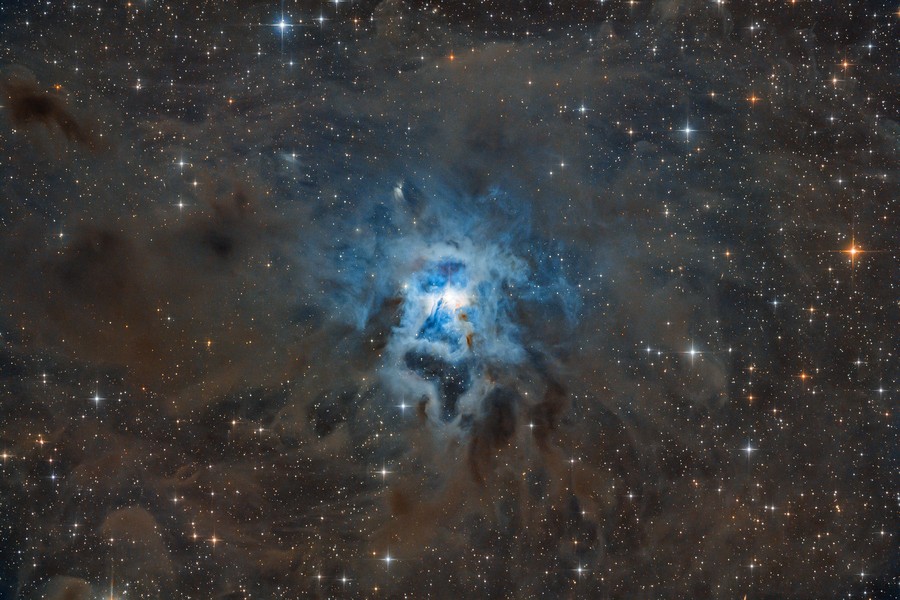
Image: Andreigusan

Finder map for NGC 7023
Its well-established name, the “Iris Nebula,” is derived from its flower-like appearance in deep color photographs, making it a familiar object in modern amateur astronomy and astrophotography. Best observed from the Northern Hemisphere. With a declination near +68°, it is circumpolar for observers north of about 22° N and reaches high altitude for most mid-northern latitudes. The primary challenge is simply detecting the nebula’s very low surface brightness. In 4–8 inch telescopes it usually appears as a faint, diffuse glow around the illuminating star, with little or no visible color and without the detailed dust structures seen in photographs.
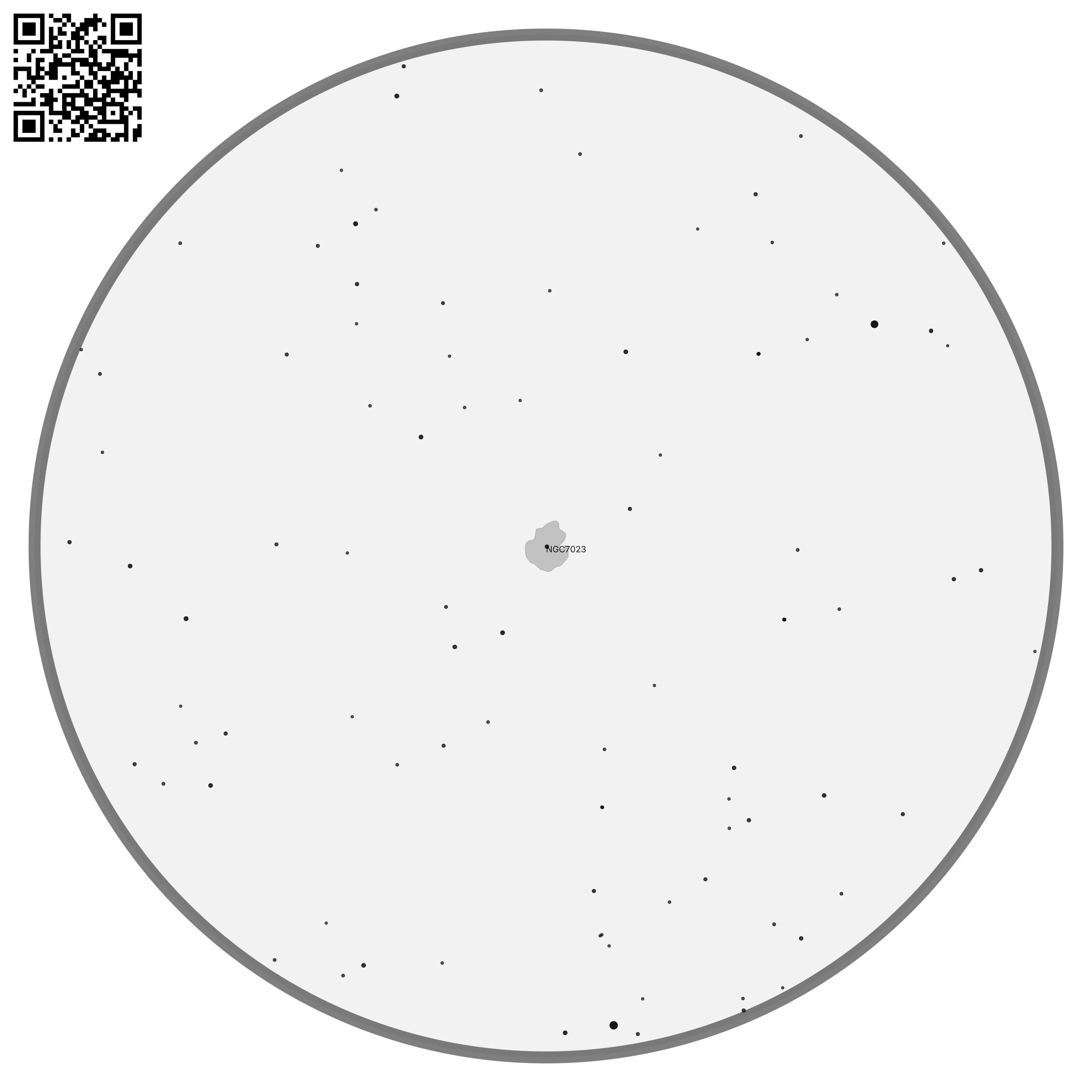
Finder scope & binocular view of NGC 7023
| Property | Value |
|---|---|
| Common names | Iris Nebula, Caldwell 4 |
| Catalog names | C 4, NGC 7023, vdB 139, LBN 487, Cr 429, … |
| Type | Stellar Cluster |
| Subtype | Open Cluster |
| Coordinates | 21h 01m 36.90s, +68° 09’ 48.00” |
| Season | July - September |
| Best month | August |
| Beginner friendly | Marginal |
| Visual reward | Moderate |
| Filters required | None |
| LP tolerance | Low |
| Minimum equipment | Small telescope |
| Optimal equipment | Medium telescope |
| Magnitude | 6.8 |
| Size | 10.0 arcminutes x 8.0 arcminutes |
| Constellation | Cepheus |
Observation Notes
Naked Eye
Not visible.
Binoculars
The central star may be seen in large binoculars from very dark sites, but the surrounding nebulosity is not detectable.
Small Telescope
In 4–6 inch apertures under dark skies, the 7th-magnitude central star is prominent, with a very faint, diffuse glow of nebulosity surrounding it. The nebula is subtle and easily overlooked without careful averted vision.
Medium Telescope
With 8–12 inches, more of the surrounding glow becomes apparent, extending unevenly around the star in a loose, fan-like manner. Gentle contrast variations may be suspected within the nebulosity, but no sharply defined structure is visible.
Large Telescope
In apertures of roughly 14 inches and larger under excellent conditions, the nebula appears more extensive, with soft brightness variations and darker regions suggested as contrast effects rather than crisp filaments. A faint bluish tint may be noticed with averted vision, but all internal detail remains low contrast and seeing-dependent.