Crab Nebula
4-8 inch Telescope • Supernova Remnants
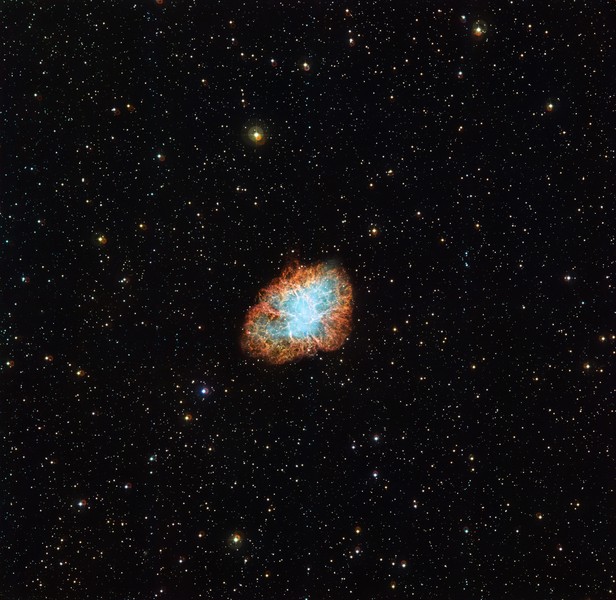
Image: ESO / Manu Mejias
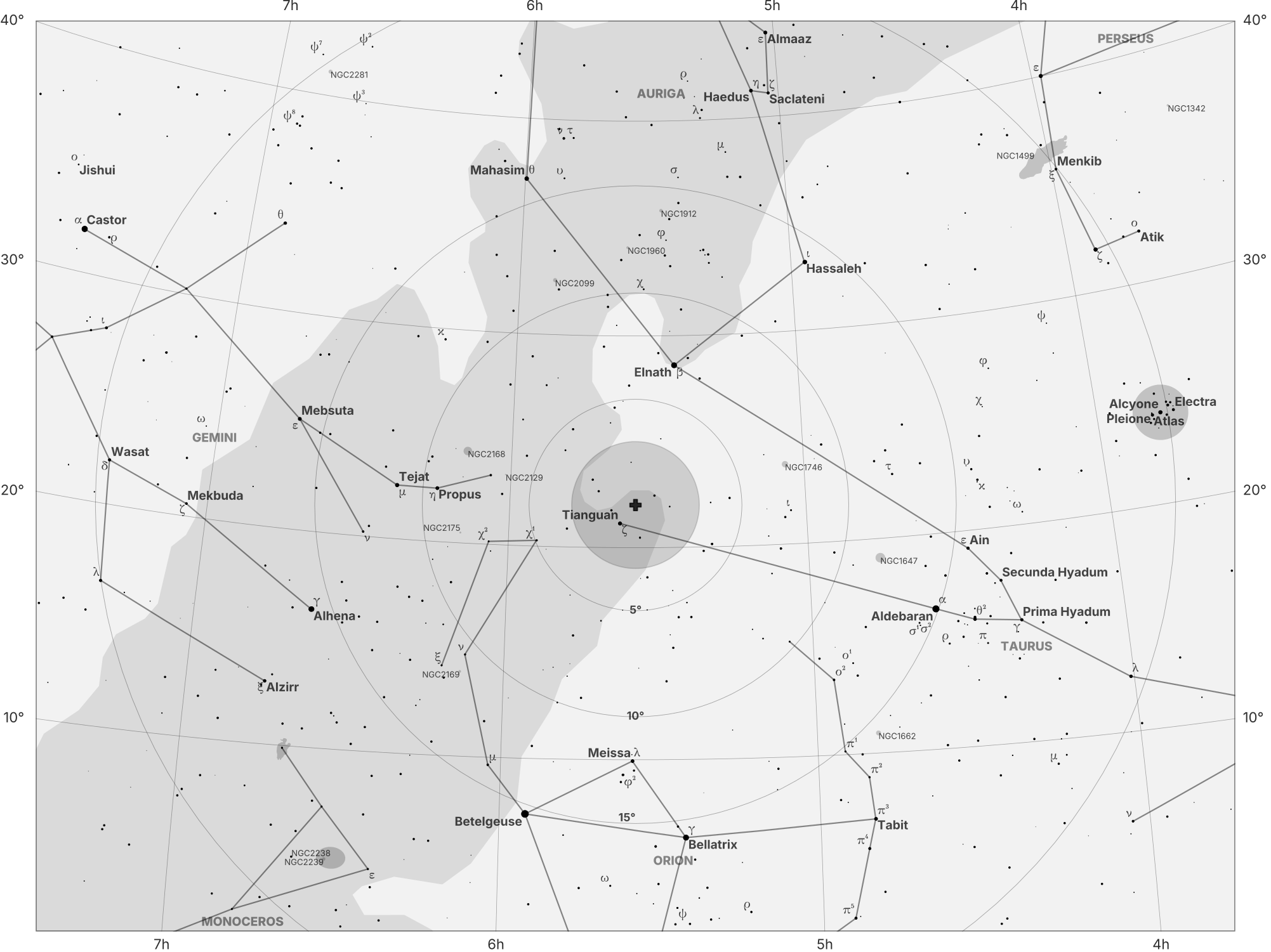
Finder map for Crab Nebula
The supernova of 1054 CE was recorded by astronomers in East Asia—most notably in China—and by Islamic scholars, with possible references in other cultures. Today, the Crab Nebula is one of the most iconic and intensively studied objects in astronomy, representing the explosive death of a massive star. Best observed when high in the sky to reduce atmospheric extinction and improve contrast, ideally above about 40 degrees altitude. The primary visual challenge is detecting the nebula’s faint, diffuse glow and uneven brightness against the background sky. In 4–8 inch telescopes the Crab appears as an elongated, mottled patch, while the fine filamentary structure seen in images lies beyond visual resolution.
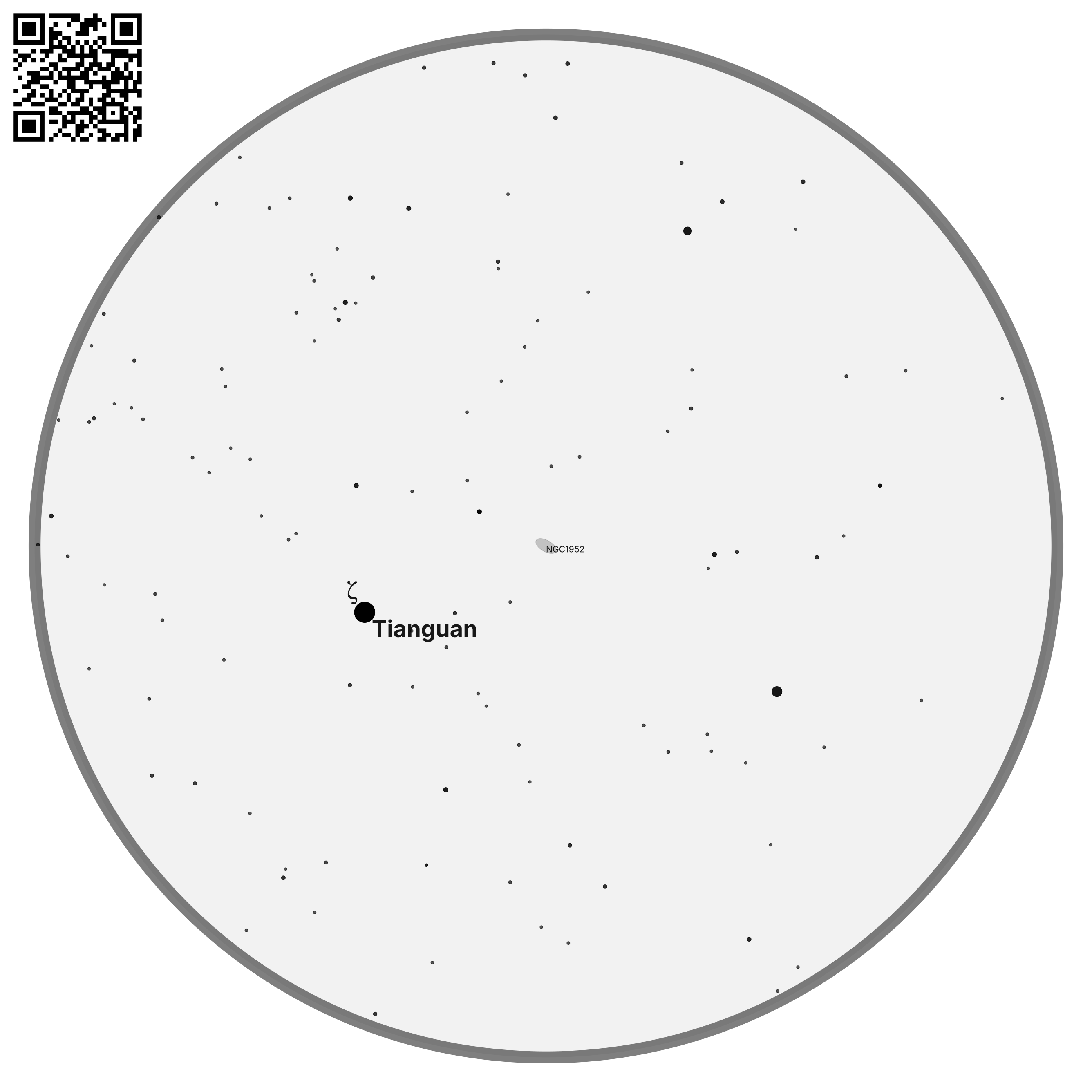
Finder scope & binocular view of Crab Nebula
| Property | Value |
|---|---|
| Common names | Taurus A |
| Catalog names | M 1, NGC 1952, SH 2-244, LBN 833, Ced 53, … |
| Type | Interstellar Medium |
| Subtype | Supernova Remnant |
| Coordinates | 5h 34m 31.78s, +22° 01’ 02.64” |
| Season | November - January |
| Best month | Mid-December |
| Beginner friendly | Yes |
| Visual reward | Moderate |
| Filters required | OIII, UHC |
| LP tolerance | Low |
| Minimum equipment | Binoculars |
| Optimal equipment | Medium telescope |
| Magnitude | 8.4 |
| Size | 6.0 arcminutes x 4.0 arcminutes |
| Constellation | Taurus |
Observation Notes
Naked Eye
Not visible.
Binoculars
Under very dark, transparent skies, large binoculars (around 15×70 or larger) can show M1 as a small, faint, diffuse patch; detection in 10×50 is possible for experienced observers but remains marginal.
Small Telescope
In 4–6 inch apertures, appears as a small, diffuse, oval glow with no central condensation. It can be difficult to distinguish from a faint galaxy or a nucleus-less comet, and no internal structure is visible.
Medium Telescope
With 8–12 inches under dark skies, the oval outline is better defined and the nebula appears brighter against the background. Subtle unevenness in brightness may be suspected with averted vision, but the view remains largely featureless.
Large Telescope
In apertures of roughly 16 inches and larger under excellent conditions, delicate filamentary structure may begin to emerge with averted vision, giving the nebula a ragged appearance. Narrowband filters such as UHC or O-III can provide modest contrast improvement, but filament visibility remains dependent on aperture, sky quality, and observing technique.