NGC 6822
4-8 inch Telescope • Dwarf Galaxies
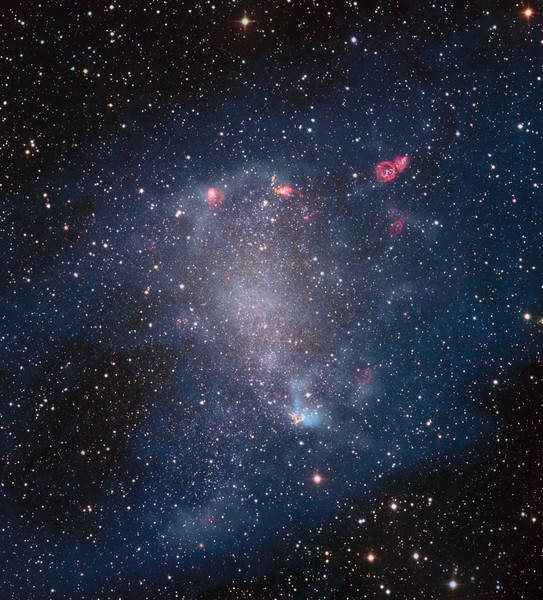
Image: ESO, ALMA (ESO/NAOJ/NRAO)/A. Schruba, VLA (NRAO)/Y. Bagetakos/Little THINGS
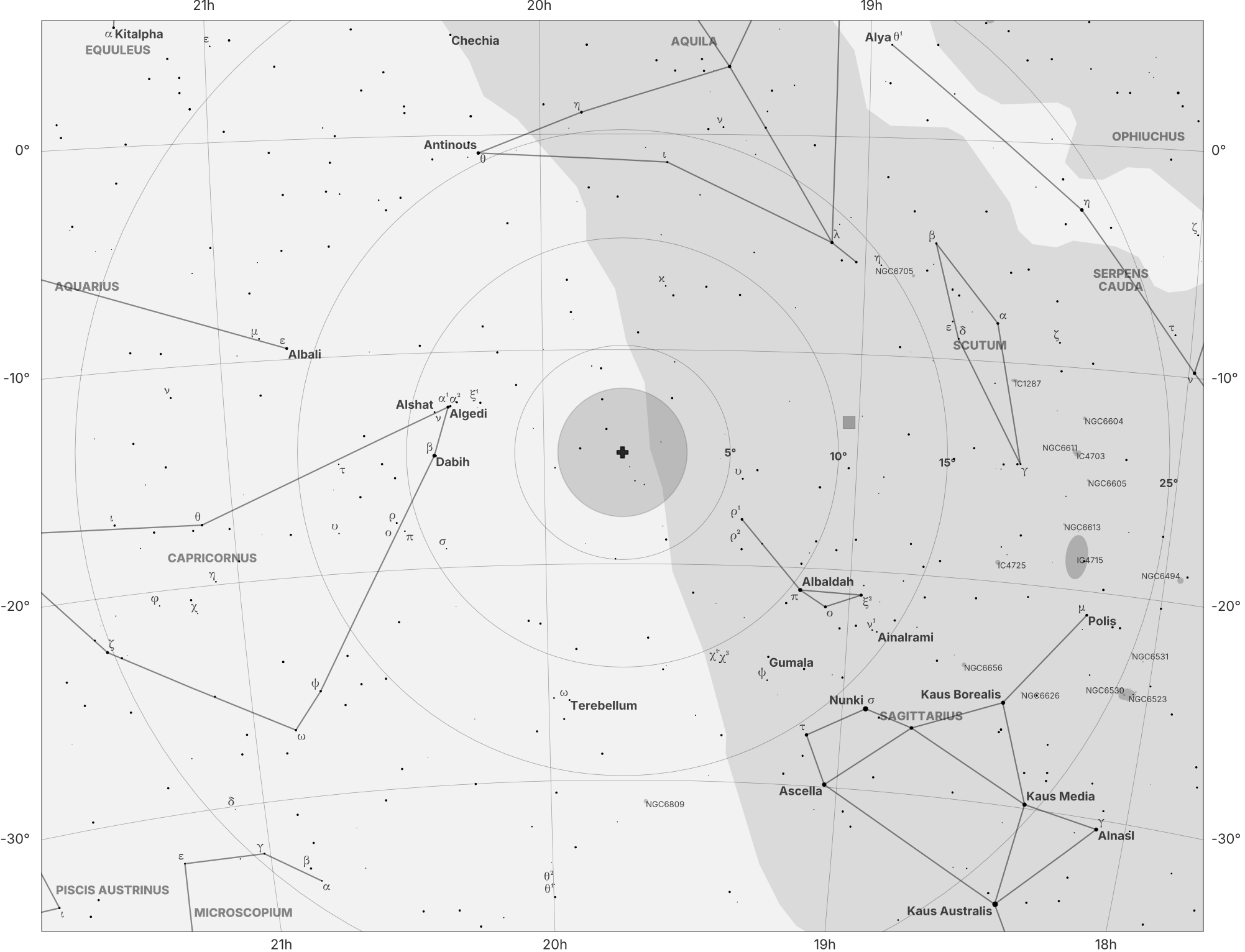
Finder map for NGC 6822
Hubble measured Cepheid variables in NGC 6822 in 1925, demonstrating it lies beyond the Milky Way and helping confirm that spiral nebulae are external galaxies. This work helped settle the question raised by the 1920 ‘Great Debate’ Remains low on the horizon for most mid-northern latitude observers, requiring a clear southern view. Much better positioned for observers in the Southern Hemisphere. Its extremely low surface brightness makes NGC 6822 difficult to detect against any background sky glow. In 4–8 inch telescopes it appears as a very large, diffuse, uneven glow with little internal detail, requiring dark skies, excellent transparency, and careful use of averted vision.
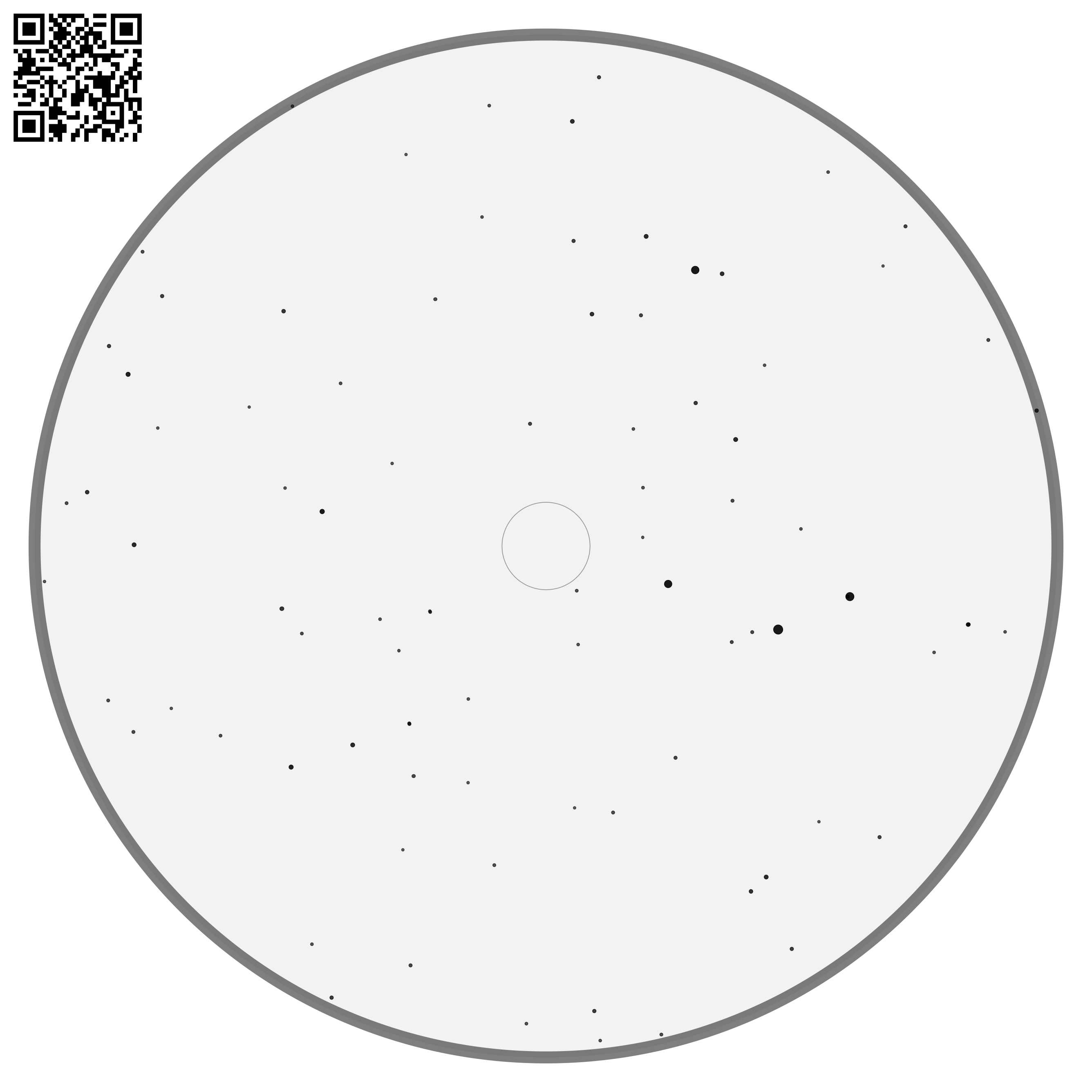
Finder scope & binocular view of NGC 6822
| Property | Value |
|---|---|
| Common names | Barnard’s Galaxy, IC 4895, Caldwell 57 |
| Catalog names | C 57, NGC 6822, IC 4895, PGC 63616 |
| Type | Galaxy |
| Subtype | - |
| Coordinates | 19h 44m 56.20s, -14° 47’ 51.29” |
| Season | June - August |
| Best month | Mid-July |
| Beginner friendly | No |
| Visual reward | Moderate |
| Filters required | None |
| LP tolerance | Low |
| Minimum equipment | Small telescope |
| Optimal equipment | Medium telescope |
| Magnitude | 10.6 |
| Size | 15.49 arcminutes x 13.49 arcminutes |
| Constellation | Sagittarius |
Observation Notes
Naked Eye
Not visible.
Binoculars
Generally not visible. Even under exceptional dark-sky conditions, most observers do not reliably detect it in binoculars due to its extremely low surface brightness and large angular size.
Small Telescope
Under very dark, transparent skies, appears as an exceedingly faint, large, diffuse glow with averted vision. The galaxy is easy to miss, and only a vague, elongated brightening may be suspected. No structure is visible.
Medium Telescope
The galaxy becomes more securely detected as a broad, low-contrast oval haze. The primary challenge remains its low surface brightness. Highly experienced observers under excellent conditions may suspect unevenness in the glow or a very mild central brightening, but these impressions are subtle and uncertain.
Large Telescope
In large apertures under pristine skies, the galaxy’s irregular nature becomes more apparent as a patchy, diffuse glow. A few of the brightest H II regions may be detected as extremely faint, tiny knots by expert observers. Narrowband filters (UHC preferred; O III as a secondary option) can help isolate these nebulae, while no filter is best for viewing the galaxy’s overall glow. All such details remain difficult and seeing- and transparency-dependent.