NGC 5128
10+ inch Telescope • Active Galaxies
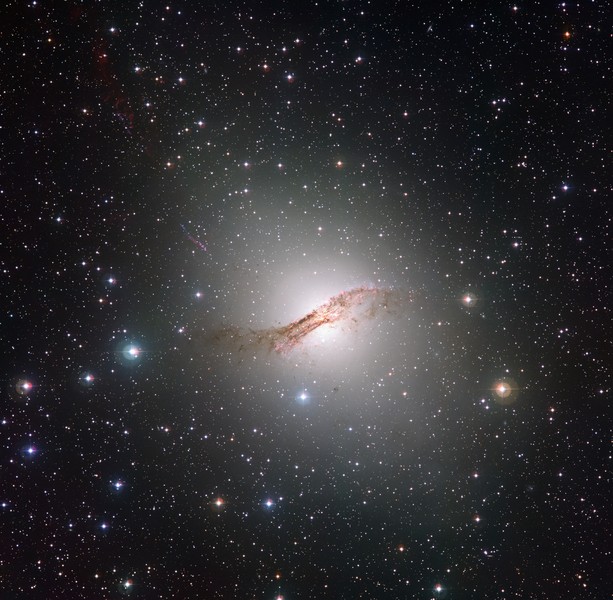
Image: ESO
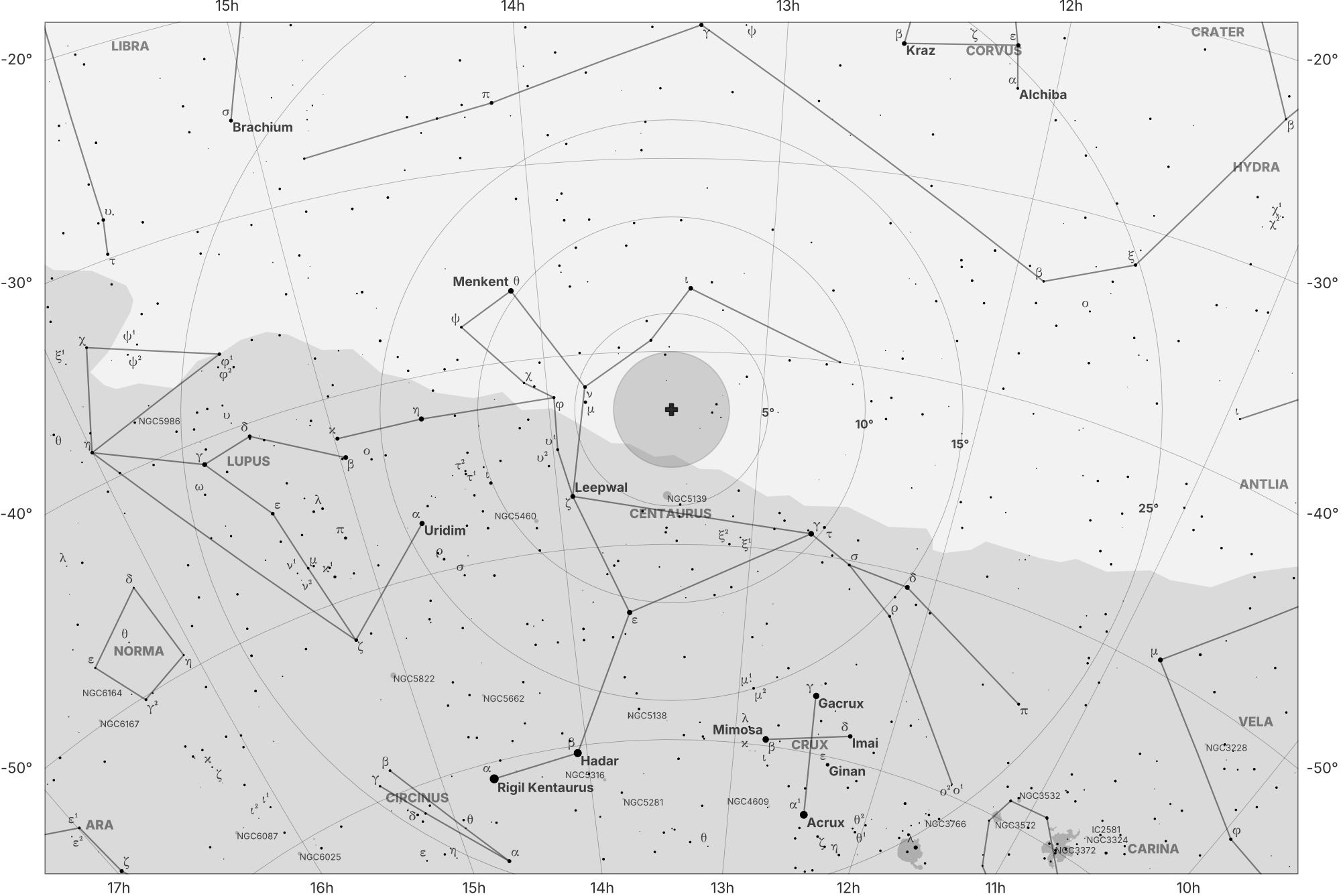
Finder map for NGC 5128
As one of the earliest and strongest extragalactic radio sources identified, Centaurus A played a central role in the rise of extragalactic radio astronomy and helped establish that some galaxies host active, energetic nuclei rather than being quiescent collections of stars. Best viewed from the Southern Hemisphere, where it climbs high in the sky. From mid- and high-northern latitudes it remains very low on the southern horizon or is unobservable, requiring an unobstructed southern view. Seeing the prominent central dust lane is straightforward in large apertures under dark southern skies, but discerning fine structure within it and tracing the galaxy’s faint outer halo remains challenging.
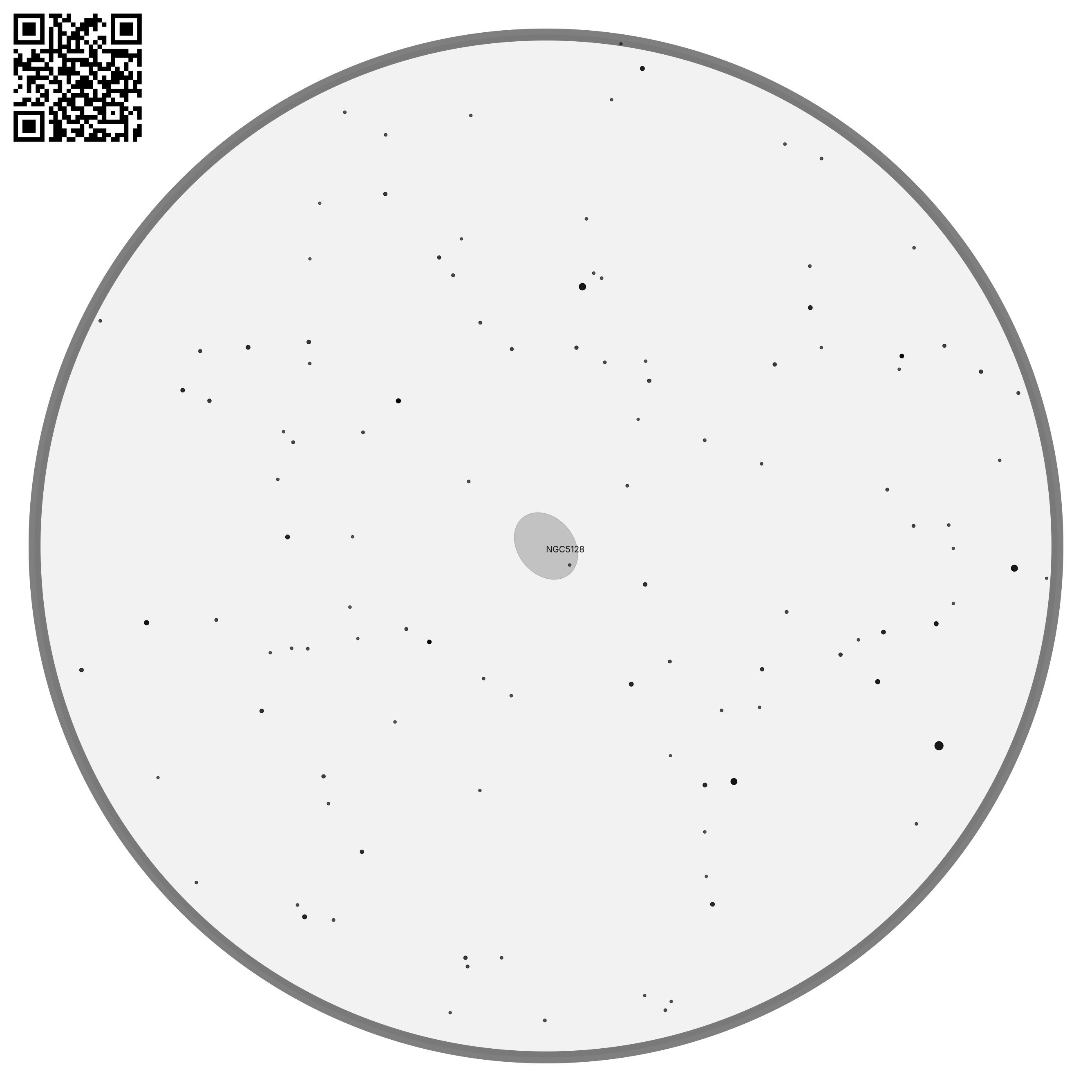
Finder scope & binocular view of NGC 5128
| Property | Value |
|---|---|
| Common names | Centaurus A, Cen A |
| Catalog names | C 77, NGC 5128, PGC 46957, Arp 153, ESO 270-9 |
| Type | Seyfert Galaxy |
| Subtype | Seyfert 2 Galaxy |
| Coordinates | 13h 25m 27.62s, -43° 01’ 08.81” |
| Season | March - May |
| Best month | Mid-April |
| Beginner friendly | Yes |
| Visual reward | High |
| Filters required | None |
| LP tolerance | Medium |
| Minimum equipment | Binoculars |
| Optimal equipment | Medium telescope |
| Magnitude | 6.8 |
| Size | 25.7 arcminutes x 19.95 arcminutes |
| Constellation | Centaurus |
Observation Notes
Naked Eye
Not visible to the naked eye under any conditions, despite its intrinsic brightness, due to its extended nature and low surface brightness.
Binoculars
Appears as a conspicuous, non-stellar oval glow. Large binoculars (15×70 or larger) from dark southern skies may suggest slight elongation, but no internal detail is visible.
Small Telescope
Shows a large, bright, oval galaxy with a strongly condensed central region. The famous dust lane is usually not seen at this aperture, though under excellent conditions a hint of unevenness across the core may be suspected.
Medium Telescope
Under dark, steady skies, the prominent dust lane becomes detectable as a dark band cutting across the bright central region, giving the galaxy a distinctive split appearance.
Large Telescope
The dust lane is obvious and well defined, showing irregularity and texture rather than sharp detail. With averted vision, the faint outer halo can be traced well beyond the bright central regions, revealing the galaxy’s impressive true size.