Eagle Nebula
4-8 inch Telescope • Star Forming Regions
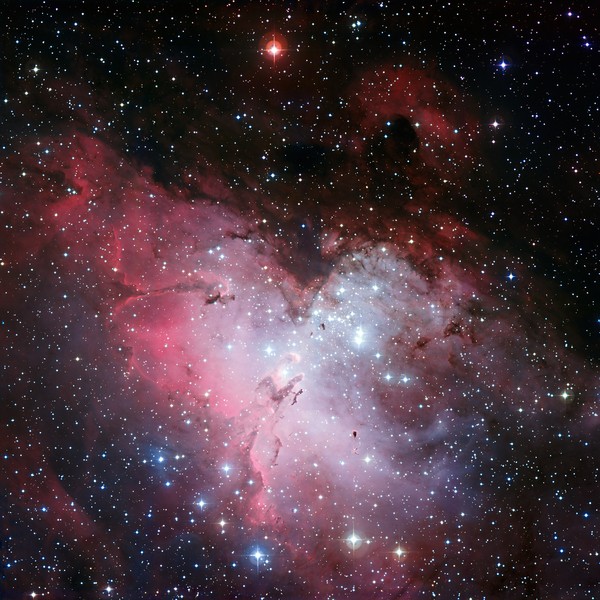
Image: ESO
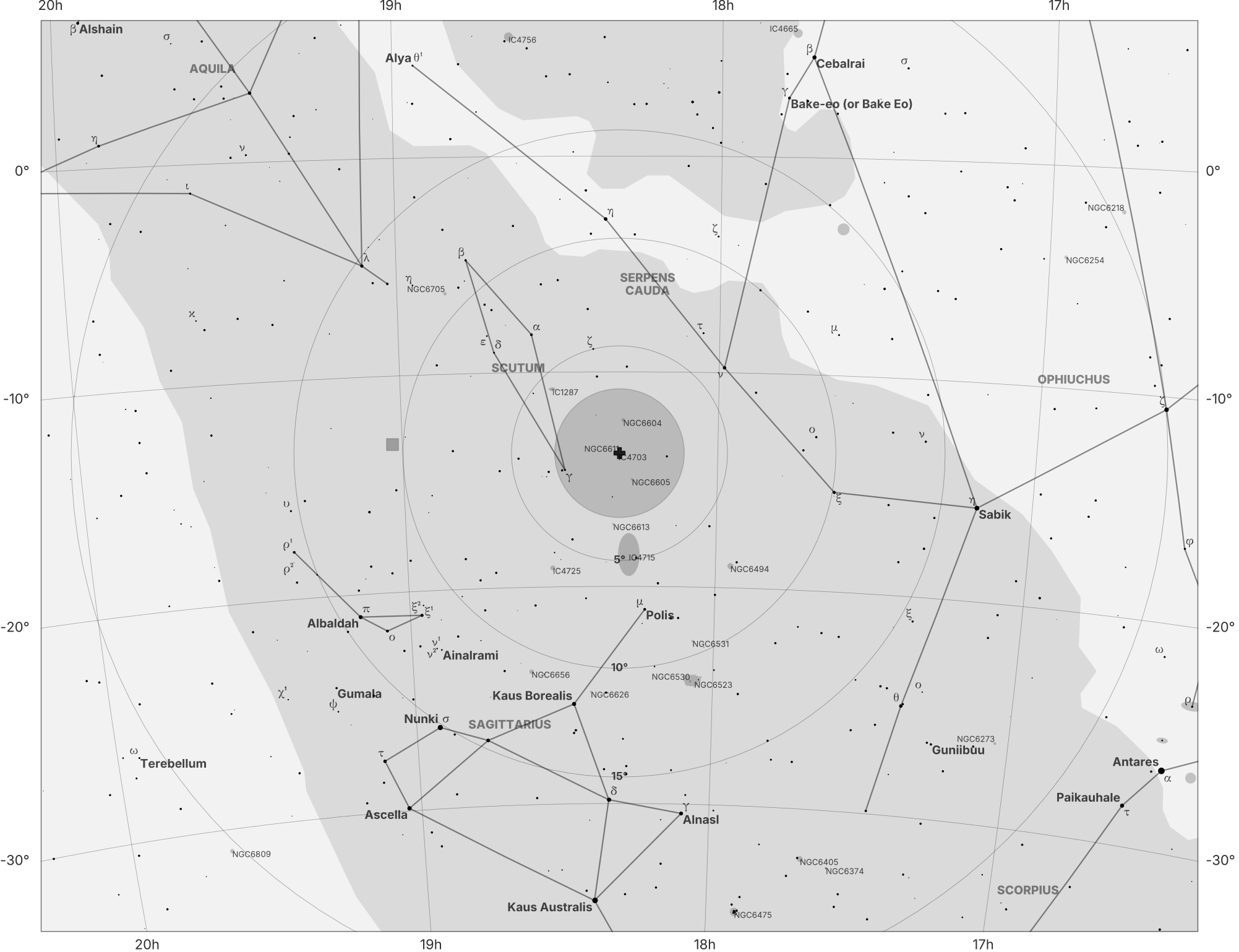
Finder map for Eagle Nebula
NGC 6611 is the young open cluster embedded within the Eagle Nebula (M16). The nebula surrounding it is famous in modern culture for the “Pillars of Creation” images, which have become global icons of space and scientific discovery. Best observed when near meridian transit. From mid-northern latitudes it culminates at moderate altitude in the southern sky, while observers in the Southern Hemisphere see it much higher and under more favorable conditions. The main visual challenge is detecting the faint, diffuse glow of the surrounding Eagle Nebula against the background sky, particularly from light-polluted locations. In 4–8 inch telescopes the nebula appears as a weak, uneven haze around the bright cluster stars, while the famous pillar structures seen in images lie entirely beyond visual reach.
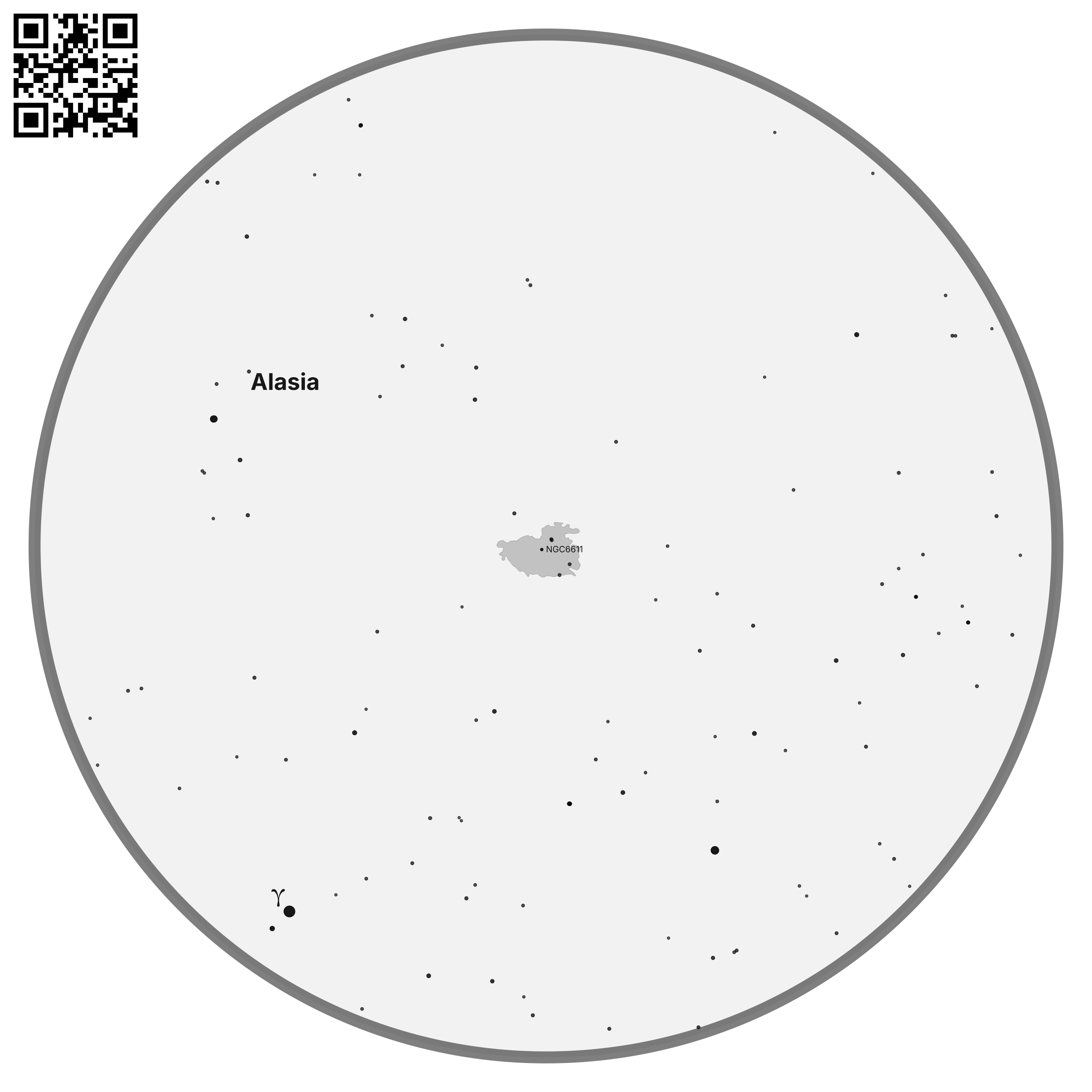
Finder scope & binocular view of Eagle Nebula
| Property | Value |
|---|---|
| Common names | Star Queen Nebula |
| Catalog names | M 16, NGC 6611, IC 4703, SH 2-49, RCW 165, … |
| Type | Stellar Cluster |
| Subtype | Open Cluster |
| Coordinates | 18h 18m 45.12s, -13° 47’ 31.20” |
| Season | June - August |
| Best month | July |
| Beginner friendly | Marginal |
| Visual reward | Moderate |
| Filters required | UHC |
| LP tolerance | Medium |
| Minimum equipment | Binoculars |
| Optimal equipment | Medium telescope |
| Magnitude | 6.0 |
| Size | 8.0 arcminutes x 8.0 arcminutes |
| Constellation | Serpens |
Observation Notes
Naked Eye
Not visible.
Binoculars
Under dark skies, the central star cluster NGC 6611 can be detected as a loose concentration of stars, but no nebulosity is visible at binocular magnifications.
Small Telescope
In 4–6 inch apertures, the star cluster is easily resolved, standing out clearly from the surrounding Milky Way. Any associated nebulosity is extremely faint and appears only as a weak, diffuse glow requiring dark adaptation and averted vision.
Medium Telescope
With 8–12 inches and a UHC or O-III filter, portions of the surrounding nebulosity become more apparent as uneven bright regions and darker bays. The overall outline may suggest a bird-like form, but this impression remains subtle and contrast-limited.
Large Telescope
In apertures of roughly 14 inches and larger under pristine conditions, the nebula shows increased contrast with mottling and dark intrusions visible against brighter background glow. All structure appears as soft brightness variations rather than sharply defined features; the famous pillar formations are not visible visually.