Messier 17
4-8 inch Telescope • Star Forming Regions
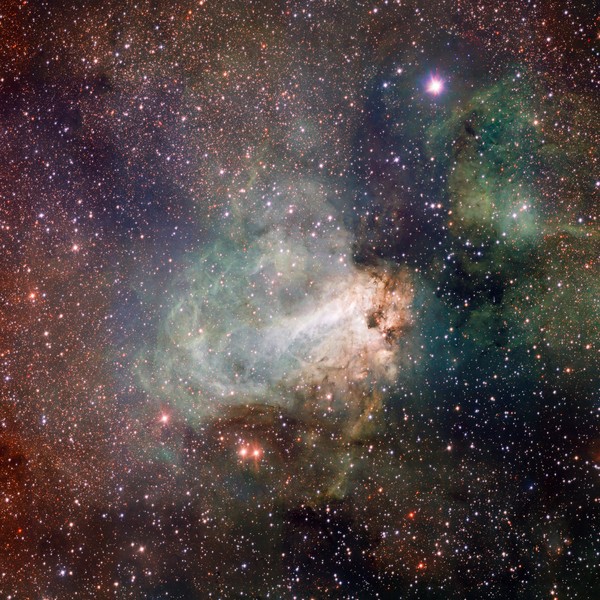
Image: ESO/INAF-VST/OmegaCAM.
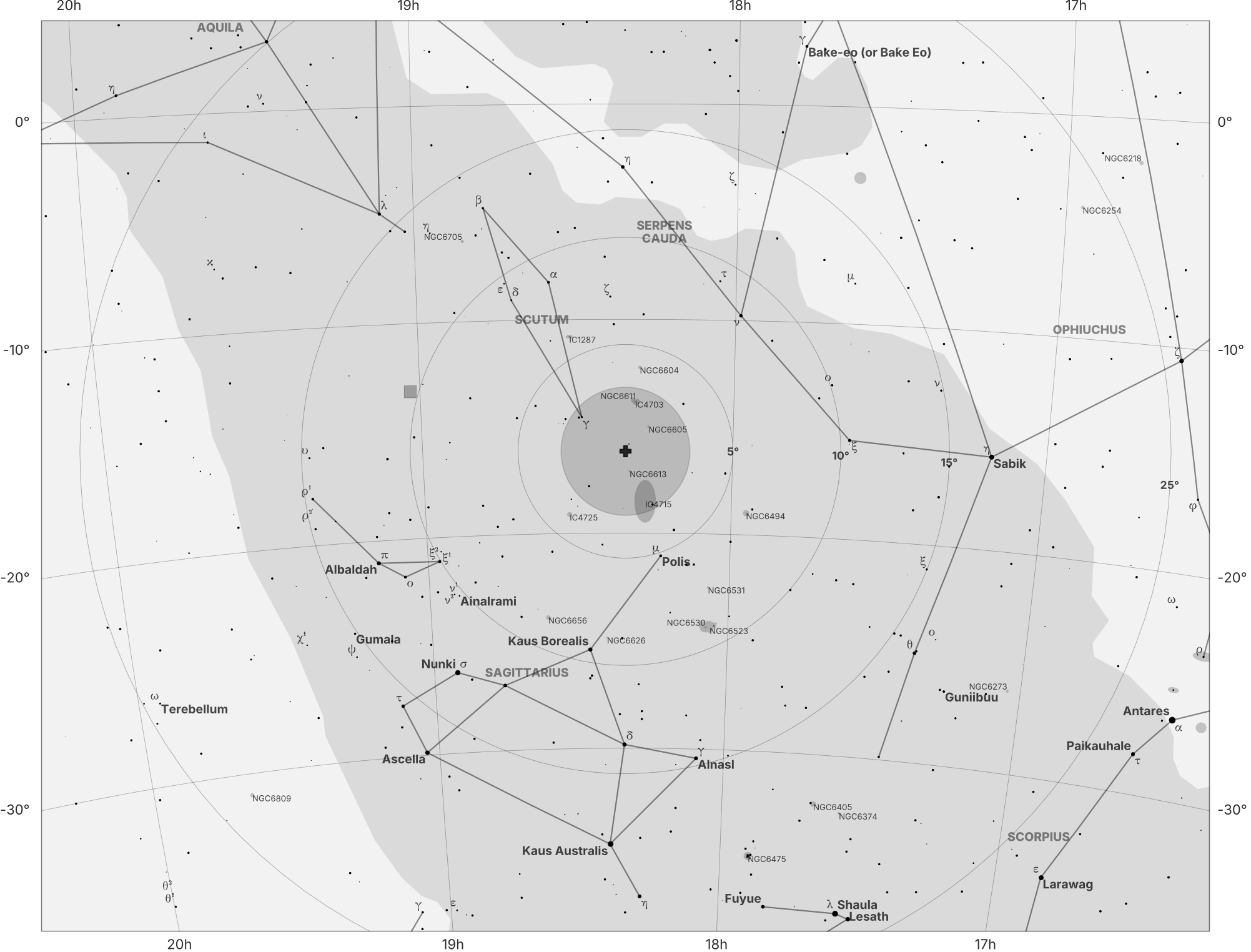
Finder map for Messier 17
NGC 6618 is the young open cluster embedded within the Lagoon Nebula (M8). The surrounding nebula is one of the most famous and frequently photographed deep-sky objects and a major showpiece of the summer sky for amateur astronomers. Best viewed when high in the sky. Its southern declination means it does not rise high for far northern latitude observers. The visual challenge lies in detecting the nebula’s uneven brightness and broad dark divisions within the glowing gas, especially from light-polluted sites. In 4–8 inch telescopes the Lagoon appears as a bright but irregular nebular mass, while the extended loops and fine dust lanes seen in photographs lie beyond reliable visual detection.
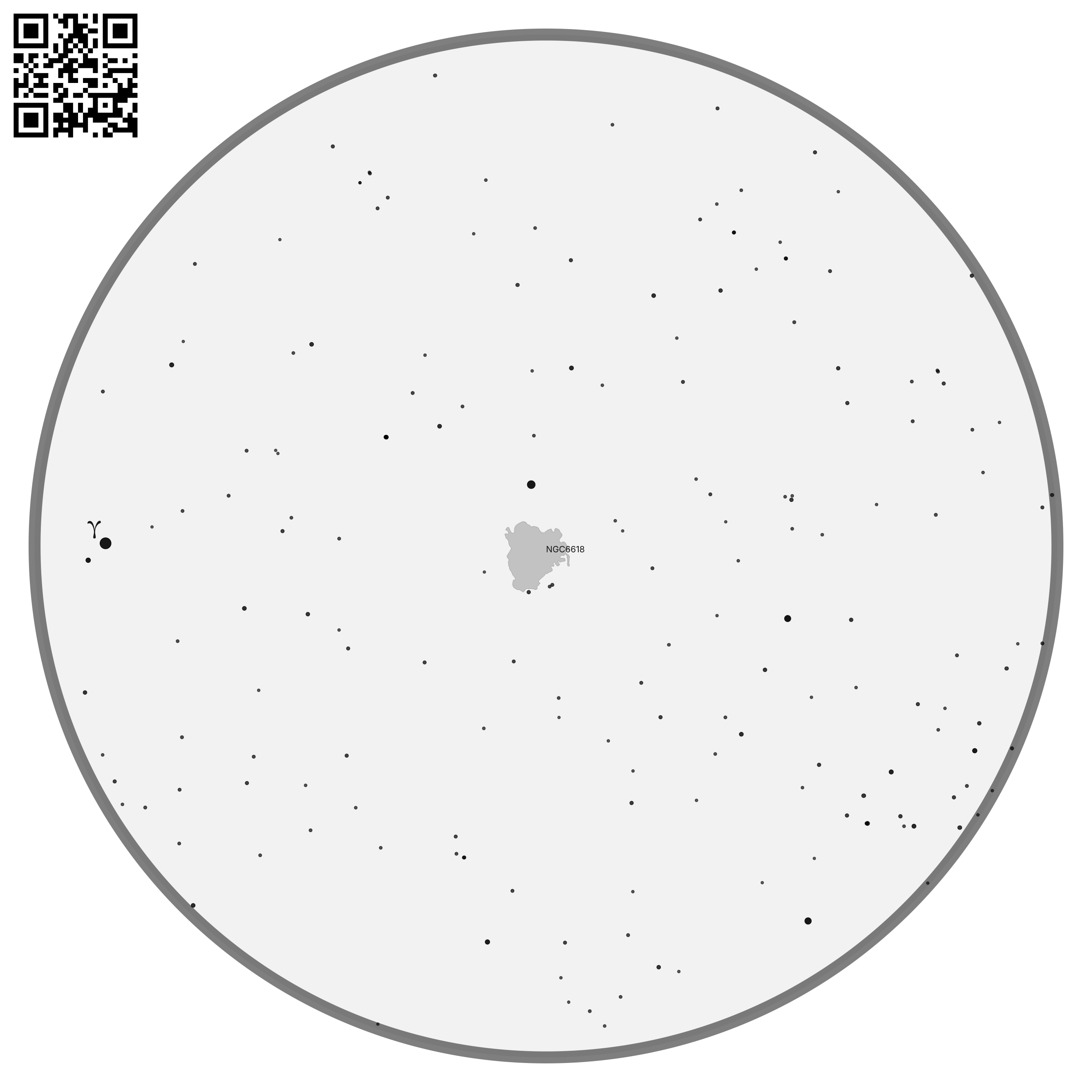
Finder scope & binocular view of Messier 17
| Property | Value |
|---|---|
| Common names | Omega Nebula, Swan Nebula, Checkmark Nebula, Lobster Nebula, Horseshoe Nebula |
| Catalog names | M 17, NGC 6618, SH 2-45, RCW 160, LBN 60, … |
| Type | Stellar Cluster |
| Subtype | Open Cluster |
| Coordinates | 18h 20m 47.00s, -16° 10’ 18.00” |
| Season | June - August |
| Best month | July |
| Beginner friendly | Yes |
| Visual reward | High |
| Filters required | UHC, OIII |
| LP tolerance | Medium |
| Minimum equipment | Binoculars |
| Optimal equipment | Medium telescope |
| Magnitude | 6.0 |
| Size | 20.0 arcminutes x 15.0 arcminutes |
| Constellation | Sagittarius |
Observation Notes
Naked Eye
Generally not visible; under exceptionally dark, transparent skies a few experienced observers report a very faint enhancement in the Milky Way at its position, but naked-eye detection is uncertain and not routine.
Binoculars
Easily visible in 7×50 or 10×50 binoculars as a bright, elongated patch of nebulosity set against the Milky Way. Under good conditions, its curved or swan-like outline may be suggested, though detail remains low contrast.
Small Telescope
In 4–6 inch apertures, the characteristic Omega or Swan shape becomes apparent, with a bright central region contrasting against darker surrounding sky. The overall form is clear, but internal detail is limited.
Medium Telescope
With 8–12 inches and a UHC or O-III filter, the nebula shows increased contrast, revealing mottled brightness and dark bays within the glowing gas. The structure appears richer and more complex, though all detail remains soft and contrast-based rather than sharply defined.
Large Telescope
In apertures of roughly 14 inches and larger, the nebula fills a wide field with extensive, uneven nebulosity surrounding the bright core. Fainter extensions and subtle texture become visible with careful observation, but fine filaments and loops remain elusive and dependent on sky quality and observing technique.