NGC 281
4-8 inch Telescope • Star Forming Regions
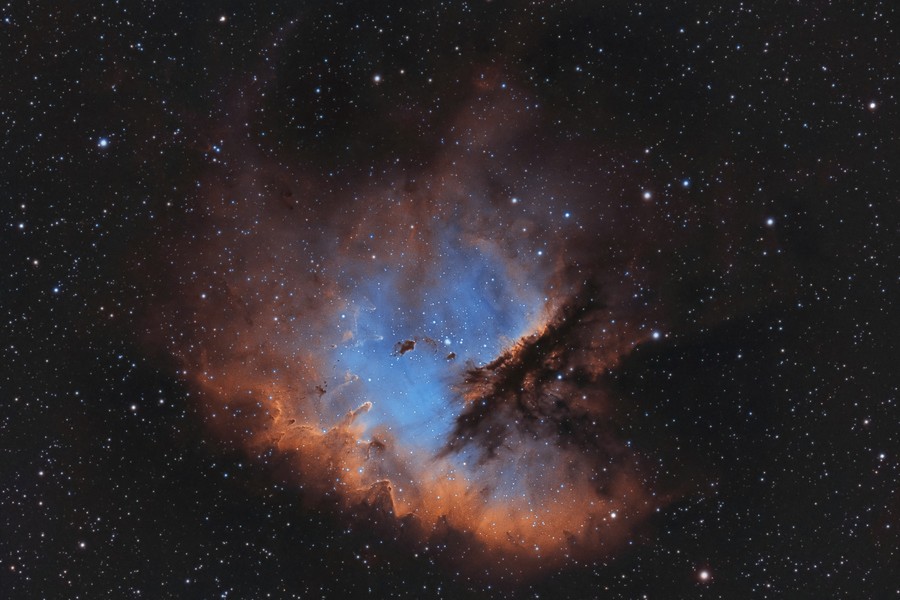
Image: Chuck Ayoub
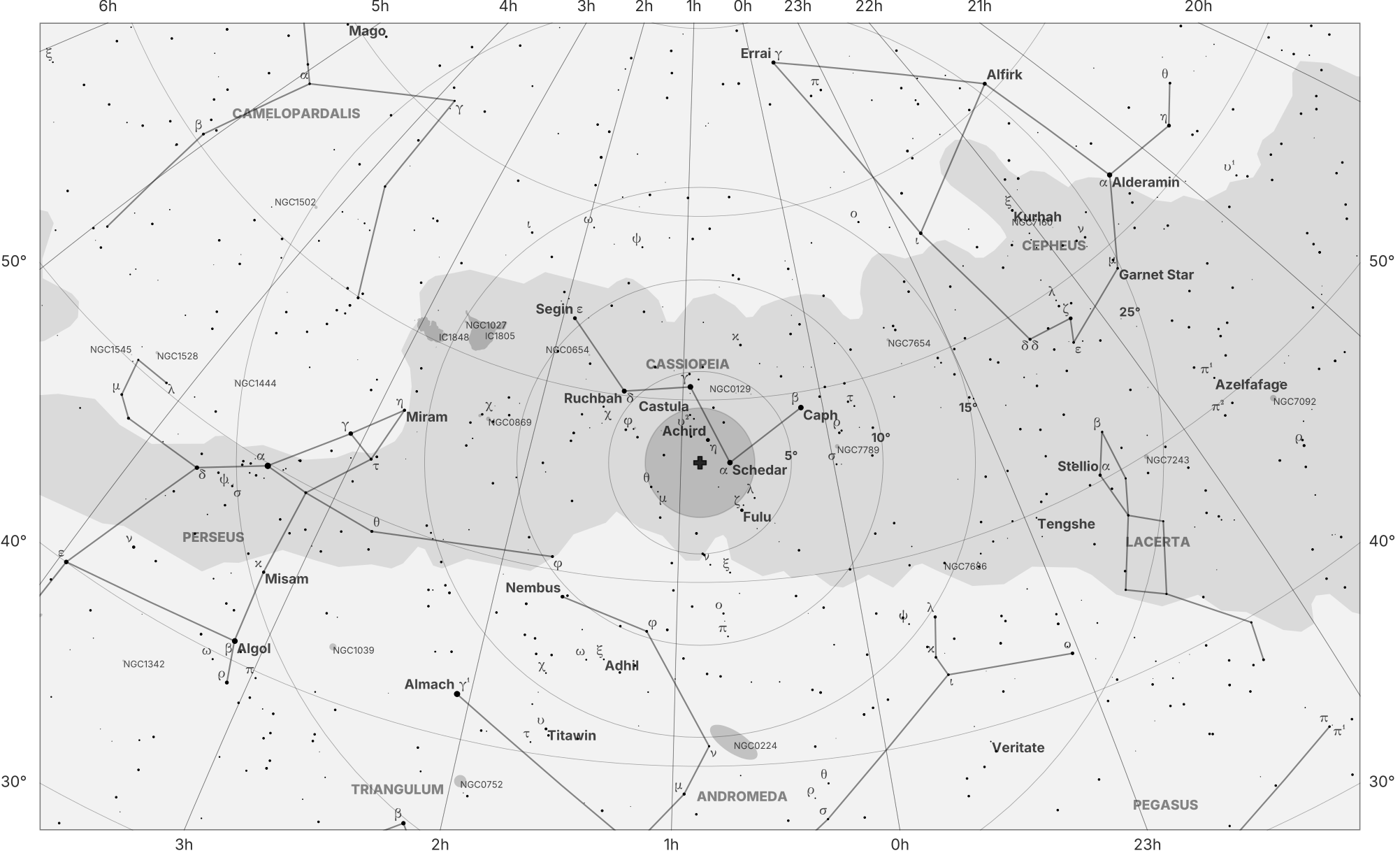
Finder map for NGC 281
Widely known by its modern nickname, the “Pacman Nebula,” derived from its resemblance in photographs to the iconic video game character. It is a familiar object in modern amateur astronomy, particularly in astrophotography. Best observed from the Northern Hemisphere, where it reaches high altitude. From the Southern Hemisphere it remains very low on the northern horizon and is difficult to observe, becoming inaccessible from far-southern latitudes. The main visual challenge is detecting the nebula’s faint, diffuse glow against the background sky, which demands dark, transparent conditions and the use of a nebula filter. The small dark globules and finer structural details seen in images lie beyond reliable visual detection in 4–8 inch telescopes.
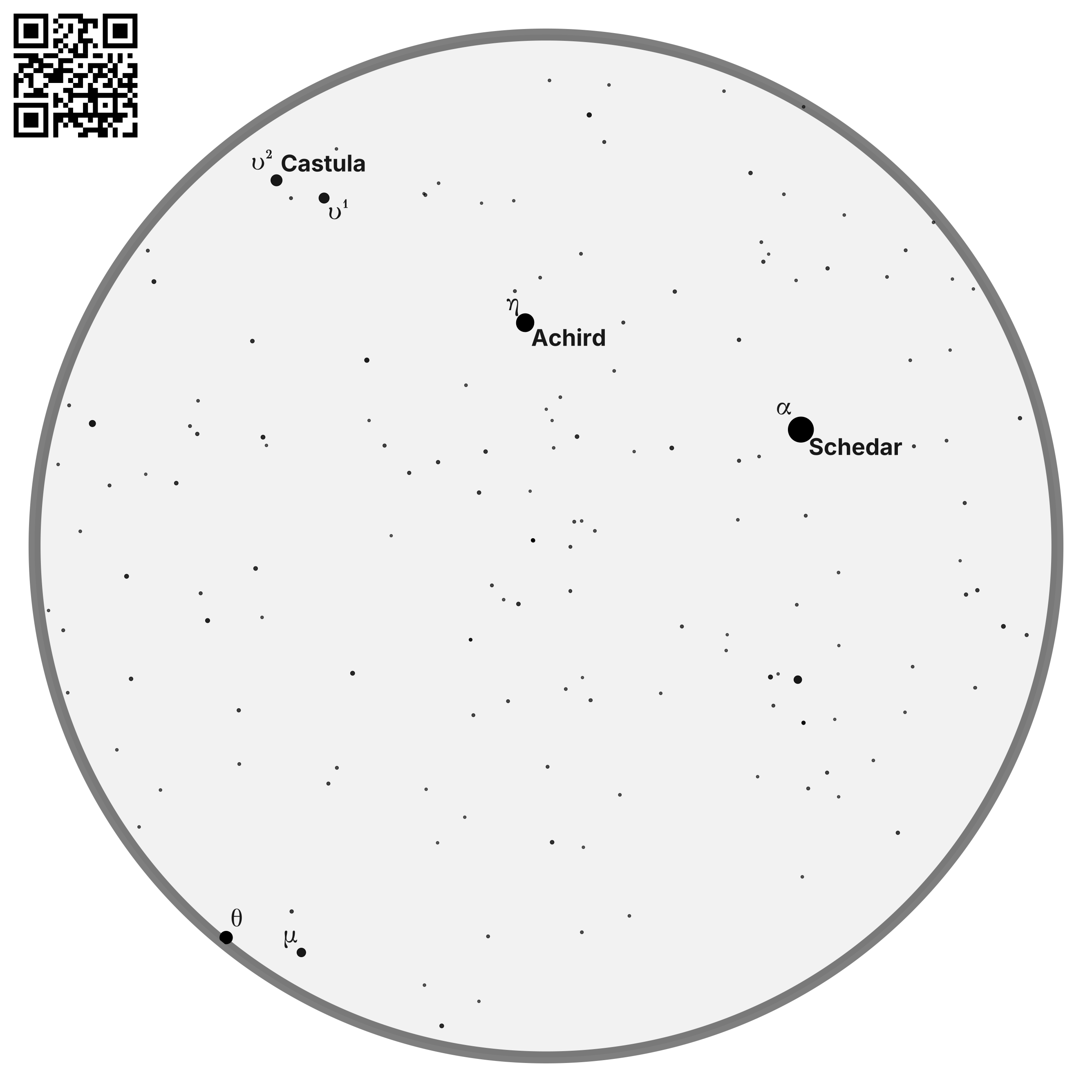
Finder scope & binocular view of NGC 281
| Property | Value |
|---|---|
| Common names | Pacman Nebula, Sh2-184 |
| Catalog names | NGC 281, SH 2-184, LBN 616, Ced 3 |
| Type | Interstellar Medium |
| Subtype | HII Region |
| Coordinates | 0h 52m 25.10s, +56° 33’ 54.00” |
| Season | September - November |
| Best month | October |
| Beginner friendly | No |
| Visual reward | Moderate |
| Filters required | UHC |
| LP tolerance | Low |
| Minimum equipment | Small telescope |
| Optimal equipment | Medium telescope |
| Magnitude | - |
| Size | 35.0 arcminutes x 30.0 arcminutes |
| Constellation | Cassiopeia |
Observation Notes
Naked Eye
Not visible.
Binoculars
The nebulosity is not visible; under exceptionally dark skies the central star cluster may be suspected as a very faint, non-stellar patch, but no nebulous glow is seen.
Small Telescope
In 4–6 inch apertures under dark skies, the IC 1590 cluster is visible. With a UHC or O-III filter, a very faint, large, diffuse glow from the surrounding nebula can be detected, though contrast remains low.
Medium Telescope
With 8–12 inches and a suitable nebular filter, the nebulosity becomes more apparent as a broad, uneven glow, and the characteristic dark bay forming the “Pacman mouth” can be discerned as a contrast feature. Additional stars in the central cluster are resolved.
Large Telescope
In apertures of roughly 14 inches and larger under excellent conditions, the nebula shows increased contrast with subtle texture and brightness variations across its extent. Very small dark features may be suspected as tiny notches against the brighter background, but these impressions are delicate and seeing-dependent rather than clearly defined structures.