NGC 7000
Binoculars • Emission Nebulae
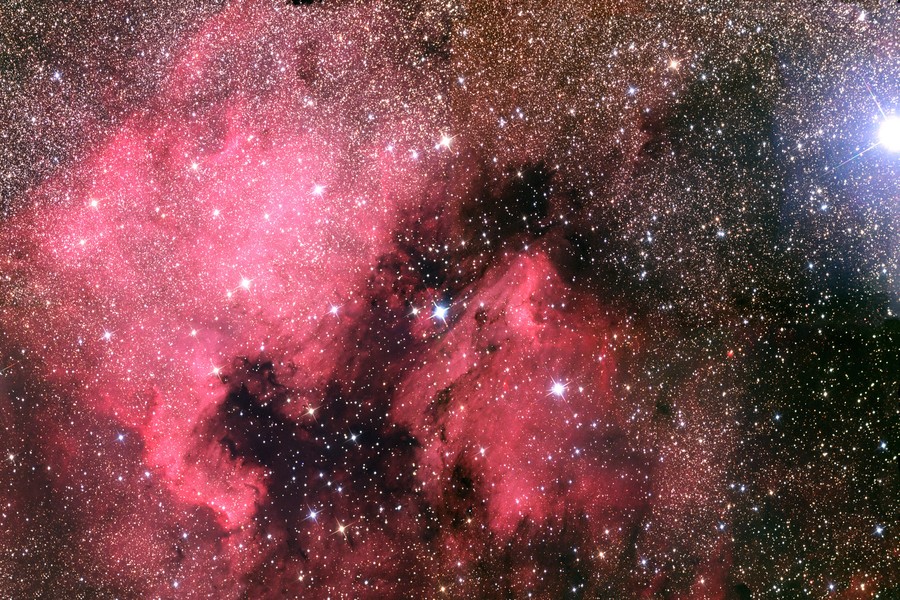
Image: KPNO/NOIRLab/NSF/AURA/Adam Block
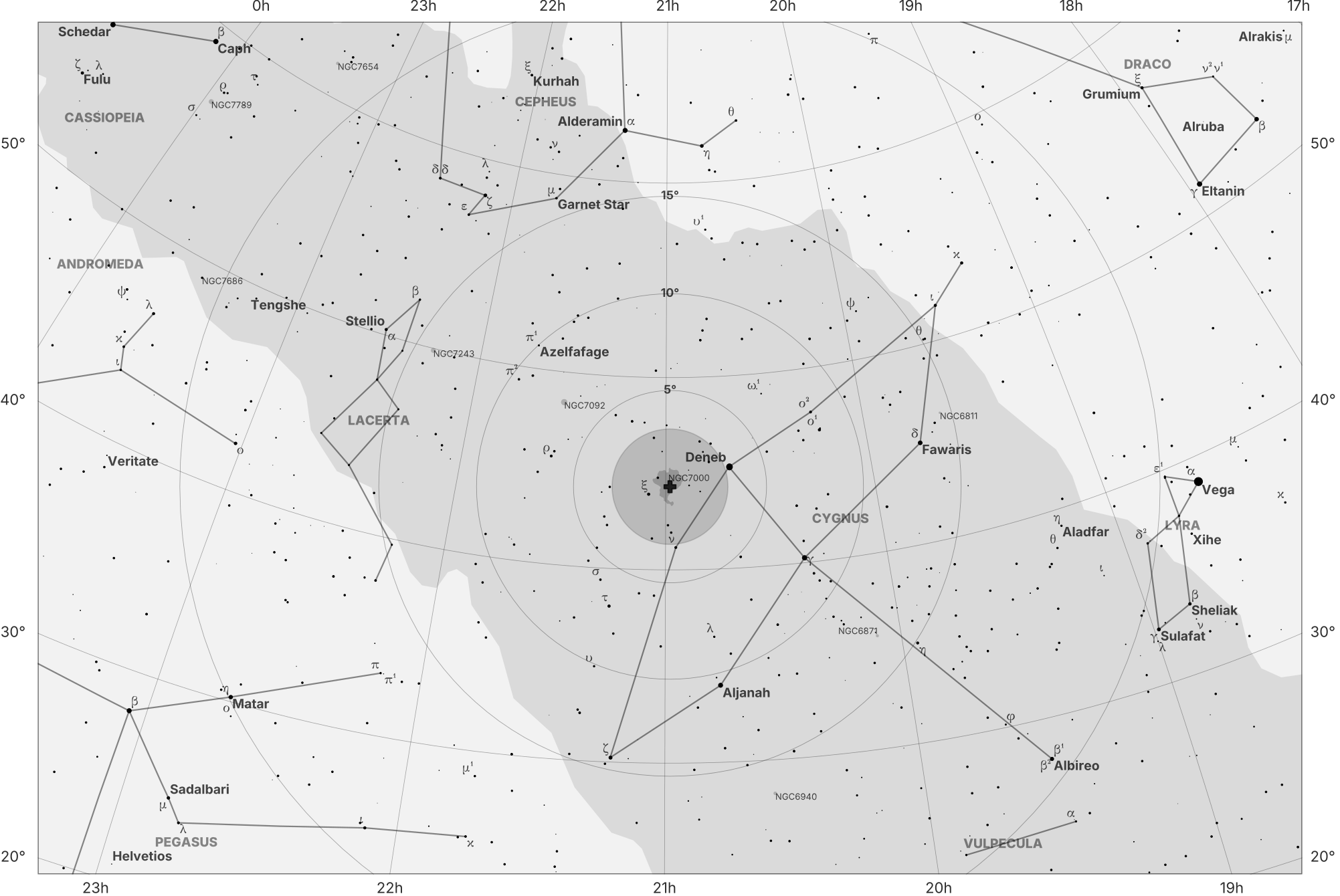
Finder map for NGC 7000
One of the most famous and recognizable deep-sky objects for amateur astronomers and the public due to its unique and familiar shape. Best viewed when high in the sky to minimize atmospheric extinction, primarily a Northern Hemisphere object. Very low surface brightness; from light-polluted sites it is very difficult or effectively invisible without a nebula filter. Its roughly 2-degree extent requires a very wide field of view to appreciate the shape.
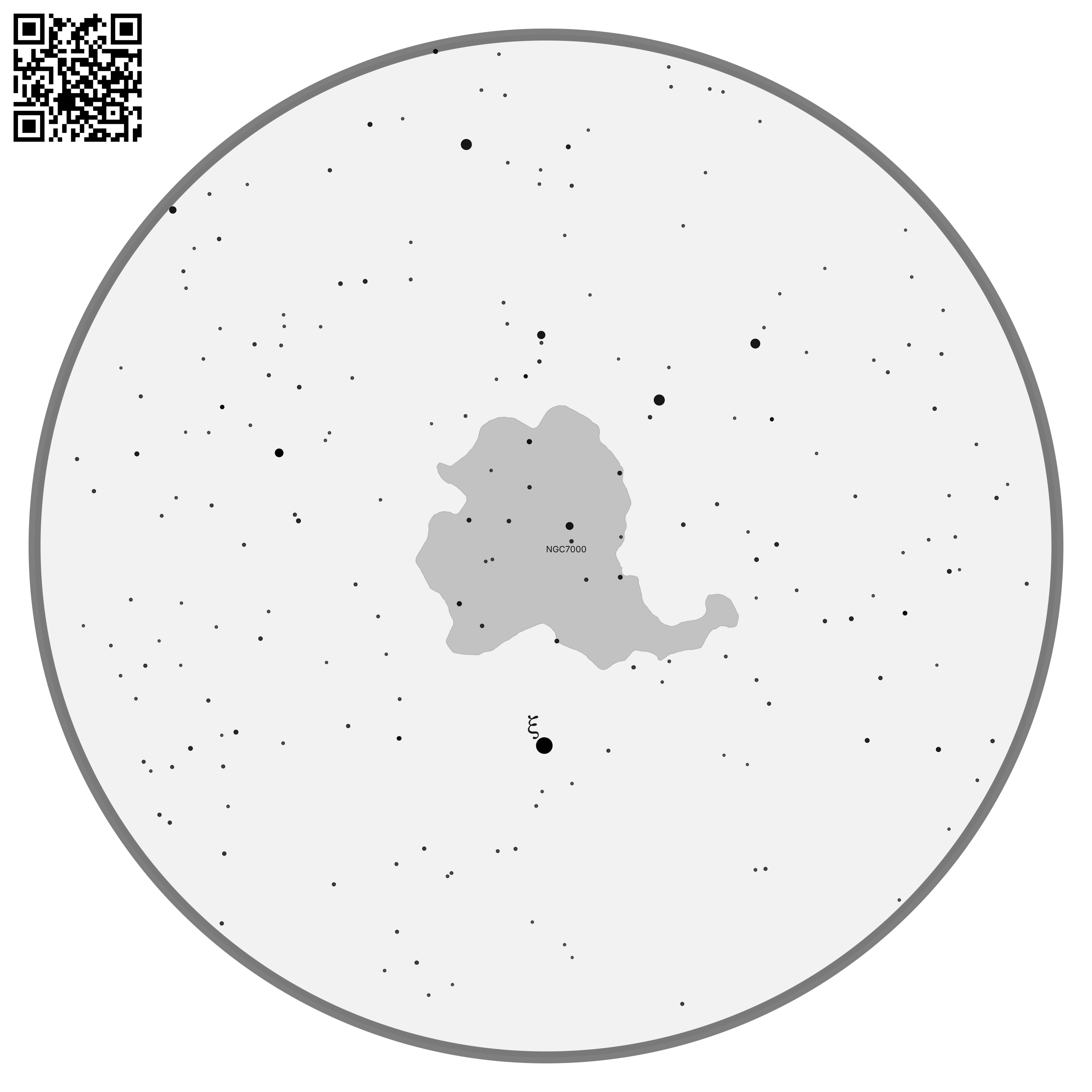
Finder scope & binocular view of NGC 7000
| Property | Value |
|---|---|
| Common names | North America Nebula |
| Catalog names | C 20, NGC 7000, SH 2-117, LBN 373, Ced 183d |
| Type | Interstellar Medium |
| Subtype | HII Region |
| Coordinates | 20h 58m 47.00s, +44° 19’ 48.00” |
| Season | July - September |
| Best month | August |
| Beginner friendly | Marginal |
| Visual reward | Moderate |
| Filters required | UHC |
| LP tolerance | Low |
| Minimum equipment | Binoculars |
| Optimal equipment | Binoculars |
| Magnitude | 5.0 |
| Size | 120.0 arcminutes x 100.0 arcminutes |
| Constellation | Cygnus |
Observation Notes
Naked Eye
Not visible as a distinct object. Under exceptionally dark and transparent skies, experienced observers may only suspect a vague brightening in the Milky Way near Deneb, without a clearly defined shape.
Binoculars
Detection is difficult and highly dependent on sky quality. From very dark sites, binoculars may show uneven brightness and dark intrusions within the Milky Way, but the full North America outline and the “Gulf of Mexico” are usually subtle and not reliably obvious without filters.
Small Telescope
Best attempted with a rich-field telescope at low magnification using a UHC filter to improve contrast. The nebula is very large and will not fit in a single field of view of most telescopes, requiring slow sweeping to appreciate its extent.
Medium Telescope
Under dark skies and with a UHC filter, specific brighter regions such as parts of the Cygnus Wall can be examined, though the structure remains diffuse and low-contrast rather than sharply defined.
Large Telescope
Not suitable for viewing the nebula as a whole. Increased aperture does not dramatically improve visibility, and higher magnification often reduces contrast. The object is best appreciated with wide-field, low-power instruments and appropriate filters.