Trifid Nebula
4-8 inch Telescope • Emission Nebulae Detailed
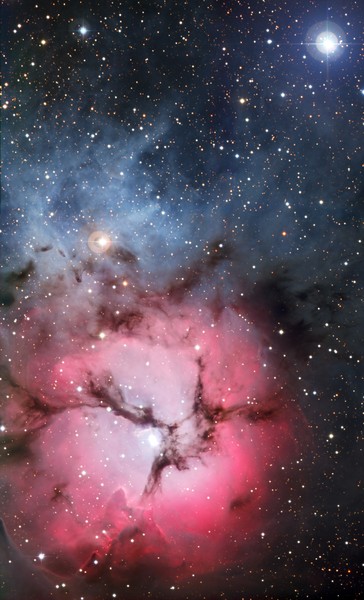
Image: ESO
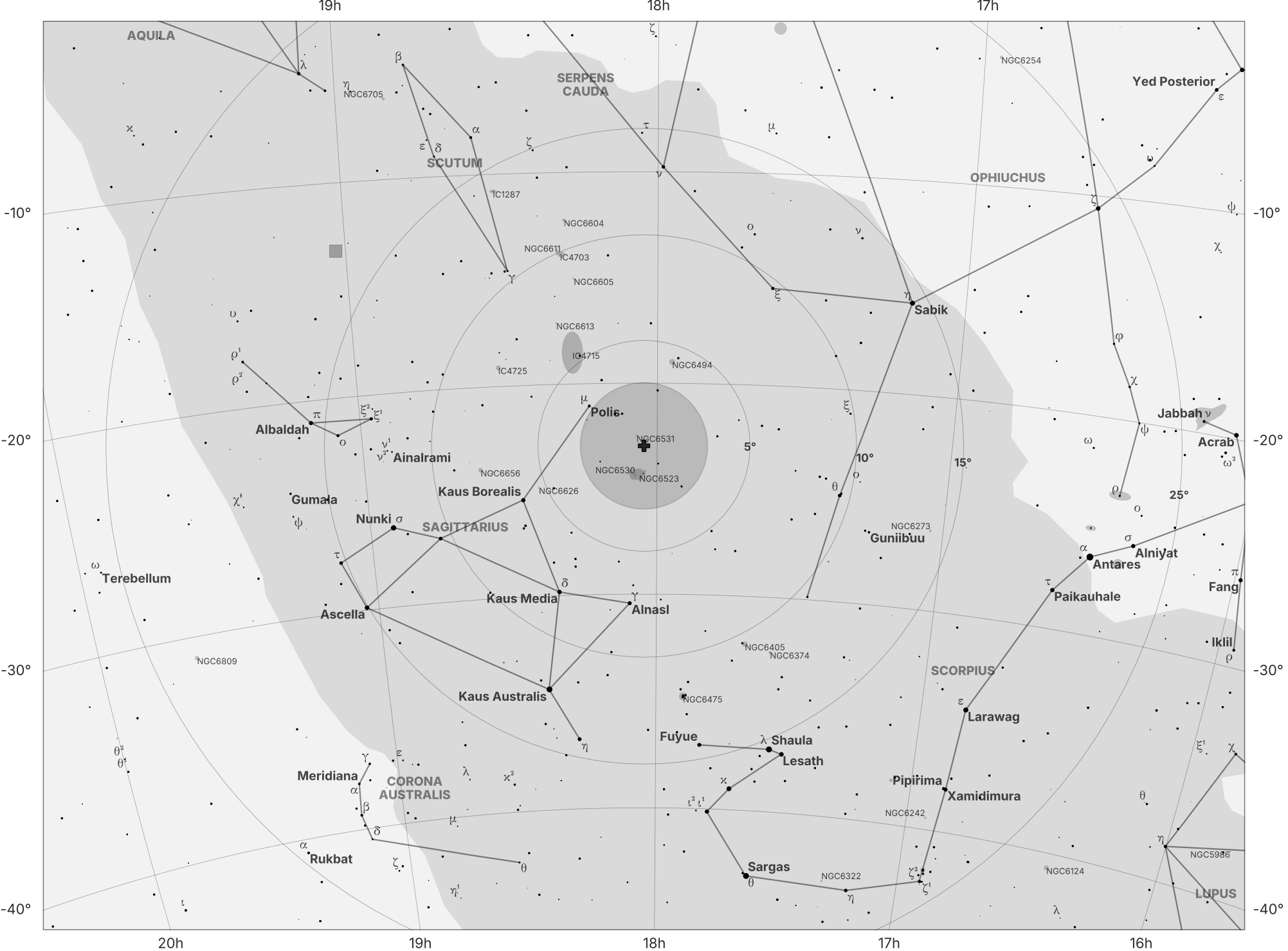
Finder map for Trifid Nebula
A classic and widely recognized ‘showpiece’ object for amateur astronomers and astrophotographers, often featured in books and documentaries as a prime example of a stellar nursery. Best viewed when high above the horizon. Can be low for mid-to-high northern latitudes, requiring a clear southern view. Detecting the dark lanes that divide the nebula, which are prominent in photographs but subtle visually. Under excellent conditions, observers may notice differences between the emission and reflection regions, though this contrast is far more apparent in imaging than at the eyepiece.
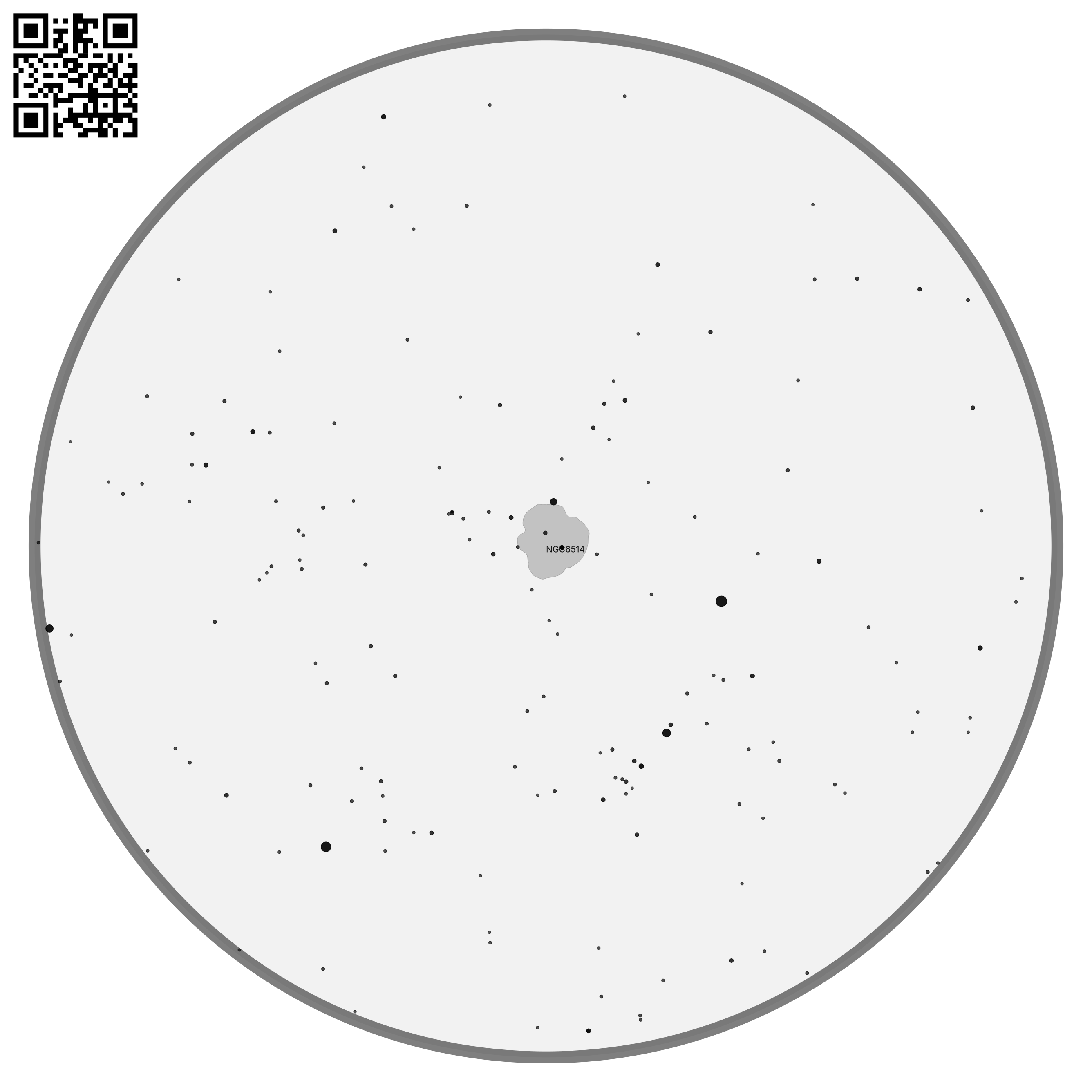
Finder scope & binocular view of Trifid Nebula
| Property | Value |
|---|---|
| Common names | The Trifid Nebula, Messier 20, The Trifid |
| Catalog names | M 20, NGC 6514, SH 2-30, RCW 146, LBN 27, … |
| Type | Interstellar Medium |
| Subtype | HII Region |
| Coordinates | 18h 02m 42.00s, -22° 58’ 18.00” |
| Season | May - July |
| Best month | Mid-June |
| Beginner friendly | Marginal |
| Visual reward | Moderate |
| Filters required | UHC, OIII |
| LP tolerance | Low |
| Minimum equipment | Binoculars |
| Optimal equipment | Small telescope |
| Magnitude | 6.3 |
| Size | 20.0 arcminutes x 20.0 arcminutes |
| Constellation | Sagittarius |
Observation Notes
Naked Eye
Not visible as a discrete object. Only the surrounding Sagittarius Milky Way star fields are seen with the unaided eye, even from very dark sites.
Binoculars
In standard binoculars, the Trifid is difficult and often appears only as a small star group. Large binoculars under dark skies may show a very faint, compact patch of nebulosity, but this is subtle and easily lost in the rich background.
Small Telescope
Shows a small, roundish glow surrounding the bright central star, with the associated open cluster visible. The characteristic dark lanes are usually not distinct at this aperture and may only be suspected at best under excellent conditions.
Medium Telescope
In apertures around 8–10 inches under dark, transparent skies, the dark lanes begin to stand out, giving the nebula its classic trifid appearance. The contrast between the emission region and the surrounding reflection component is noticeable but remains subtle visually.
Large Telescope
Provides the most reliable view of the nebula’s structure. The dark lanes are clearly defined, and irregular brightness variations within the emission region can be traced. A UHC filter can enhance the emission component, while O-III filters are generally less effective for this object and may suppress the reflection nebulosity.