Rosette Nebula
4-8 inch Telescope • Emission Nebulae Detailed
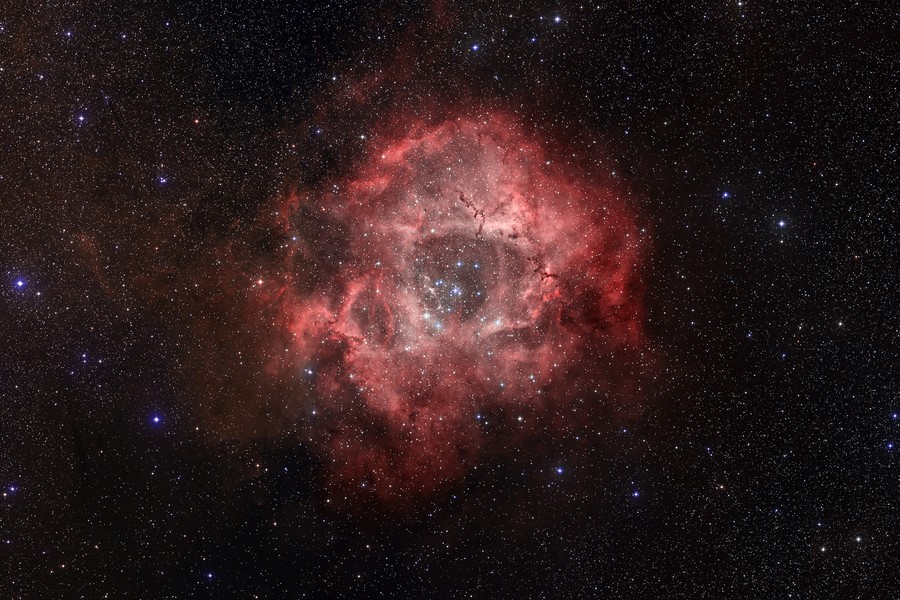
Image: John Corban & the ESA/ESO/NASA
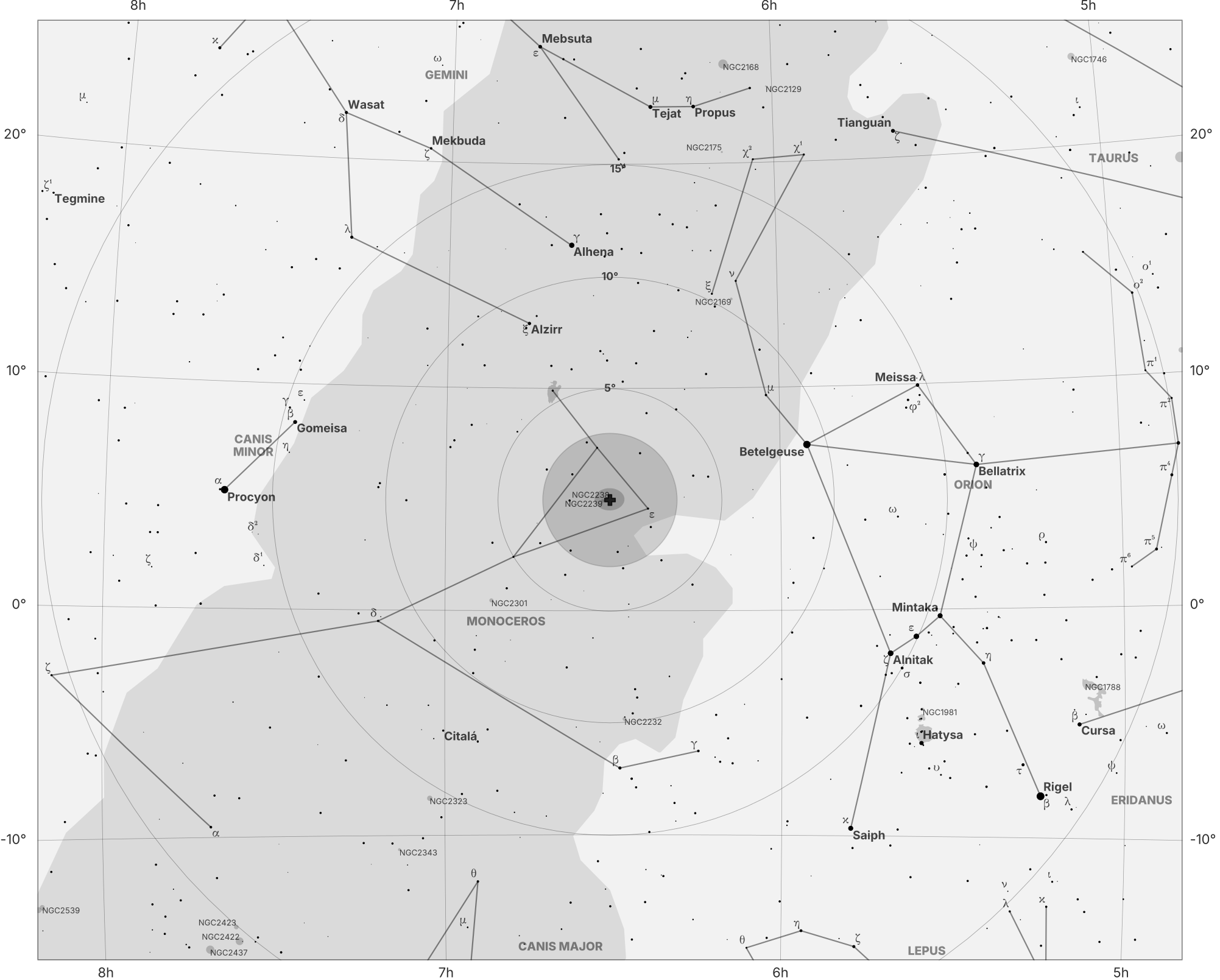
Finder map for Rosette Nebula
As part of the Rosette Nebula complex, NGC 2237 contributes to the iconic, flower-like appearance seen in astrophotography, making the region a popular subject in popular astronomy media. Best viewed when high in the sky to reduce atmospheric extinction, which is critical for this low surface brightness object. Its very low surface brightness makes visual observation challenging and highly dependent on dark skies and the use of narrowband filters. In small telescopes, the nebula appears as faint, uneven arcs and patches rather than the well-defined, petal-like structure seen in images.
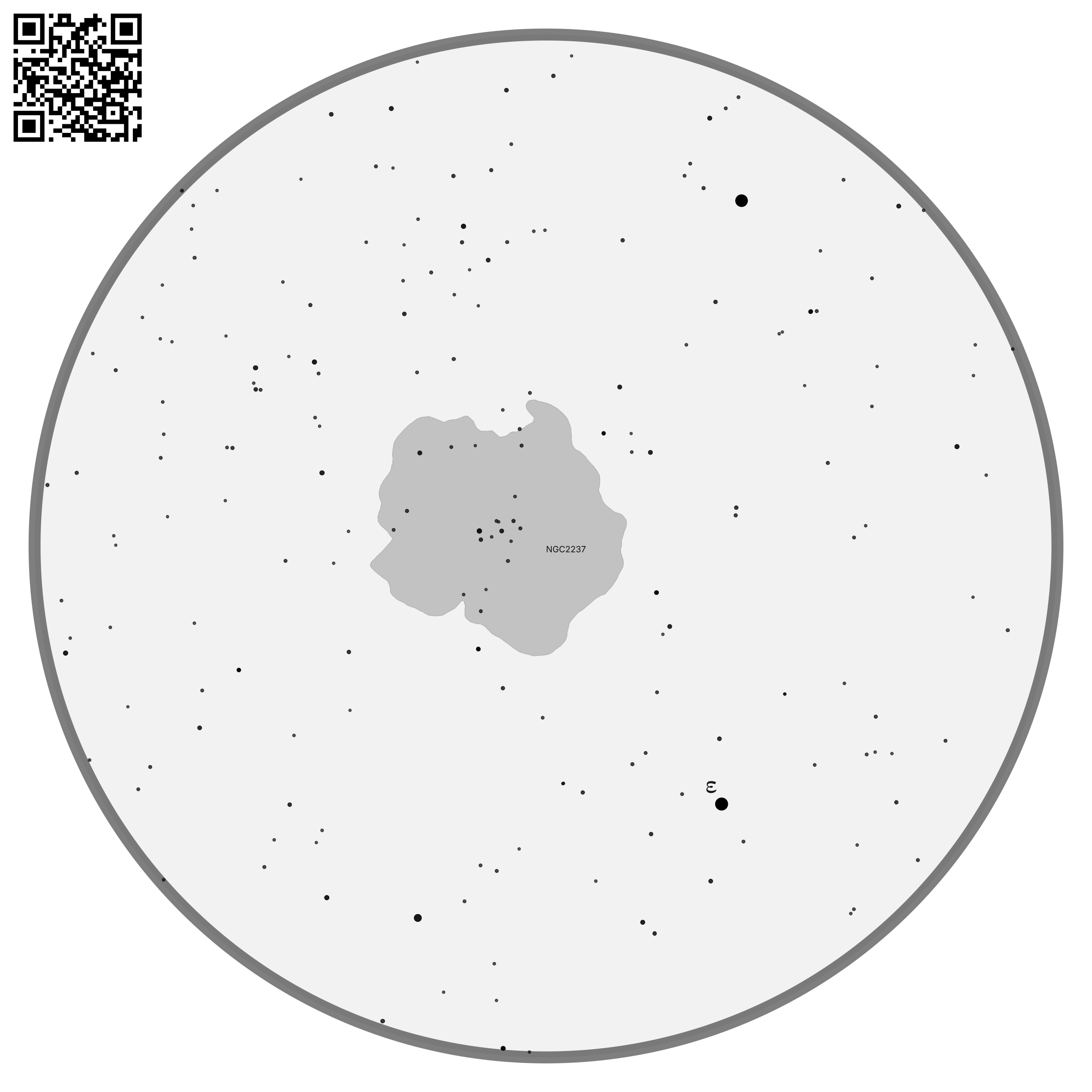
Finder scope & binocular view of Rosette Nebula
| Property | Value |
|---|---|
| Common names | Caldwell 49, Sh2-275 |
| Catalog names | NGC 2237 |
| Type | Interstellar Medium |
| Subtype | HII Region |
| Coordinates | 6h 30m 36.10s, +4° 58’ 50.60” |
| Season | December - February |
| Best month | January |
| Beginner friendly | No |
| Visual reward | Moderate |
| Filters required | UHC |
| LP tolerance | Low |
| Minimum equipment | Small telescope |
| Optimal equipment | Medium telescope |
| Magnitude | 9.0 |
| Size | 80.0 arcminutes x 50.0 arcminutes |
| Constellation | Monoceros |
Observation Notes
Naked Eye
The nebula itself is not visible. From exceptionally dark sites, a few of the brighter stars of the central cluster NGC 2244 may be seen individually, but the cluster does not appear as a nebulous patch.
Binoculars
Binoculars such as 10×50 show the central open cluster NGC 2244 as a loose grouping of bright stars. The surrounding nebulosity is not visible in binoculars.
Small Telescope
In apertures of 4–6 inches from a dark site, the nebula is difficult. With a good UHC or O-III filter, experienced observers may glimpse very faint, uneven arcs of nebulosity surrounding parts of the cluster. Without a filter, only the stars of NGC 2244 are visible.
Medium Telescope
An 8–12 inch telescope under dark, transparent skies with a nebula filter shows the nebula more reliably as broad, curved arcs and patches encircling the cluster. The impression is of large-scale structure rather than fine detail, with contrast highly dependent on sky quality.
Large Telescope
In apertures of roughly 14 inches and larger under pristine skies, the nebula becomes more extensive and easier to trace, with multiple arcs and gaps visible around the cluster. The overall ring-like form is more apparent, but internal filaments and small dark globules remain subtle or unseen visually.