Messier 107
4-8 inch Telescope • Globular Clusters Detailed
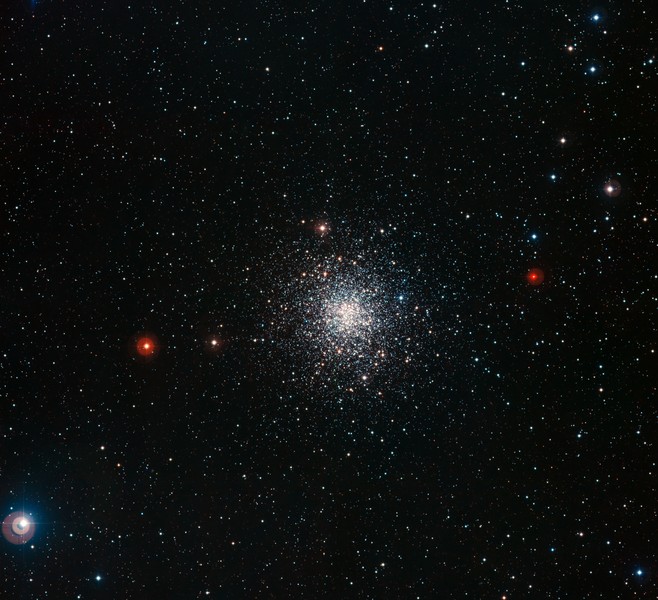
Image: ESO/ESO Imaging Survey
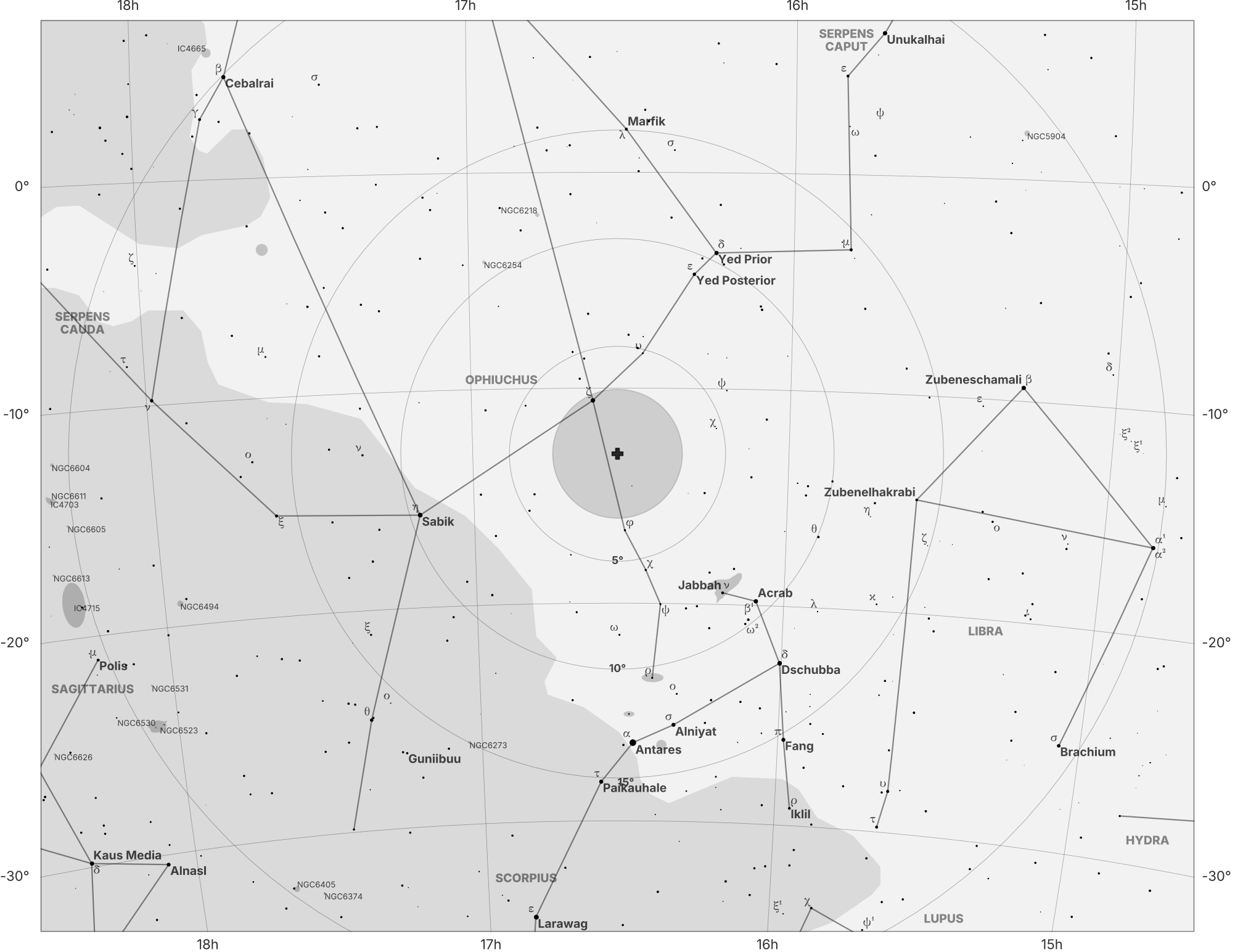
Finder map for Messier 107
Although observed by Charles Messier, NGC 6171 was not included in his published catalog and was later designated Messier 107 in the mid-20th century based on his original observations. Best viewed near meridian transit to maximize altitude and reduce atmospheric extinction. Its extremely loose structure (Shapley–Sawyer class XI) and relatively low surface brightness make it difficult to resolve in small telescopes, particularly from light-polluted skies. Visually, it can resemble a faint, loosely condensed open cluster rather than a classic, dense globular.
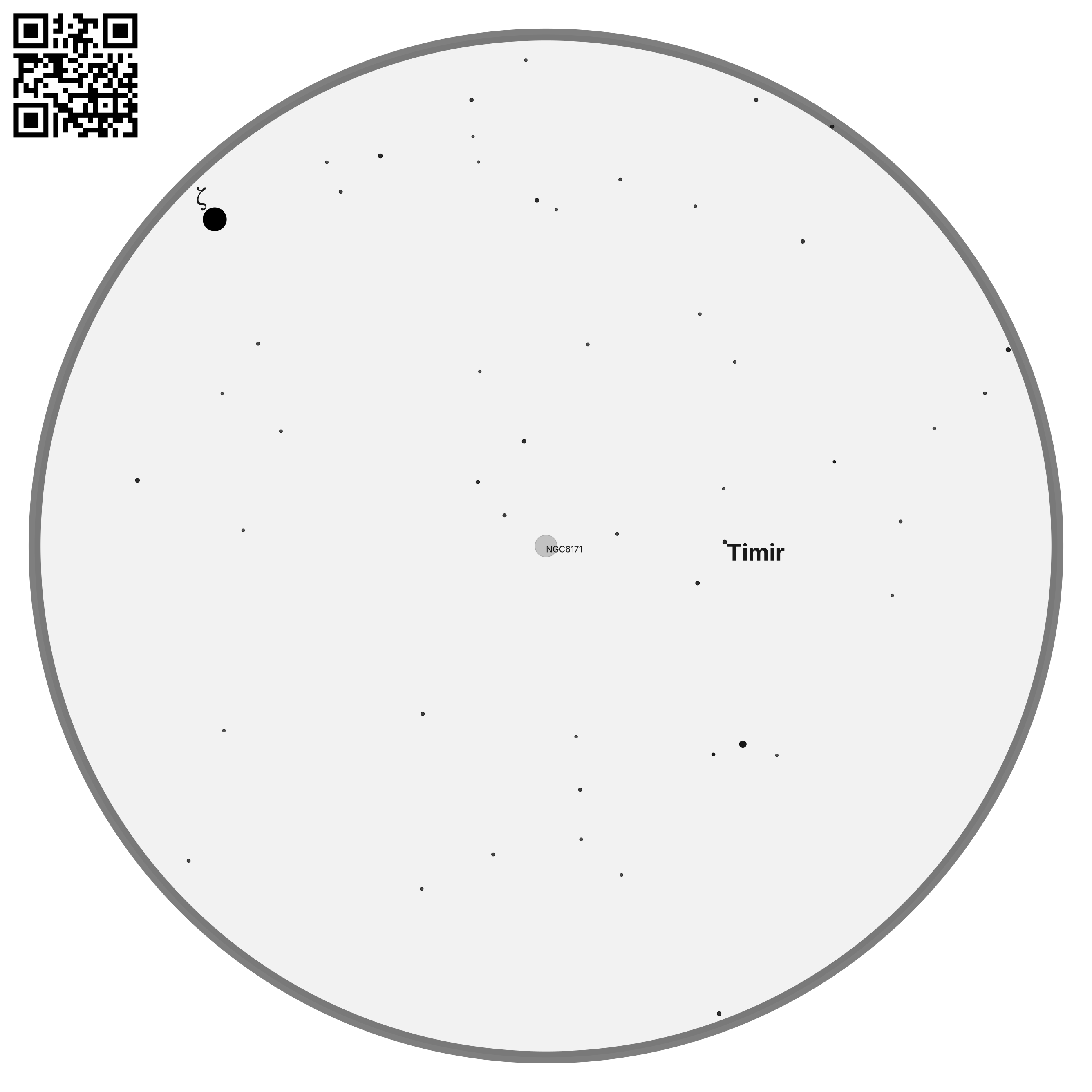
Finder scope & binocular view of Messier 107
| Property | Value |
|---|---|
| Common names | M107, NGC 6171 |
| Catalog names | M 107, NGC 6171, Mel 148 |
| Type | Stellar Cluster |
| Subtype | Globular Cluster |
| Coordinates | 16h 32m 31.86s, -13° 03’ 13.60” |
| Season | May - July |
| Best month | June |
| Beginner friendly | Marginal |
| Visual reward | Moderate |
| Filters required | None |
| LP tolerance | High |
| Minimum equipment | Small telescope |
| Optimal equipment | Medium telescope |
| Magnitude | 7.8 |
| Size | 13.0 arcminutes x 13.0 arcminutes |
| Constellation | Ophiuchus |
Observation Notes
Naked Eye
Not visible.
Binoculars
Under exceptionally dark, transparent skies, large binoculars (around 15×70 or larger) may barely show it as a very faint, small, diffuse glow; detection is difficult and not routine.
Small Telescope
In 4–6 inch apertures, appears as a dim, round patch of light with slight central brightening. The cluster remains unresolved, with no individual stars visible.
Medium Telescope
With 8–12 inches at moderate to high magnification, the cluster develops a grainy or sandy texture, and a few of the brightest outer stars may begin to resolve as faint pinpoints, emphasizing its loose structure.
Large Telescope
In apertures of roughly 14 inches and larger, a significant number of stars are resolved across the outer regions, while the core remains a dense, unresolved haze. The overall appearance is that of a sparse, low-concentration globular rather than a tightly packed cluster.