Messier 22
Binoculars • Globular Clusters
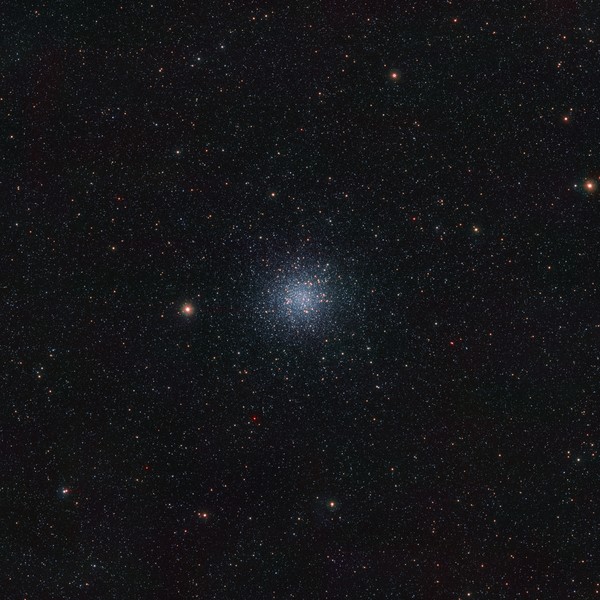
Image: ESO/VVVX survey
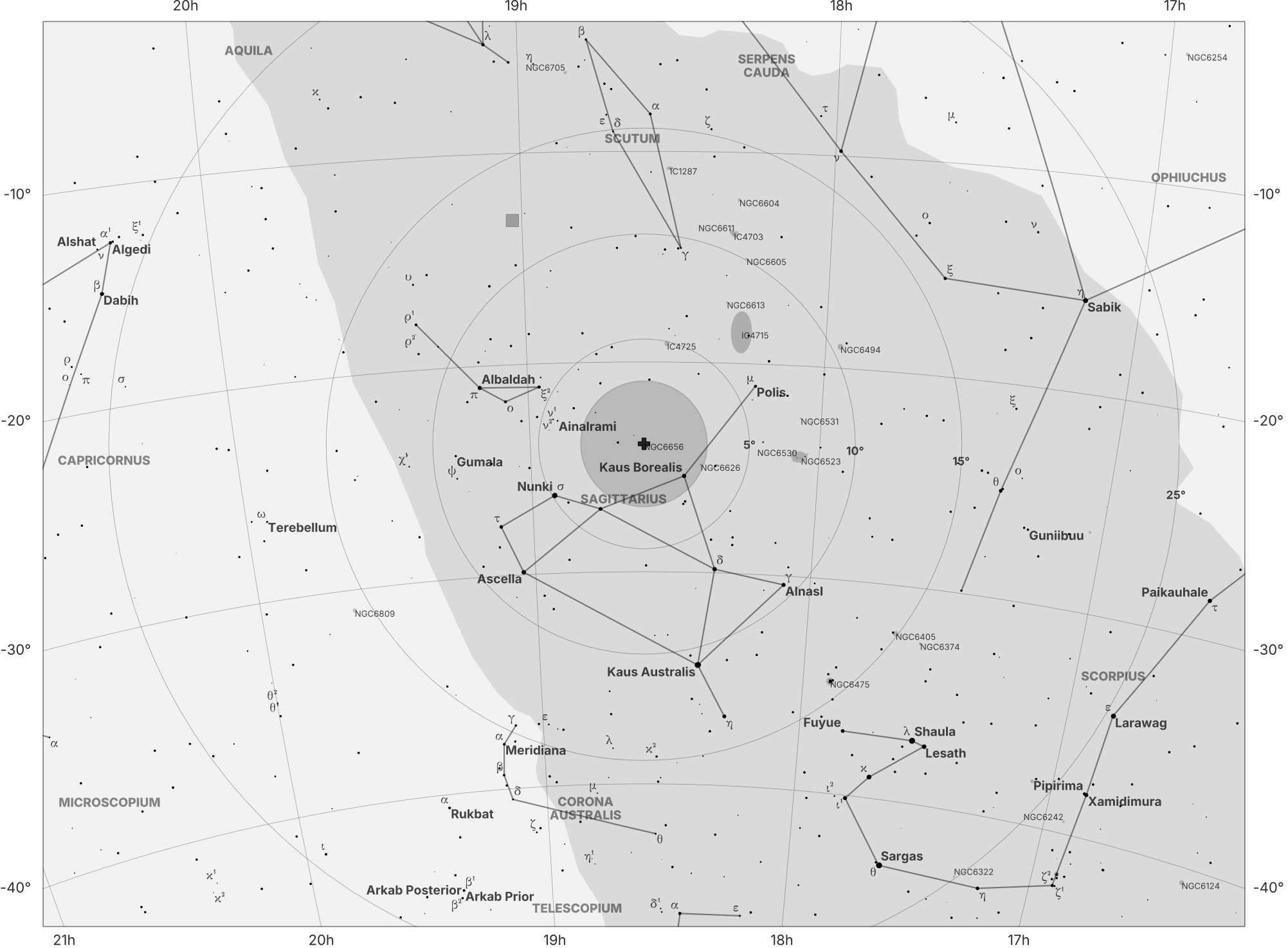
Finder map for Messier 22
One of the brightest and nearest globular clusters, making it a premier showpiece for amateur astronomers. It lies in the direction of the Sagittarius star fields near the Galactic Center, a region long central to both mythological traditions and astronomical exploration. Well-placed for southern hemisphere observers. Remains low in the southern sky for mid-to-high northern latitudes, requiring a clear southern horizon. Noticing the cluster’s granularity and slight elongation under good conditions. Fully resolving the dense core into individual stars requires moderate to large telescopes, high magnification, and steady atmospheric seeing.
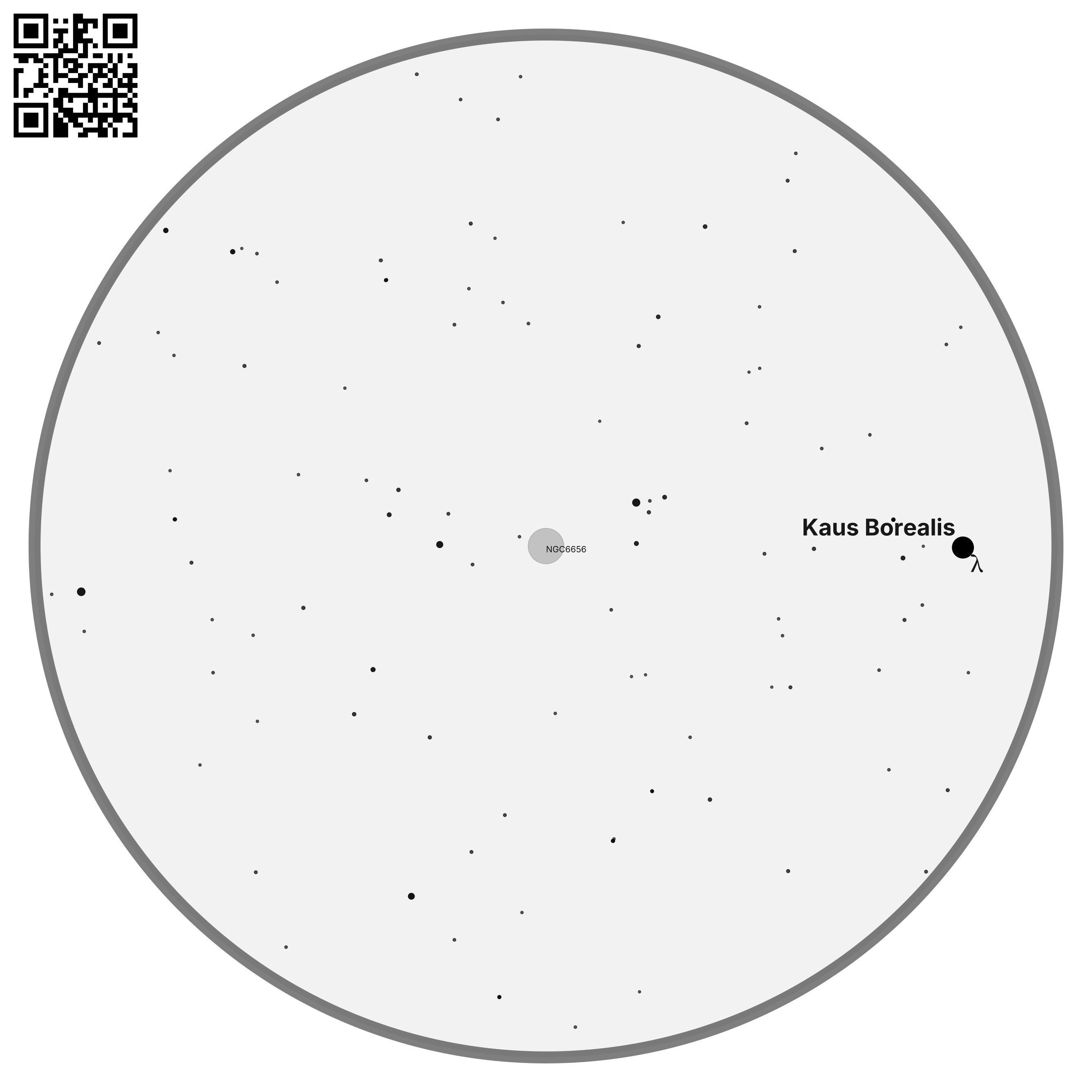
Finder scope & binocular view of Messier 22
| Property | Value |
|---|---|
| Common names | Sagittarius Cluster |
| Catalog names | M 22, NGC 6656, Mel 208 |
| Type | Stellar Cluster |
| Subtype | Globular Cluster |
| Coordinates | 18h 36m 23.94s, -23° 54’ 17.10” |
| Season | June - August |
| Best month | July |
| Beginner friendly | Yes |
| Visual reward | High |
| Filters required | None |
| LP tolerance | Medium |
| Minimum equipment | Naked eye |
| Optimal equipment | Small telescope |
| Magnitude | 5.2 |
| Size | 32.0 arcminutes x 32.0 arcminutes |
| Constellation | Sagittarius |
Observation Notes
Naked Eye
Visible to experienced observers under very dark, transparent skies (typically Bortle 1–2) as a faint, fuzzy, star-like patch set against the rich Sagittarius Milky Way.
Binoculars
Easily visible as a bright, large, circular nebulous glow with a noticeably brighter center. Clearly non-stellar, though individual stars are not resolved.
Small Telescope
Begins to resolve individual stars around the periphery, giving the cluster a grainy or salt-and-pepper appearance. The core remains a bright, concentrated glow.
Medium Telescope
Resolves large numbers of stars across much of the cluster, producing a richly textured view. Uneven star density and occasional star chains can be noticed, while the central region remains only partially resolved.
Large Telescope
Provides an exceptionally rich and three-dimensional star field, with extensive resolution and pronounced granularity throughout most of the cluster. The dense core remains intensely packed and only partially resolved rather than fully broken into individual stars.