Crux
Naked Eye • Asterisms
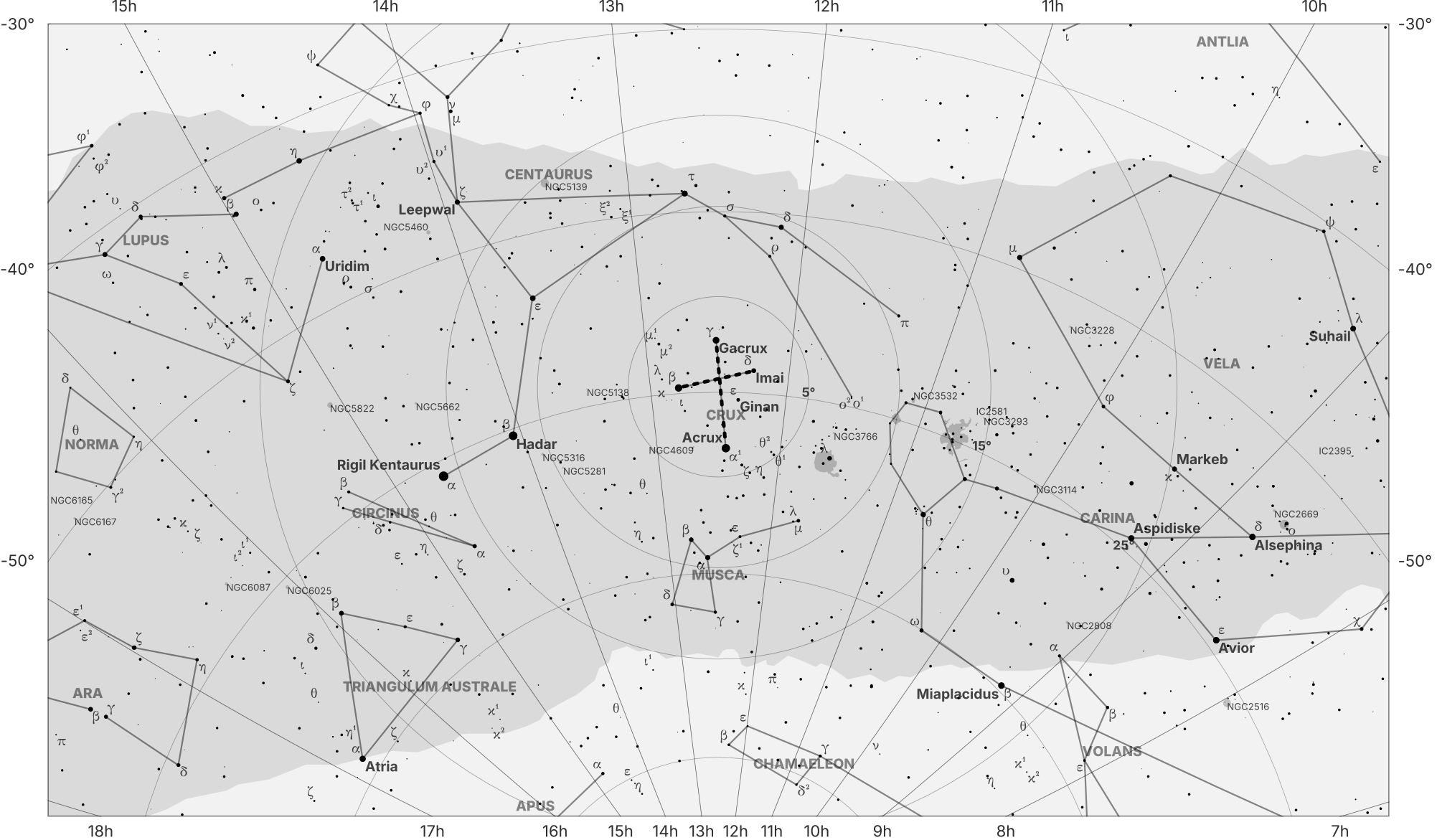
Finder map for Crux
An iconic symbol of the Southern Hemisphere, featured on the national flags of Australia, New Zealand, Brazil, Papua New Guinea, and Samoa. The Southern Cross holds deep and varied significance in numerous Indigenous traditions, where it has been associated with ancestral figures, animals, landscapes, and cosmological narratives. Visible from southern latitudes and from low northern latitudes, where it remains very low above the southern horizon and requires exceptionally clear conditions. The constellation is circumpolar for observers south of about 34° S. Under light-polluted skies, the contrast of the Coalsack Nebula can be greatly reduced or lost entirely. From low northern latitudes, the Southern Cross remains very low above the horizon, making haze and extinction the primary challenges.
| Property | Value |
|---|---|
| Common names | Southern Cross, The Cross |
| Catalog names | - |
| Type | Asterism |
| Subtype | - |
| Coordinates | 12h 30m 11.7s, -59° 41’ 38.2” |
| Season | March - May |
| Best month | April |
| Beginner friendly | Yes |
| Visual reward | High |
| Filters required | None |
| LP tolerance | High |
| Minimum equipment | Naked eye |
| Optimal equipment | Naked eye |
| Magnitude | - |
| Size | - |
| Constellation | Crux |
Observation Notes
Naked Eye
A bright, unmistakable cross-shaped asterism prominent in southern skies. The nearby “Pointer Stars” (Alpha and Beta Centauri) lead directly to it. The main stars range from Acrux (mag ~0.8) to Delta Crucis (mag ~2.8). Under dark skies, the adjacent Coalsack Nebula appears as a conspicuous dark void against the Milky Way.
Binoculars
Reveals the extraordinary richness of the surrounding Milky Way star fields. The Jewel Box Cluster (NGC 4755) begins to resolve into individual stars, with subtle color differences becoming apparent. The Coalsack appears larger and more structured, with irregular edges and embedded stars.
Small Telescope
The Jewel Box resolves into a striking open cluster with vivid color contrast among its brighter blue and orange-red members. Acrux (Alpha Crucis) can be split into its two primary components under good conditions. Numerous additional open clusters populate the surrounding fields.
Medium Telescope
Cleanly resolves the close pair of Acrux in steady seeing. The much fainter third component is extremely challenging and usually beyond reliable detection at this aperture. The Jewel Box becomes increasingly rich, and the contrast along the edges of the Coalsack is enhanced, though it remains a dark nebula rather than a luminous object.
Large Telescope
Provides deeper views of the Jewel Box and other nearby open clusters, revealing many faint members while preserving strong color contrast. The Coalsack remains a prominent silhouette, but no faint emission nebulosity is reliably visible visually; the region’s appeal lies in star fields, clusters, and dark nebulae rather than luminous gas.