False Cross
Naked Eye • Asterisms
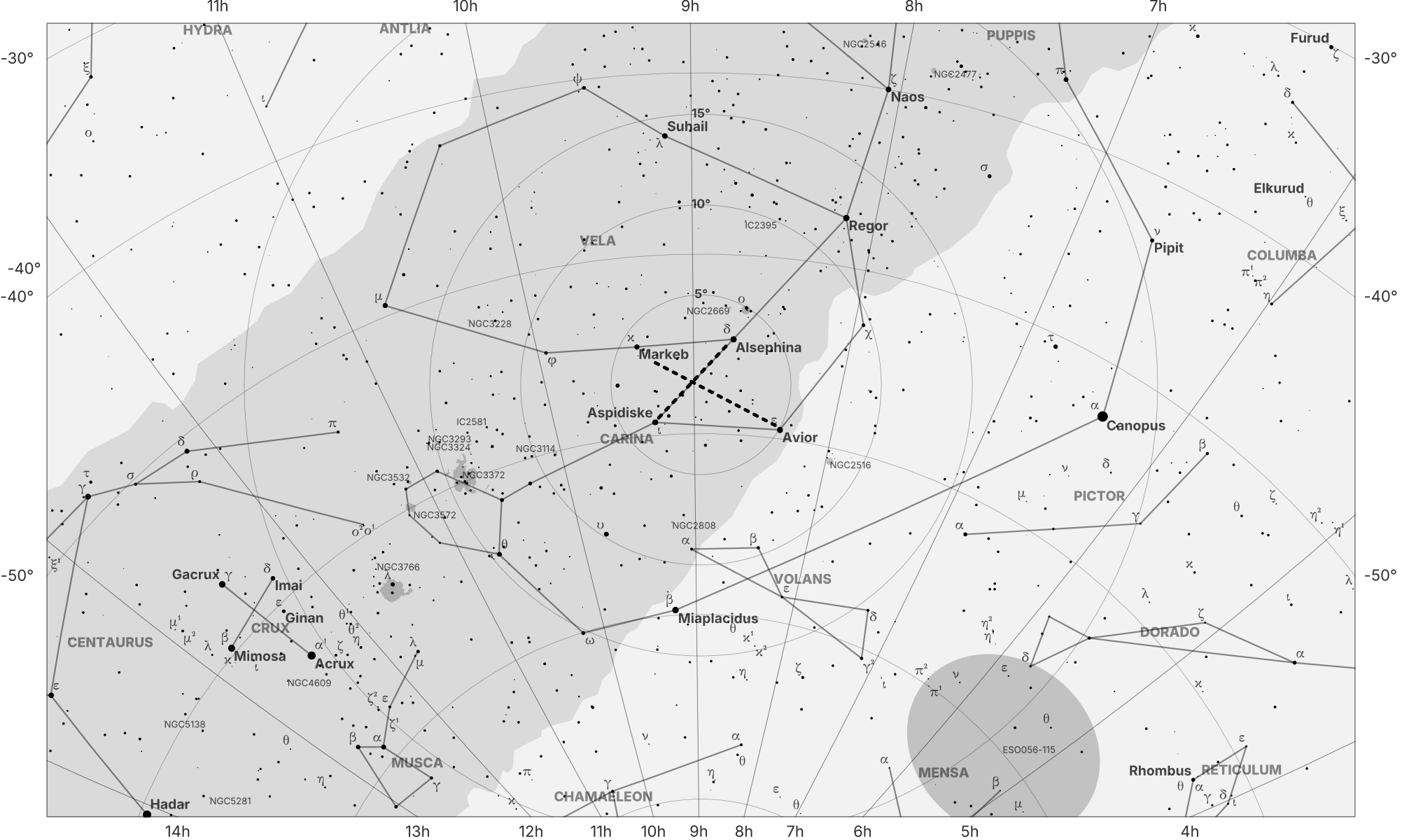
Finder map for False Cross
A well-known “false Southern Cross” in modern celestial navigation and observational lore. Unlike the true Southern Cross (Crux), it has no established mythological or cultural significance and is primarily noted as a navigational look-alike in the southern sky. Best viewed from southern latitudes, where it rises high in the sky. From low northern latitudes it remains very low above the southern horizon and is easily obscured; it is inaccessible from mid- and high-northern latitudes. The primary challenge for beginners is distinguishing it from the true Southern Cross (Crux).
| Property | Value |
|---|---|
| Common names | Diamond Cross |
| Catalog names | - |
| Type | Asterism |
| Subtype | - |
| Coordinates | 08h 57m 04.7s, -57° 16’ 23.6” |
| Season | January - March |
| Best month | February |
| Beginner friendly | Yes |
| Visual reward | High |
| Filters required | None |
| LP tolerance | Medium |
| Minimum equipment | Naked eye |
| Optimal equipment | Naked eye |
| Magnitude | - |
| Size | - |
| Constellation | Multiple |
Observation Notes
Naked Eye
Easily visible from the Southern Hemisphere as a prominent diamond-shaped pattern formed by four bright stars. Because of its shape and orientation, it is sometimes mistaken by beginners for the Southern Cross, though it is larger and lacks the distinctive short crossbar of Crux.
Binoculars
Frames the entire asterism attractively against the rich southern Milky Way. Subtle color differences among the component stars are more noticeable at this scale.
Small Telescope
Far too large to fit in a single field of view. Individual stars can be examined separately; Delta Velorum is a noteworthy multiple star system, though resolving its components depends on aperture and seeing.
Medium Telescope
Allows cleaner separation of Delta Velorum’s brighter components under good conditions. Primarily useful for studying individual stars and the surrounding dense star fields rather than for any nebulous detail.
Large Telescope
Not suitable for viewing the asterism as a whole. Best used for detailed study of the individual stars or for observing unrelated deep-sky objects in the surrounding fields.