Northern Cross
Naked Eye • Asterisms
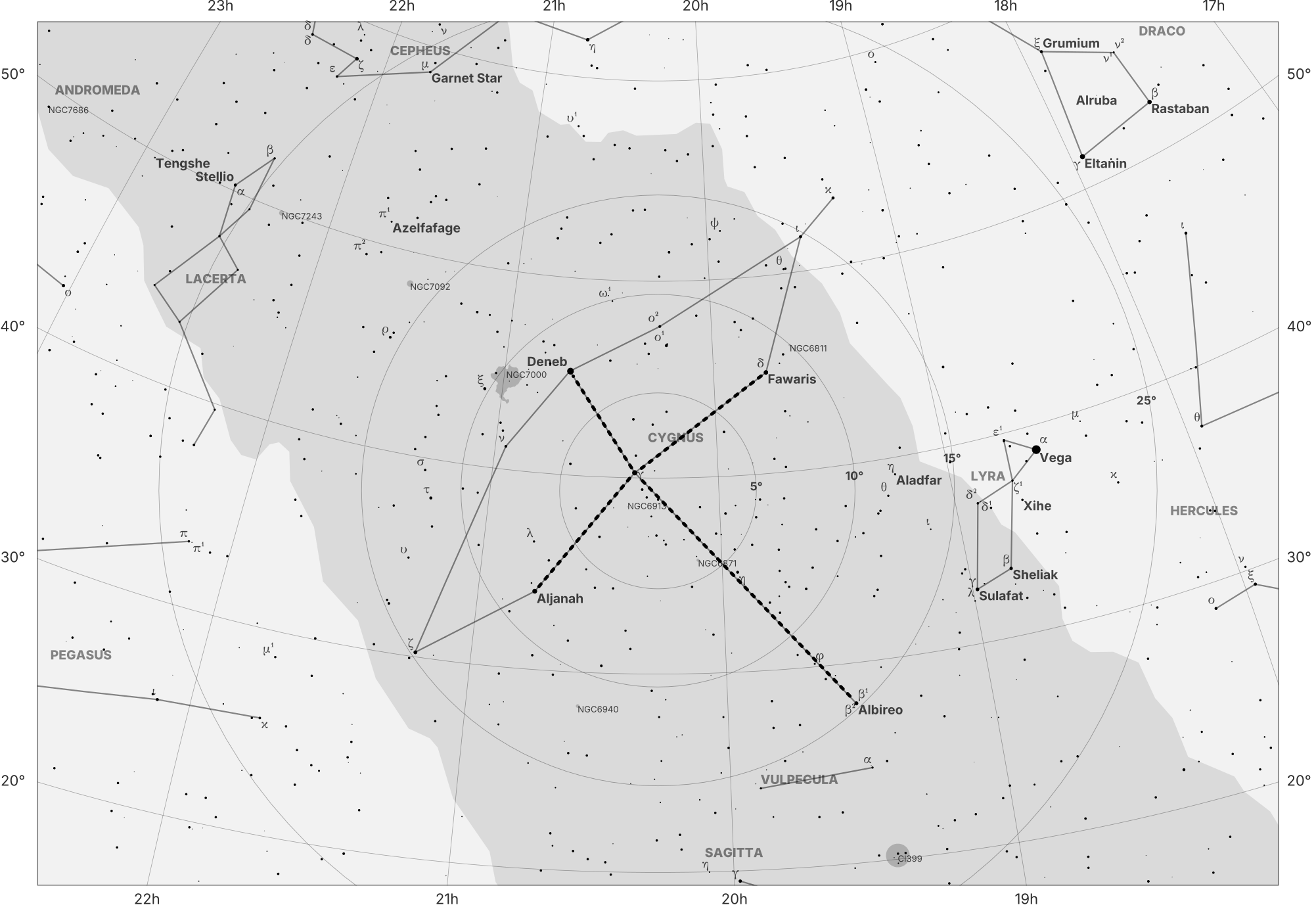
Finder map for Northern Cross
The Northern Cross is formed from the brightest stars of the constellation Cygnus, which in Greek mythology represents the swan associated with Zeus. As an asterism, the Northern Cross itself has no independent mythological significance. Best viewed when high overhead. For mid-northern latitudes, it is nearly zenith during late summer evenings. Distinguishing the fainter stars of the cross can be difficult under heavy light pollution. Its large angular size can also make it challenging for beginners to perceive as a single coherent pattern.
| Property | Value |
|---|---|
| Common names | Northern Cross Asterism |
| Catalog names | - |
| Type | Asterism |
| Subtype | - |
| Coordinates | 20h 16m 01.5s, +39° 20’ 25.7” |
| Season | July - September |
| Best month | August |
| Beginner friendly | Yes |
| Visual reward | High |
| Filters required | None |
| LP tolerance | High |
| Minimum equipment | Naked eye |
| Optimal equipment | Naked eye |
| Magnitude | - |
| Size | - |
| Constellation | Cygnus |
Observation Notes
Naked Eye
A prominent cross-shaped pattern dominating the Milky Way in Cygnus, best seen high overhead during summer and early autumn evenings for northern observers. Deneb marks one end of the cross and also forms a vertex of the Summer Triangle.
Binoculars
Sweeping the Northern Cross reveals one of the richest Milky Way star fields in the sky, filled with dense star clouds and dark lanes. A few loose open clusters can be detected, but most of the visual impact comes from the sheer density of stars rather than resolved clusters.
Small Telescope
Albireo is the principal highlight, resolving cleanly into a striking color-contrast double star. Around the central star Sadr, the field is extremely rich, though surrounding nebulosity is very low in surface brightness and generally not obvious without filters and dark skies.
Medium Telescope
With dark skies and appropriate nebular filters, sections of the Veil Nebula can be detected, though they remain faint and filamentary. Numerous open clusters in the Cygnus region are accessible, appearing as loose stellar groupings rather than compact clusters.
Large Telescope
Under dark conditions and with O-III or UHC filters, the Veil Nebula becomes a showpiece, revealing extensive, delicate filaments. Other nearby deep-sky objects associated with Cygnus, such as the Crescent Nebula (NGC 6888) and the Blinking Planetary Nebula (NGC 6826), can also be observed, though none form part of the asterism itself.