Sagittarius Teapot
Naked Eye • Asterisms
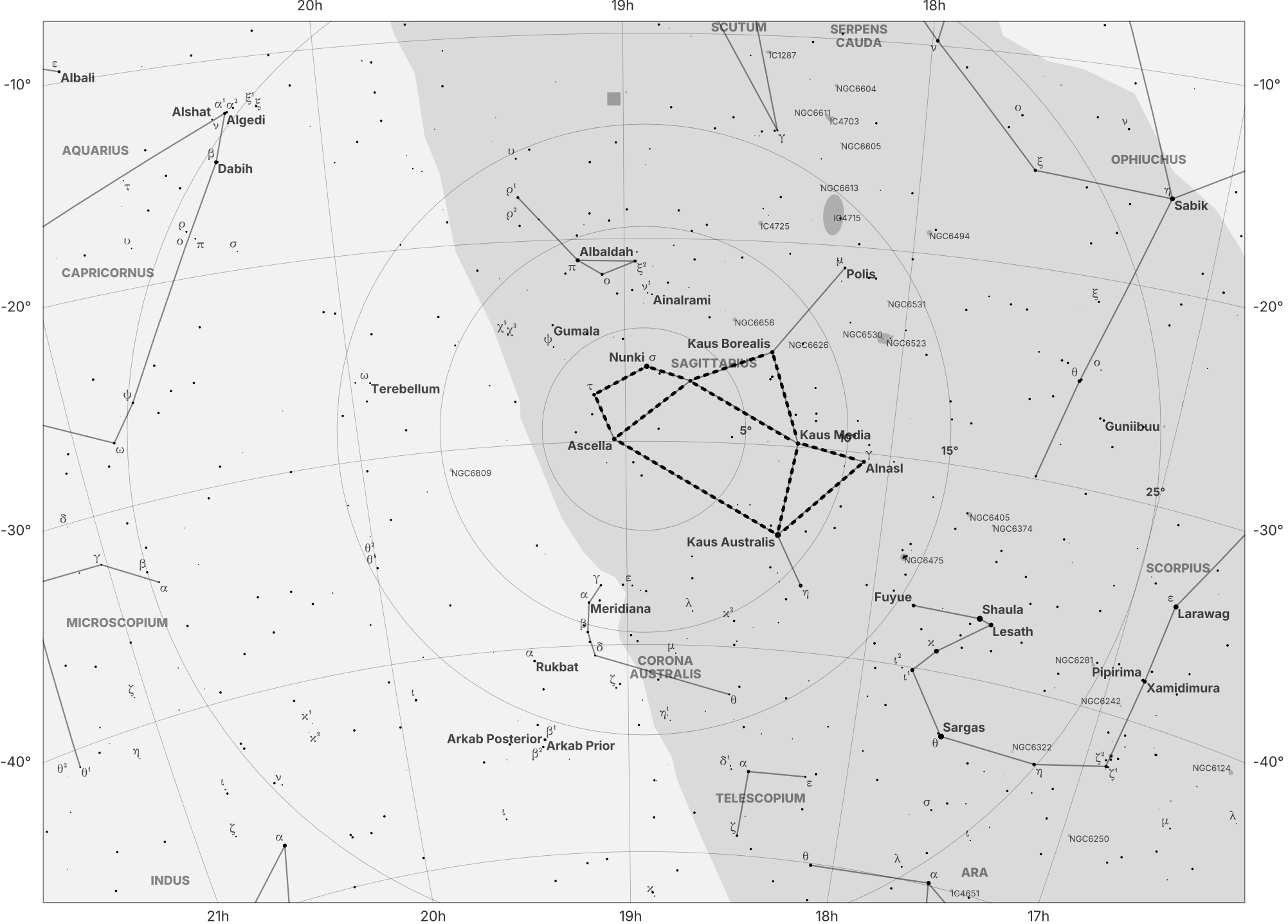
Finder map for Sagittarius Teapot
In modern amateur astronomy, the Teapot is the de facto way of identifying the constellation Sagittarius. It serves as an essential and easily recognizable guidepost to the richest region of the night sky. Best viewed from the Southern Hemisphere or southern latitudes of the Northern Hemisphere. Can be very low on the horizon from mid-northern latitudes. The Milky Way rising from the Teapot, often described as its “steam,” is highly sensitive to light pollution and can disappear entirely from urban skies. For many northern observers, the Teapot’s low altitude further reduces contrast due to atmospheric haze.
| Property | Value |
|---|---|
| Common names | The Teapot |
| Catalog names | - |
| Type | Asterism |
| Subtype | - |
| Coordinates | 18h 55m 51.9s, -29° 23’ 49.2” |
| Season | June - August |
| Best month | July |
| Beginner friendly | Yes |
| Visual reward | High |
| Filters required | None |
| LP tolerance | High |
| Minimum equipment | Naked eye |
| Optimal equipment | Naked eye |
| Magnitude | - |
| Size | - |
| Constellation | Sagittarius |
Observation Notes
Naked Eye
Visible as a distinctive teapot-shaped pattern of stars in Sagittarius, most prominent from southern latitudes and low-northern sites where it rises higher above the horizon. Kaus Australis (Epsilon Sagittarii, mag ~1.9) is the brightest star in the pattern. From a dark site, the Milky Way appears as a dense, luminous star cloud rising from the spout, a classic naked-eye Milky Way sight.
Binoculars
One of the richest binocular regions in the sky. The Milky Way star clouds are spectacular, and several bright deep-sky objects—including the Lagoon Nebula (M8), Trifid Nebula (M20), Omega Nebula (M17), and the globular cluster M22—are easily detected as bright, non-stellar patches with limited structural detail.
Small Telescope
The asterism itself is too large to fit in a single field of view. Small telescopes excel at exploring the individual objects around the Teapot, revealing nebulosity in M8 and M20 and resolving many stars in M22, though its core remains condensed.
Medium Telescope
Shows increased contrast and internal brightness variations in the brighter nebulae. Globular clusters such as M22 are well resolved into stars across much of their extent, though the central core remains dense and unresolved.
Large Telescope
Provides impressive visual views of the Sagittarius nebulae, with dark lanes and brightness variations visible in objects such as the Trifid and Lagoon Nebulae. Globular clusters are richly resolved toward the center but never fully to the core. The region remains visually overwhelming rather than sharply detailed, even in large apertures.