Summer Triangle
Naked Eye • Asterisms
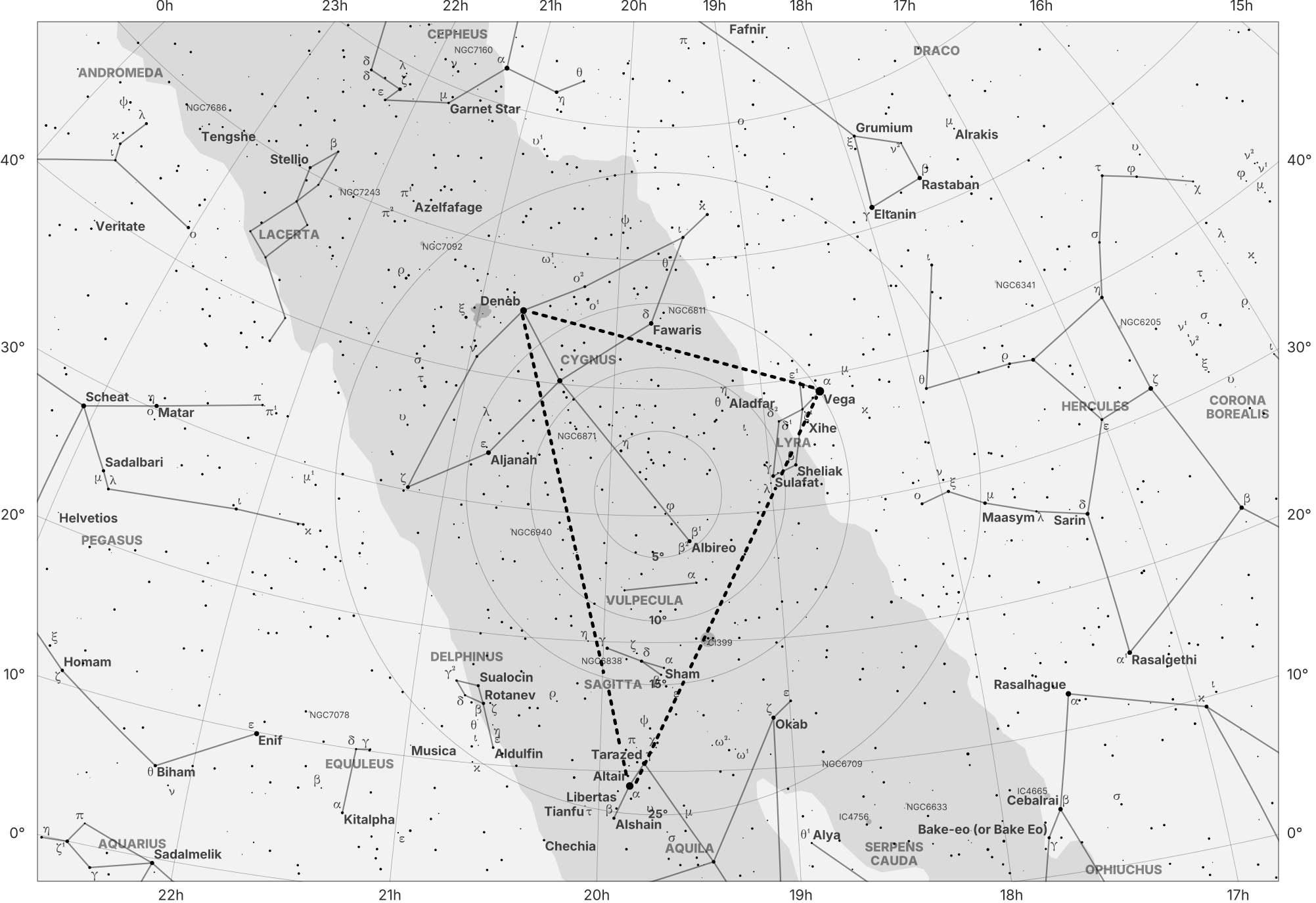
Finder map for Summer Triangle
Two of the Summer Triangle’s stars, Vega and Altair, play central roles in Chinese folklore as the Weaver Girl and the Cowherd, lovers separated by the Milky Way and reunited once a year in the story celebrated during the Qixi Festival. The Summer Triangle itself is a modern observational asterism without independent mythological significance. Best viewed when high in the sky, culminating near the zenith for mid-northern latitudes during late summer evenings. The main challenge for a novice is recognizing the large scale of the asterism and the constellations it connects.
| Property | Value |
|---|---|
| Common names | The Summer Triangle |
| Catalog names | - |
| Type | Asterism |
| Subtype | - |
| Coordinates | 19h 41m 59.0s, +31° 40’ 58.7” |
| Season | June - August |
| Best month | Mid-July |
| Beginner friendly | Yes |
| Visual reward | High |
| Filters required | None |
| LP tolerance | High |
| Minimum equipment | Naked eye |
| Optimal equipment | Naked eye |
| Magnitude | - |
| Size | - |
| Constellation | Multiple |
Observation Notes
Naked Eye
A large and prominent triangle formed by Vega, Deneb, and Altair, high in the sky during summer and early autumn evenings for northern observers. From dark sites, the Milky Way runs through the triangle, especially pronounced along the Deneb–Cygnus side.
Binoculars
Excellent for sweeping the Milky Way star clouds within and around the triangle, particularly in Cygnus. Numerous dense star fields, dark lanes, and a few loose open clusters are visible, with the emphasis on overall richness rather than sharply resolved objects.
Small Telescope
Best used for specific highlights near the triangle’s vertices. The Double-Double (Epsilon Lyrae) near Vega is a classic test object, while Albireo within the triangle provides a striking color-contrast double star.
Medium Telescope
Enables observation of well-known deep-sky objects associated with the region, such as the Ring Nebula (M57) near Vega and the Dumbbell Nebula (M27) in Vulpecula. Both appear as small but distinct planetary nebulae under dark skies.
Large Telescope
Provides more detailed visual views of planetary nebulae like M57 and M27, showing brightness variations and structure rather than photographic detail. The Summer Triangle itself remains a navigational framework; large apertures are best applied to individual targets within the surrounding Milky Way regions rather than to the asterism as a whole.