Winter Hexagon
Naked Eye • Asterisms
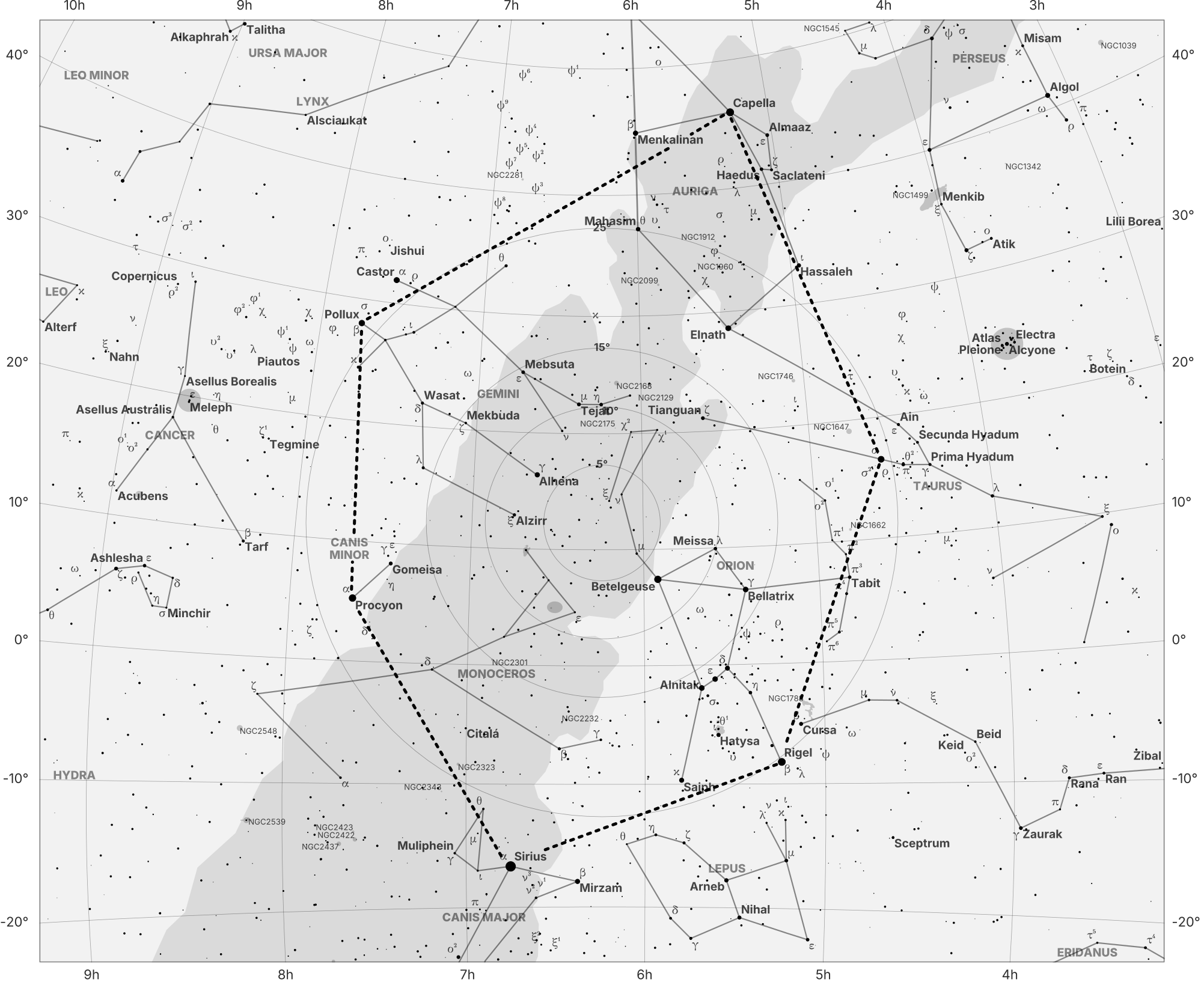
Finder map for Winter Hexagon
A modern seasonal asterism that marks the winter sky of the Northern Hemisphere. While the Winter Circle itself has no independent mythological significance, its component stars belong to constellations with deep cultural roots, including Orion the Hunter, the Heavenly Twins of Gemini, and Auriga the Charioteer. Best viewed when high in the sky, crossing the meridian. Recognizing the complete pattern from heavily light-polluted skies. The sheer size can make it difficult to take in all at once.
| Property | Value |
|---|---|
| Common names | Winter Circle |
| Catalog names | - |
| Type | Asterism |
| Subtype | - |
| Coordinates | 06h 14m 28.3s, +12° 18’ 59.8” |
| Season | December - February |
| Best month | January |
| Beginner friendly | Yes |
| Visual reward | High |
| Filters required | None |
| LP tolerance | High |
| Minimum equipment | Naked eye |
| Optimal equipment | Naked eye |
| Magnitude | - |
| Size | - |
| Constellation | Multiple |
Observation Notes
Naked Eye
A very large winter asterism formed by six bright stars—Rigel, Aldebaran, Capella, Pollux, Procyon, and Sirius—encircling much of the winter sky. It is easily recognized even from urban locations. Notable color contrasts include blue-white Rigel, orange Aldebaran, and the red supergiant Betelgeuse, which lies inside the circle rather than on its perimeter. From dark sites, portions of the Milky Way pass through the region, though not uniformly across the entire circle.
Binoculars
Excellent for sweeping the rich winter Milky Way regions contained within the circle, particularly around Orion, Auriga, and Gemini. Bright open clusters such as M35, M36, M37, and M38 are well seen, and the Orion Nebula (M42) is a standout binocular object, though many targets lie near or within the region rather than being bounded by the circle itself.
Small Telescope
Best used to explore individual deep-sky highlights within the Winter Circle’s broad area, including the Orion Nebula and the Auriga open clusters. The asterism itself is far too large to be viewed as a whole telescopically and mainly serves as a navigational framework.
Medium Telescope
Reveals a wide variety of winter deep-sky objects, including well-known nebulae and star clusters. Bright open clusters resolve easily, while larger emission nebulae require dark skies and appropriate filters to be seen at all. Most objects remain low-contrast rather than detailed.
Large Telescope
Not suited to observing the asterism itself. Large apertures are instead applied to challenging individual targets scattered across the region, such as faint galaxies or subtle nebular structures, which demand careful technique and excellent sky conditions.