Orion’s Belt
Naked Eye • Asterisms
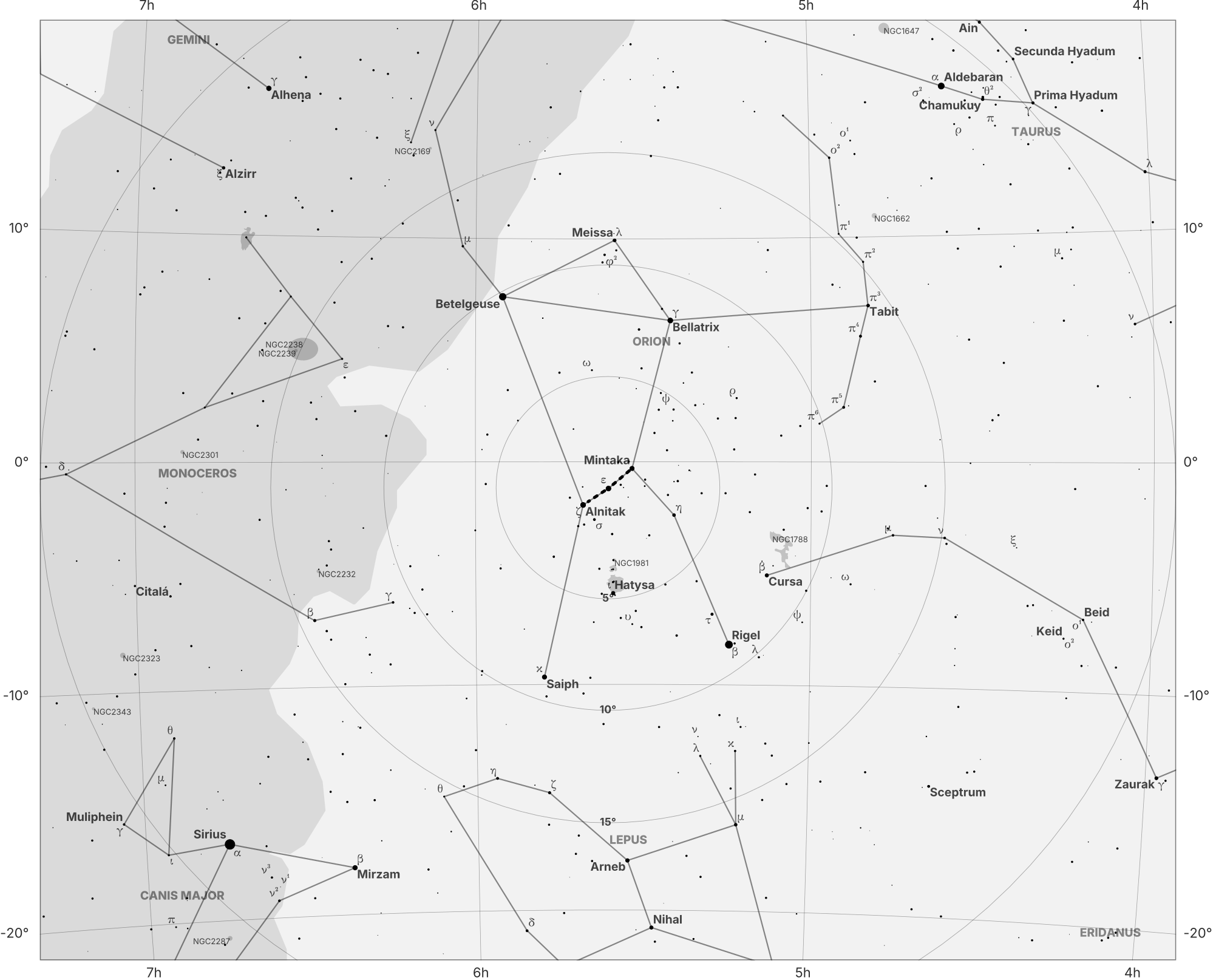
Finder map for Orion's Belt
One of the most widely recognized stellar patterns in the sky, Orion’s Belt has held significance across many cultures. In Greco-Roman mythology it forms the belt of Orion the hunter. Various folk traditions, including later Christian lore, have associated the three stars with symbolic figures, and its seasonal appearance has long served as a calendrical marker in different parts of the world. Best observed when well clear of the horizon, where its straight alignment and contrast are most easily appreciated. Nothing in particular. One of the easiest asterisms
| Property | Value |
|---|---|
| Common names | The Belt of Orion, Three Kings, Three Sisters, Jacob’s Staff |
| Catalog names | - |
| Type | Asterism |
| Subtype | - |
| Coordinates | 05h 36m 18.3s, -01° 09’ 49.2” |
| Season | November - January |
| Best month | Mid-December |
| Beginner friendly | Yes |
| Visual reward | High |
| Filters required | None |
| LP tolerance | High |
| Minimum equipment | Naked eye |
| Optimal equipment | Naked eye |
| Magnitude | - |
| Size | - |
| Constellation | Orion |
Observation Notes
Naked Eye
A strikingly straight line of three bright blue-white stars, forming one of the most recognizable patterns in the night sky and easily visible even from light-polluted urban areas.
Binoculars
Enhances the rich star fields around the Belt and the cool blue-white color of its stars. The Orion Nebula (M42), located below the Belt in Orion’s Sword, is readily visible as a bright, non-stellar glow but is not part of the Belt itself.
Small Telescope
The Belt stars remain brilliant and often dominate the field. Mintaka can be resolved into a wide multiple system under good conditions. The Flame Nebula (NGC 2024), adjacent to Alnitak, is usually not visible in small apertures due to intense glare.
Medium Telescope
The Flame Nebula may be detected as a faint, uneven glow under dark skies with careful glare control, but shows little structure. Visual detection of the Horsehead Nebula is extremely unlikely and should not be expected at this aperture.
Large Telescope
Under very dark, transparent skies, the Flame Nebula shows distinct brightness variations and dark lanes. With a dedicated H-beta filter and excellent conditions, the Horsehead Nebula may be detected as a subtle, dark notch against IC 434, but this remains a difficult and highly conditional visual observation.