Great Square of Pegasus
Naked Eye • Asterisms
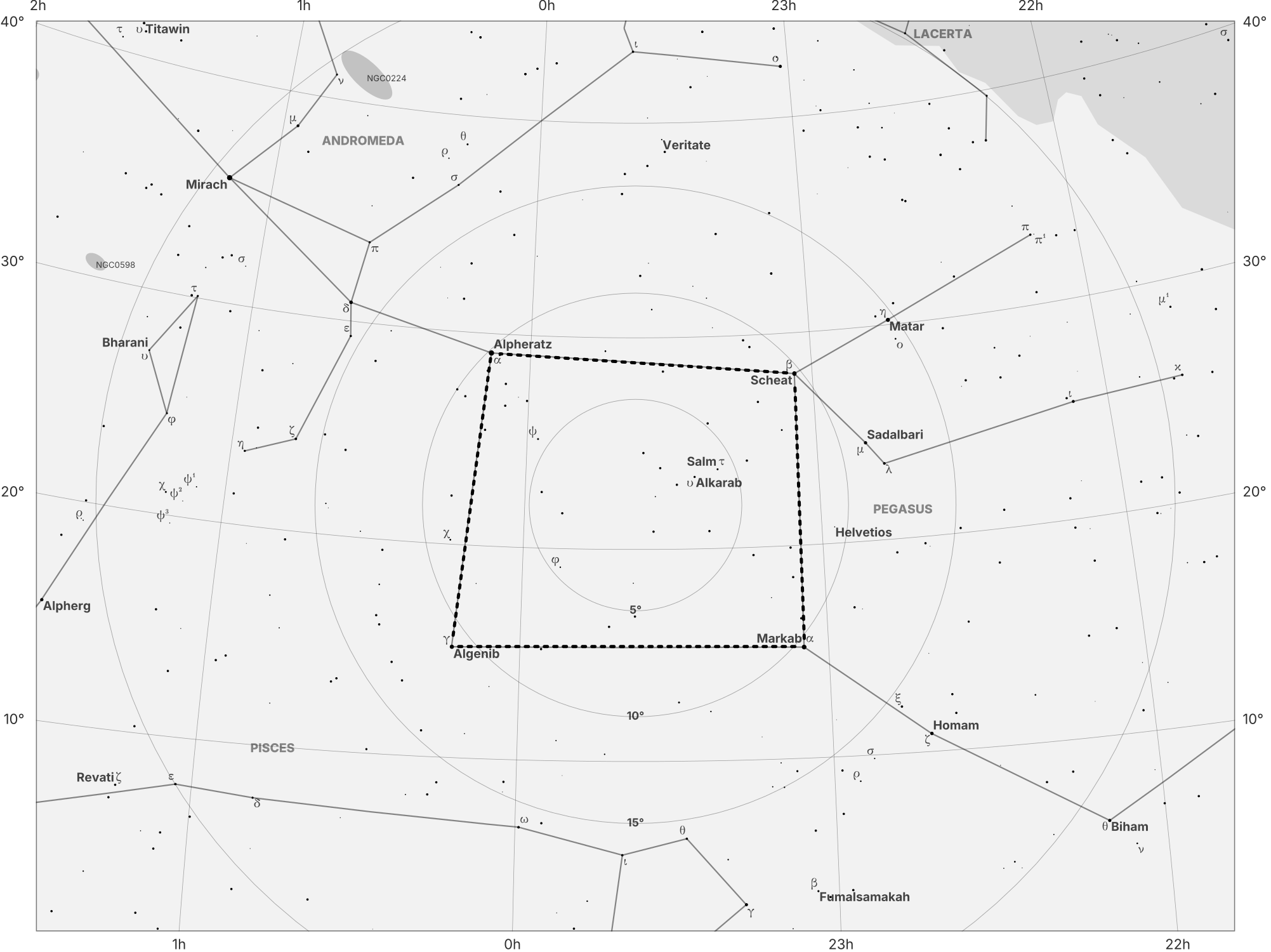
Finder map for Great Square of Pegasus
A major naked-eye landmark of the Northern Hemisphere autumn sky. In Greek tradition, the stars of the Square form a prominent part of the constellation Pegasus, with one corner star historically shared with Andromeda. Best viewed when high in the sky to minimize atmospheric distortion and fully appreciate its large scale. Its very large angular size can make it difficult for beginners to perceive as a single coherent pattern. Appreciating its true scale on the sky is the primary challenge.
| Property | Value |
|---|---|
| Common names | The Square of Pegasus |
| Catalog names | - |
| Type | Asterism |
| Subtype | - |
| Coordinates | 23h 37m 30.9s, +22° 06’ 02.5” |
| Season | August - October |
| Best month | Mid-September |
| Beginner friendly | Yes |
| Visual reward | High |
| Filters required | None |
| LP tolerance | High |
| Minimum equipment | Naked eye |
| Optimal equipment | Naked eye |
| Magnitude | - |
| Size | - |
| Constellation | Pegasus |
Observation Notes
Naked Eye
A very large, easily recognized square formed by four similarly bright stars. It serves as a major landmark of the autumn sky, with the relative sparsity of stars inside the square helping to define its outline.
Binoculars
Useful for sweeping the surrounding region and appreciating the scale of the asterism, though the entire square does not fit in a single binocular field. The warm reddish color of Scheat contrasts subtly with the bluer-white tones of the other corner stars.
Small Telescope
The corner stars remain brilliant, unresolved points. A small telescope is better used for exploring deep-sky objects located within or near the square’s boundaries rather than for the asterism itself.
Medium Telescope
Enables the detection of a number of faint galaxies in the general Pegasus region, appearing as small, low-contrast fuzzy patches under dark skies. The asterism primarily serves as a navigational framework rather than a telescopic target.
Large Telescope
Not used for the asterism as a whole. Instead, the Square functions as a starting point for challenging deep-sky targets in Pegasus, such as the bright spiral galaxy NGC 7331 and, farther afield, the very difficult Stephan’s Quintet, both of which demand dark skies and careful observation.