Orion’s Sword
Naked Eye • Asterisms
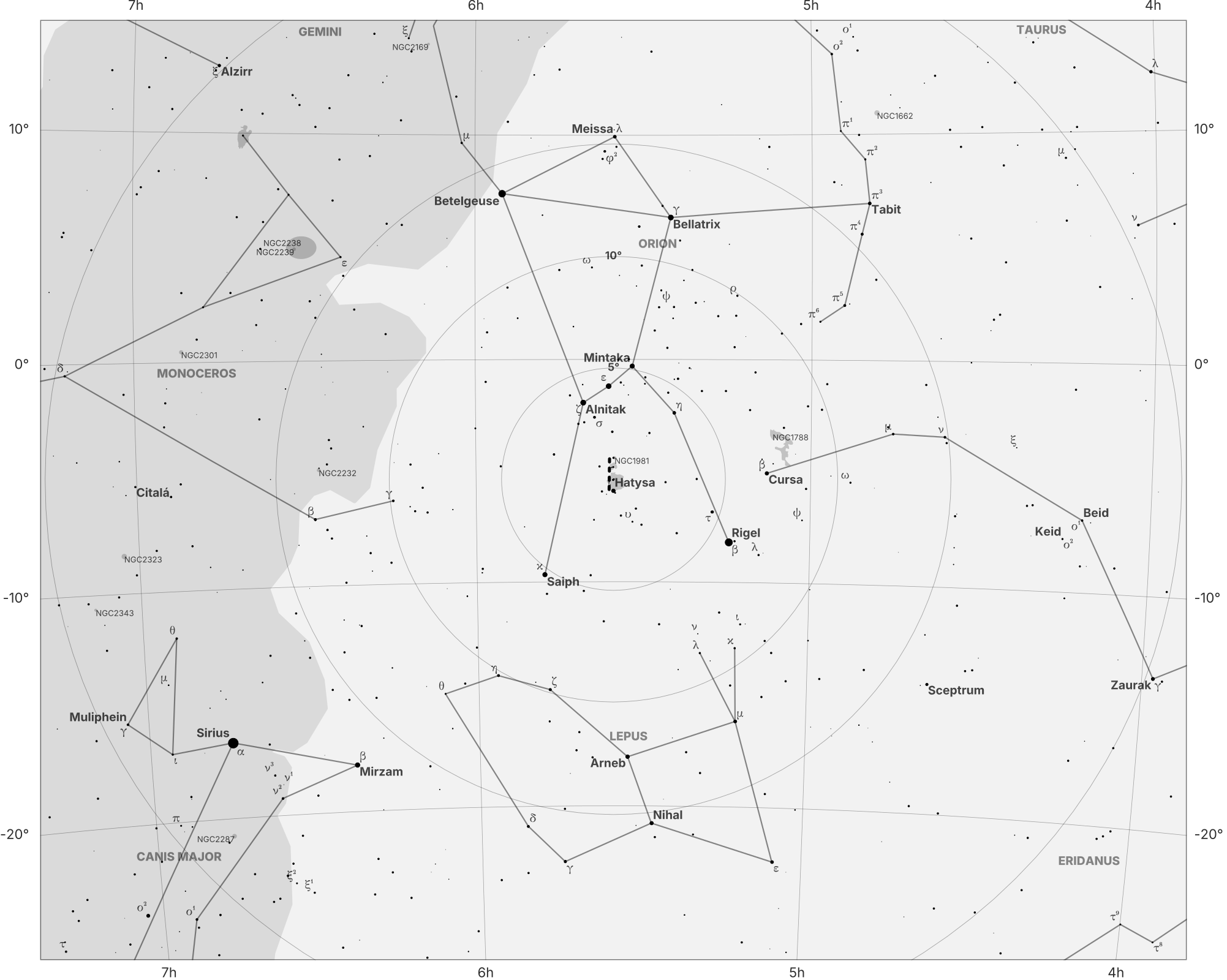
Finder map for Orion's Sword
In Greco-Roman tradition, the stars south of Orion’s Belt form the hunter’s sword or scabbard. As part of the larger Orion figure, the region has been recognized in many cultural star traditions, though the specific interpretation of the Sword itself varies or is not always distinguished. High altitude above the horizon is preferred for maximum clarity and detail, though it is easily visible even when low. Under light-polluted skies, the diffuse glow within the Sword can be muted or lost, causing the region to appear purely stellar. Under dark skies, distinguishing the Sword’s central nebulous patch from the surrounding stars is the primary naked-eye challenge.
| Property | Value |
|---|---|
| Common names | The Sword of Orion, Orion Scabbard |
| Catalog names | - |
| Type | Asterism |
| Subtype | - |
| Coordinates | 05h 35m 20.9s, -05° 23’ 04.2” |
| Season | November - January |
| Best month | Mid-December |
| Beginner friendly | Yes |
| Visual reward | Moderate |
| Filters required | None |
| LP tolerance | Medium |
| Minimum equipment | Naked eye |
| Optimal equipment | Naked eye |
| Magnitude | - |
| Size | - |
| Constellation | Orion |
Observation Notes
Naked Eye
Visible as a short line of stars hanging below Orion’s Belt, with the central region appearing as a slightly fuzzy or non-stellar patch corresponding to the Orion Nebula (M42/M43).
Binoculars
Clearly reveals the central Sword region as a bright patch of nebulosity. The main nebula shows an obvious brightness gradient and general fan-like outline, with a few embedded stars visible.
Small Telescope
Resolves the Trapezium as four bright stars at the heart of M42. The nebula’s broad “wings” extend outward, and the nearby nebula M43 appears as a distinct, comma-shaped glow separated by a dark lane.
Medium Telescope
Under dark skies, shows increased contrast in the nebula, with dark lanes and uneven brightness becoming more apparent. A subtle greenish-gray tint may be noticed by some observers. The Running Man Nebula (NGC 1977) to the north may be detected as a faint, diffuse glow, but remains low contrast and subtle.
Large Telescope
Reveals extensive detail within M42, including pronounced brightness variations, dark lanes, and a strong sense of depth. The fainter E and F stars of the Trapezium can be resolved under steady seeing. The nebula extends farther outward, though the outermost regions remain delicate and diffuse rather than sharply defined, even with filters.