Diamond of Virgo
Naked Eye • Asterisms
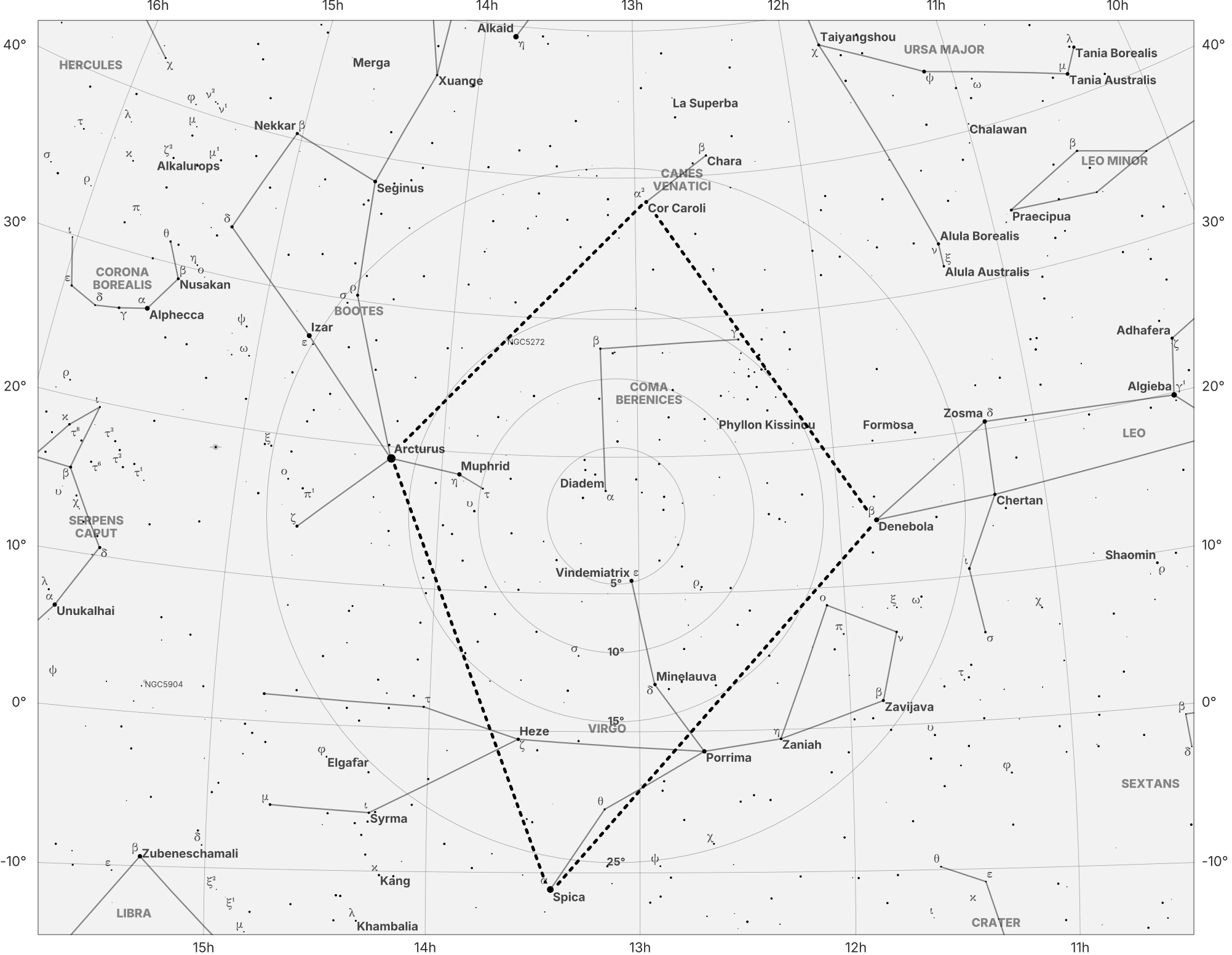
Finder map for Diamond of Virgo
A major celestial landmark of the Northern Hemisphere spring sky. The asterism frames the Virgo–Coma region often called the ‘Realm of the Galaxies’ Best viewed when high in the sky to appreciate its immense scale, well clear of horizon haze. Its sheer size can make it difficult for beginners to recognize as a single coherent pattern. While the region enclosed by the asterism contains many galaxies, observing them requires optical aid and is beyond naked-eye viewing.
| Property | Value |
|---|---|
| Common names | Virgo Diamond, Great Diamond |
| Catalog names | - |
| Type | Asterism |
| Subtype | - |
| Coordinates | 13h 06m 45.6s, +15° 42’ 44.3” |
| Season | March - May |
| Best month | Mid-April |
| Beginner friendly | Marginal |
| Visual reward | Moderate |
| Filters required | None |
| LP tolerance | High |
| Minimum equipment | Naked eye |
| Optimal equipment | Naked eye |
| Magnitude | - |
| Size | - |
| Constellation | Multiple |
Observation Notes
Naked Eye
A very large spring asterism defined by bright stars including Spica and Arcturus. Its diamond-like outline is recognizable rather than striking, with a noticeable color contrast between orange Arcturus and blue-white Spica.
Binoculars
Useful for orienting within the region known as the “Realm of the Galaxies.” Under dark skies, a few of the brightest Virgo Cluster galaxies may be suspected as very faint, diffuse patches, but most remain beyond binocular reach.
Small Telescope
Serves primarily as a guide to the Virgo Cluster. Several bright galaxies such as M87, M84, and M86 are detectable as small, faint glows under dark skies, but show little detail.
Medium Telescope
Reveals a rich galaxy field. Many Virgo Cluster members are visible as distinct patches of light, and the general arrangement of Markarian’s Chain becomes apparent, though individual galaxies remain low-contrast and largely featureless.
Large Telescope
Shows a dense concentration of Virgo Cluster galaxies, with numerous members detectable across the field. Markarian’s Chain is clearly traced as a curved sequence of galaxies, but internal structure remains subtle. Photographic features such as the jet of M87 are not visible visually.