NGC 4565
4-8 inch Telescope • Galaxies Structural
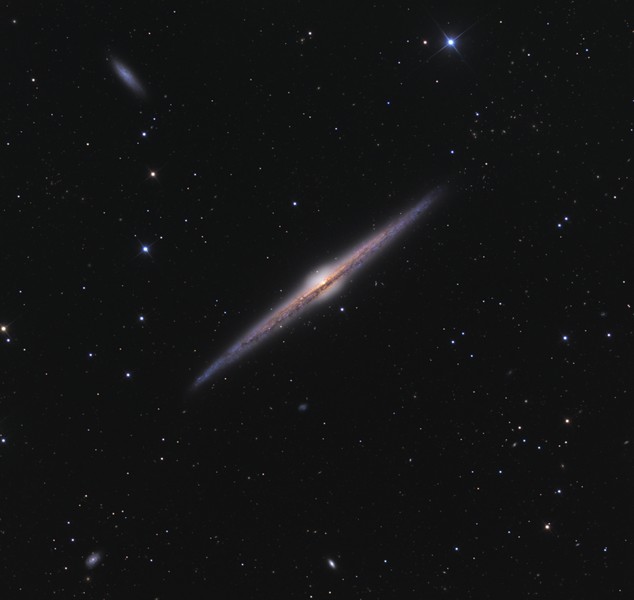
Image: Ken Crawford
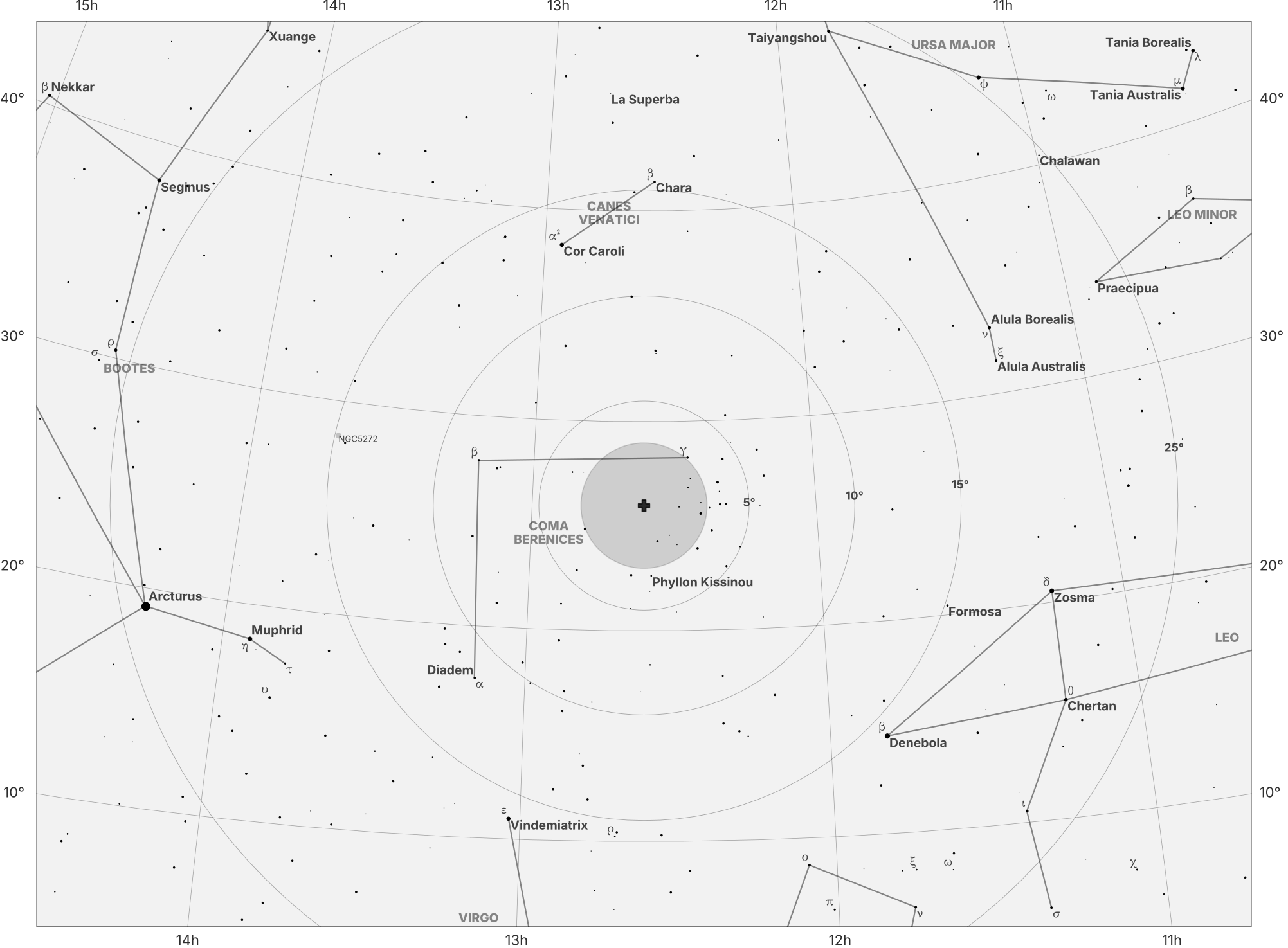
Finder map for NGC 4565
An iconic and celebrated object in amateur astronomy, often cited as one of the finest and most striking examples of an edge-on galaxy in the night sky. It is a frequent target for both visual observers and astrophotographers. Best observed when high in the sky to reduce atmospheric extinction and maximize contrast, which is important for detecting the galaxy’s dust lane. The primary challenge is detecting the prominent dust lane as a dark band bisecting the galaxy, along with tracing the galaxy’s very elongated disk under dark skies. The dust lane appears as a strong contrast feature rather than a finely resolved structure in 4–8 inch telescopes.
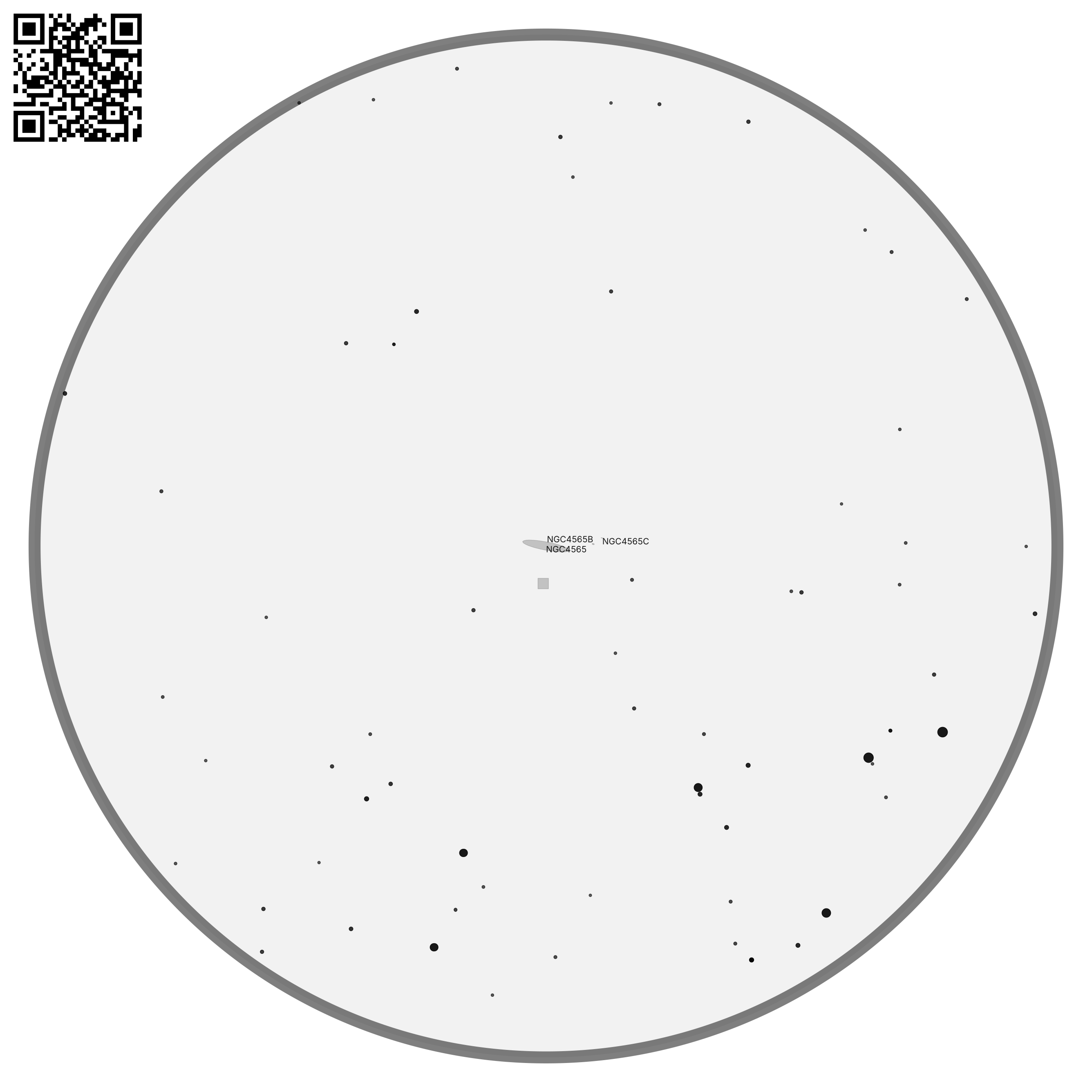
Finder scope & binocular view of NGC 4565
| Property | Value |
|---|---|
| Common names | Needle Galaxy, Caldwell 38 |
| Catalog names | C 38, NGC 4565, IC 3543, PGC 42038, UGC 7772 |
| Type | Seyfert Galaxy |
| Subtype | Seyfert 2 Galaxy |
| Coordinates | 12h 36m 20.80s, +25° 59’ 14.61” |
| Season | March - May |
| Best month | April |
| Beginner friendly | Yes |
| Visual reward | High |
| Filters required | None |
| LP tolerance | High |
| Minimum equipment | Small telescope |
| Optimal equipment | Large telescope |
| Magnitude | 9.6 |
| Size | 15.85 arcminutes x 2.14 arcminutes |
| Constellation | Coma Berenices |
Observation Notes
Naked Eye
Not visible.
Binoculars
Extremely difficult; under exceptionally dark, transparent skies it may be suspected as a very faint, tiny, elongated smudge, but detection is uncertain and not routine.
Small Telescope
In 4–6 inch apertures, appears as a faint, thin, elongated streak of light with a slightly brighter central region. The basic edge-on form is evident, but detail is minimal.
Medium Telescope
With 8–10 inches under dark skies, the striking “needle” shape stands out clearly, and the central bulge is obvious. A very subtle darkening across the bulge may be suspected with averted vision, hinting at the dust lane without clearly defining it.
Large Telescope
In apertures of roughly 14 inches and larger, the dust lane becomes a clear, continuous dark band cutting across the bright central bulge. The disk shows gentle mottling and can be traced to great length, but fine detail remains limited to contrast variations rather than distinct arm structure.