Messier 65
4-8 inch Telescope • Galaxies Structural
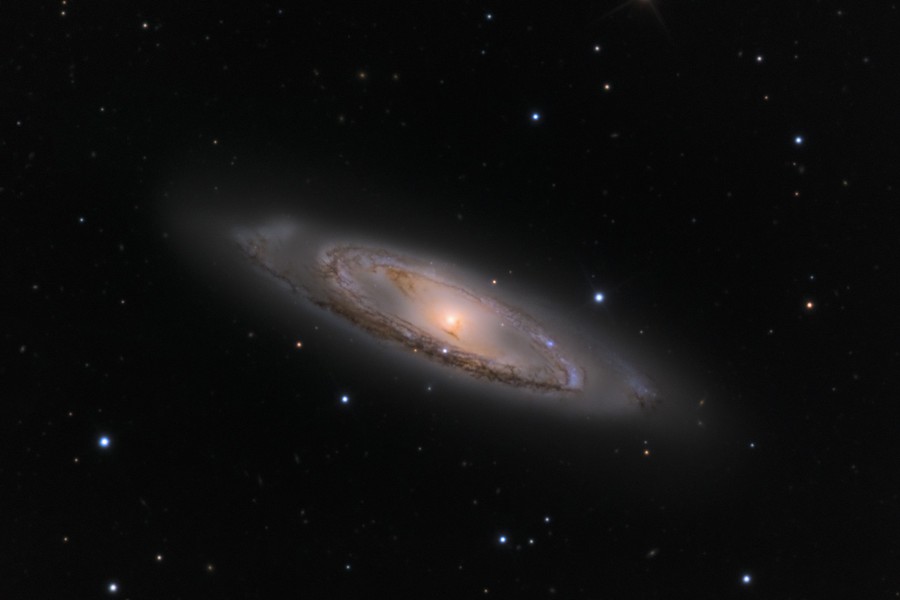
Image: Adam Block/Mount Lemmon SkyCenter/University of Arizona
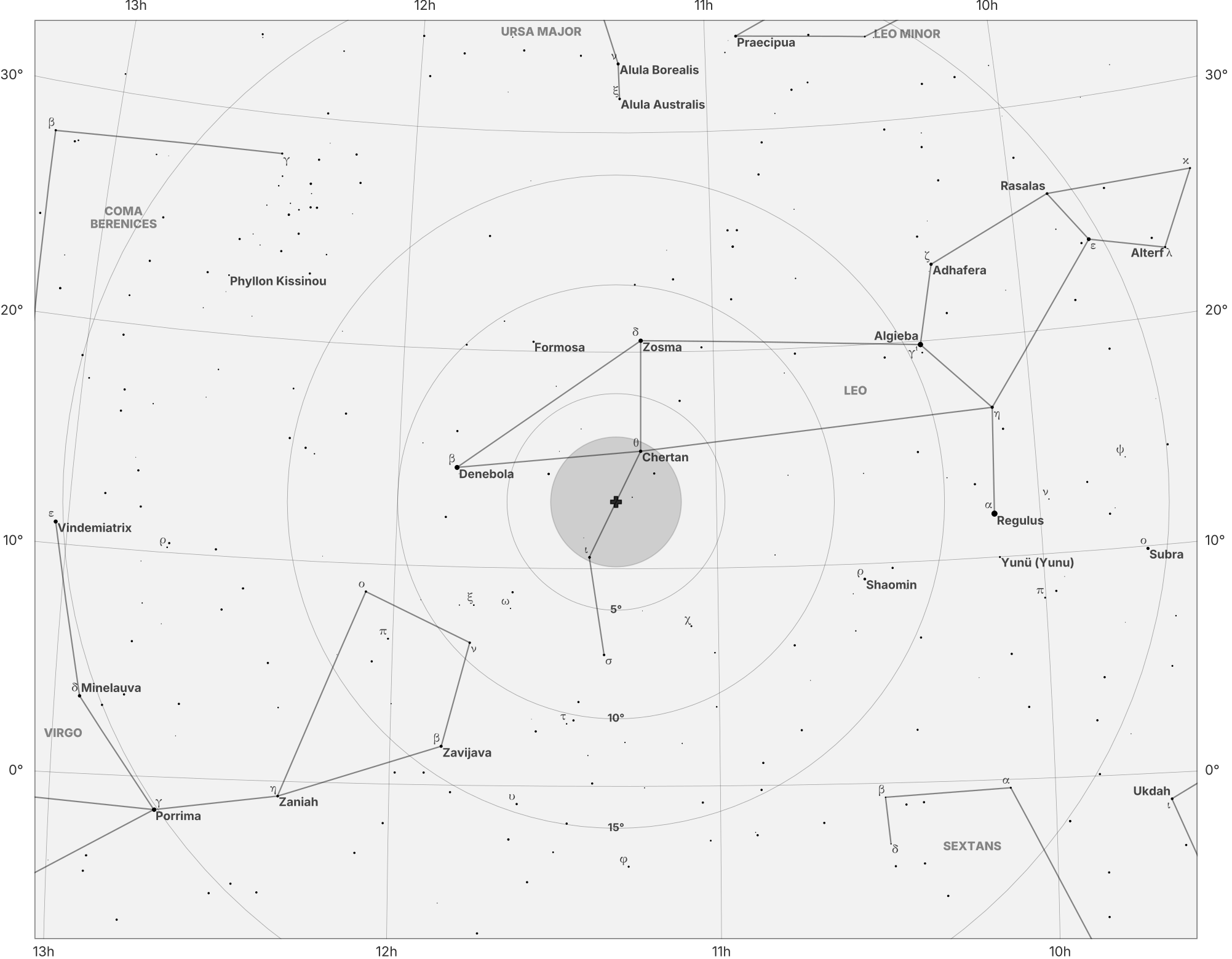
Finder map for Messier 65
A cornerstone object of the Messier Marathon and a perennial favorite for amateur astronomers worldwide due to its membership in the visually stunning Leo Triplet. Best observed when well above the horizon, ideally above about 30°, to reduce atmospheric extinction and improve contrast. In 4–8 inch telescopes, M65 appears as a bright, elongated galaxy with a concentrated core and little obvious internal detail. The dark dust lanes and subtle spiral-arm mottling visible in images and larger instruments lie beyond the visual reach of this aperture class.
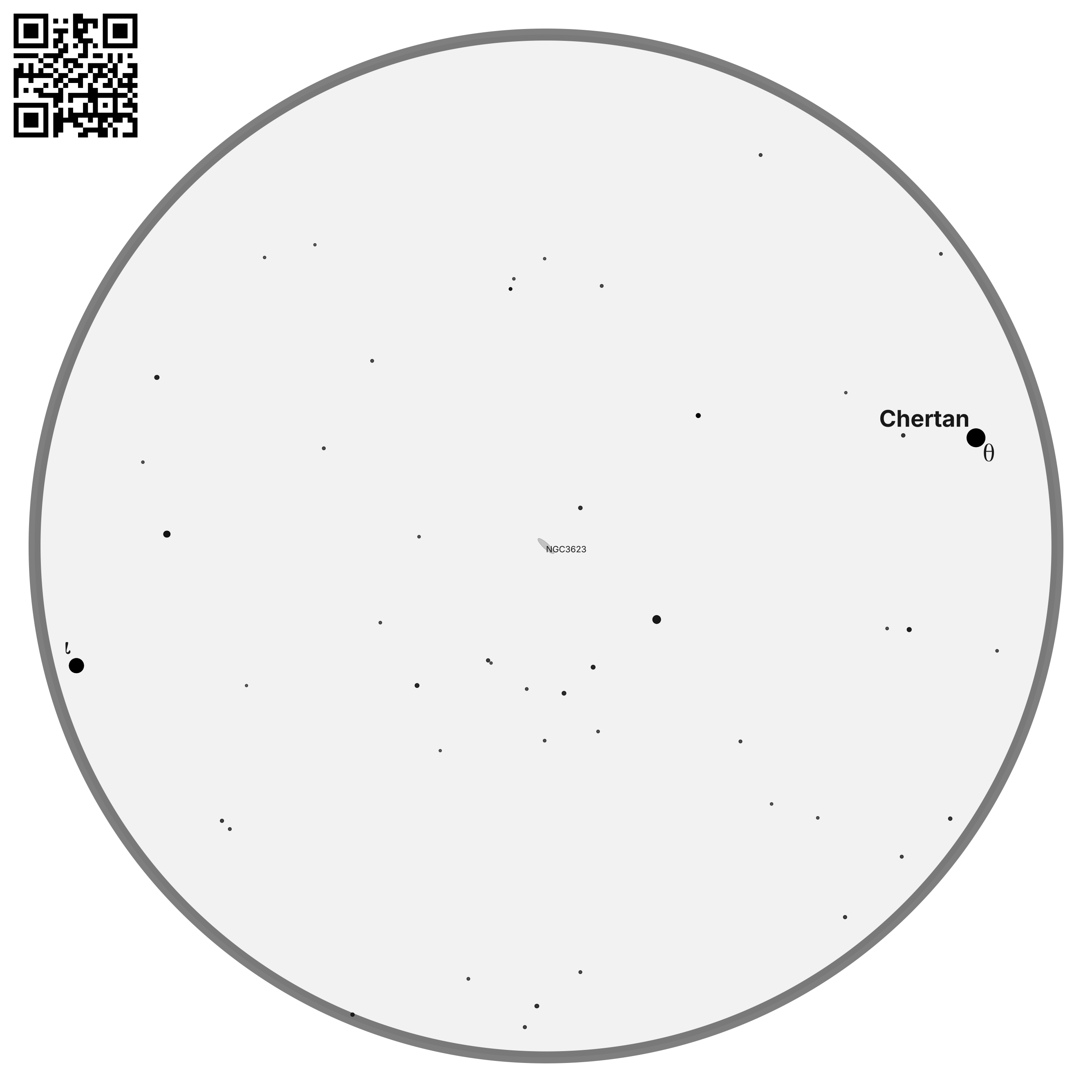
Finder scope & binocular view of Messier 65
| Property | Value |
|---|---|
| Common names | M65, Leo Triplet member |
| Catalog names | M 65, NGC 3623, PGC 34612, UGC 6328, Arp 317 |
| Type | Galaxy |
| Subtype | Galaxy in Pair |
| Coordinates | 11h 18m 55.91s, +13° 05’ 32.30” |
| Season | February - April |
| Best month | Mid-March |
| Beginner friendly | No |
| Visual reward | Low |
| Filters required | None |
| LP tolerance | Medium |
| Minimum equipment | Small telescope |
| Optimal equipment | Medium telescope |
| Magnitude | 9.3 |
| Size | 9.77 arcminutes x 2.88 arcminutes |
| Constellation | Leo |
Observation Notes
Naked Eye
Not visible.
Binoculars
Under very dark, transparent skies, M65 may be detected with 10×50 to 15×70 binoculars as an extremely faint, small, diffuse smudge; it is a difficult and non-routine binocular target.
Small Telescope
In 4–6 inch apertures, appears as a faint, elongated patch of light with little central concentration. It is often seen in the same low-power field as M66.
Medium Telescope
With 8–12 inches, the galaxy becomes a distinct oval haze with a brighter, non-stellar core. The disk remains smooth, with no obvious structural detail.
Large Telescope
In apertures of roughly 14 inches and larger under dark skies, subtle unevenness and low-contrast dust features may be suspected along the disk with averted vision; detail remains delicate and contrast-limited rather than sharply defined.