NGC 253
4-8 inch Telescope • Galaxies Structural
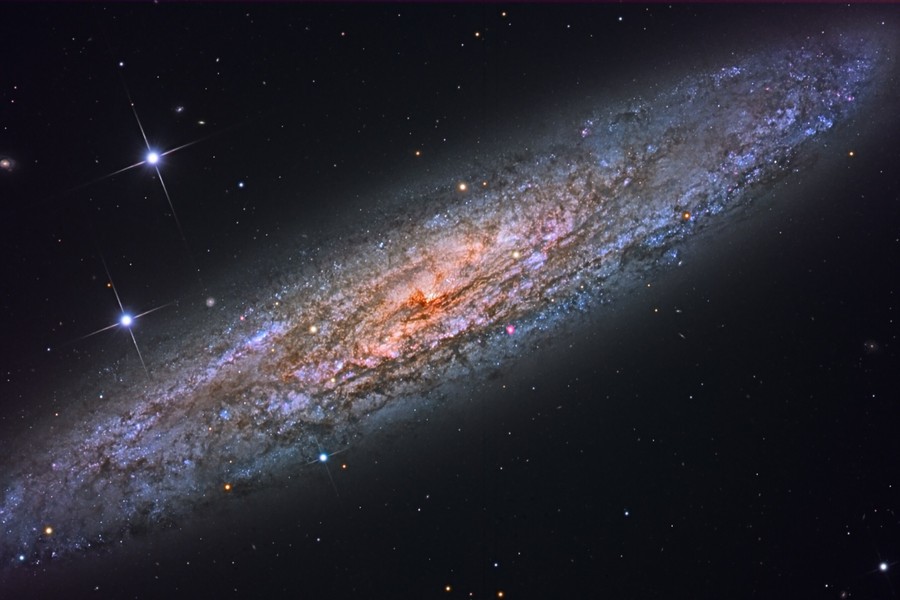
Image: SSRO/PROMPT/CTIO
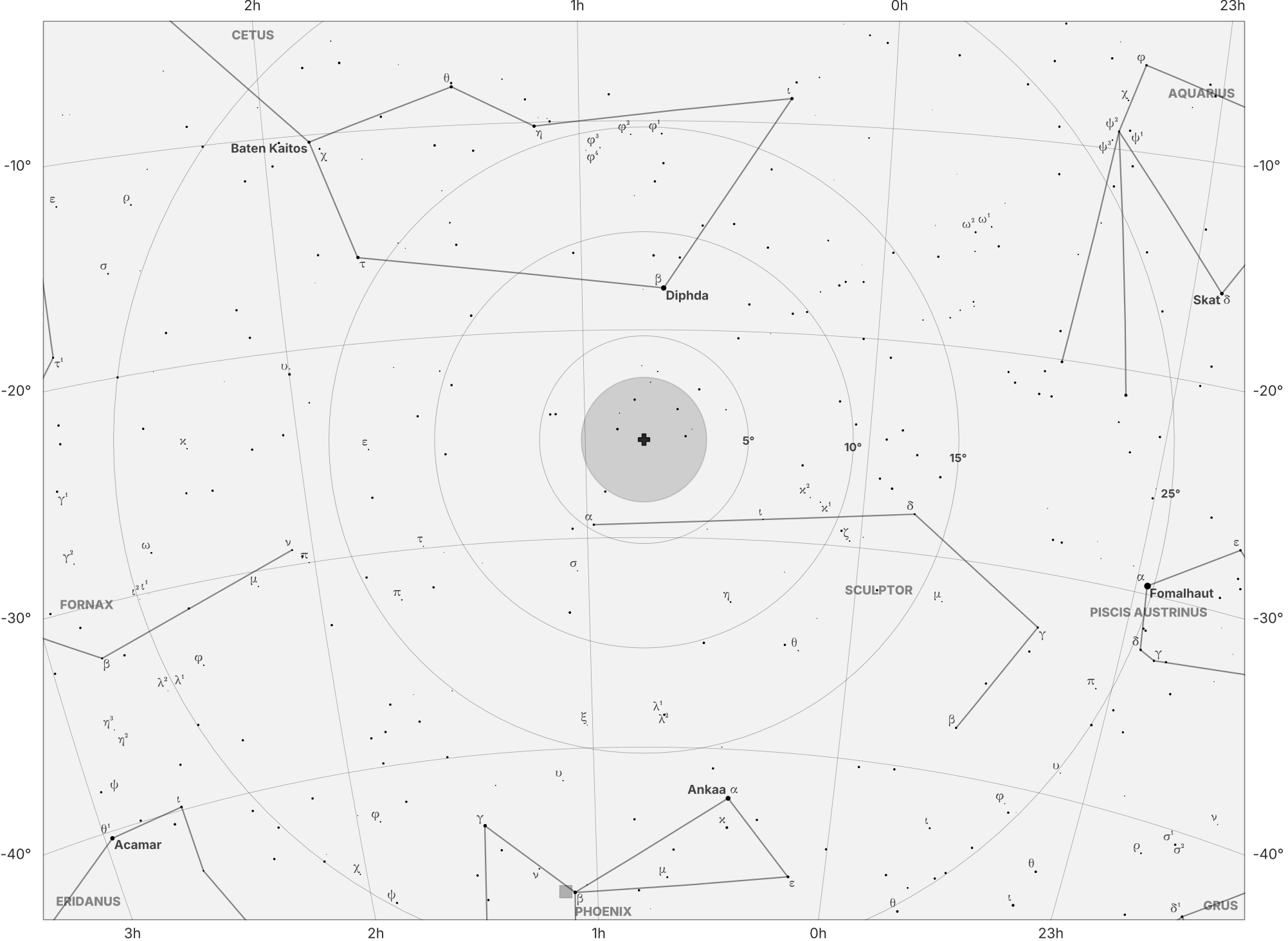
Finder map for NGC 253
One of the brightest and most prominent galaxies in the southern sky, NGC 253 is a well-known showpiece for Southern Hemisphere observers and a familiar target in amateur observing programs. Best viewed from the Southern Hemisphere where it is high in the sky. From mid-northern latitudes, it remains low above the southern horizon. In 4–8 inch telescopes, NGC 253 appears as a large, bright, elongated galaxy with pronounced mottling and uneven brightness along its disk. While this textured appearance is readily visible under dark skies, resolving individual dust lanes or H II regions lies beyond the visual reach of this aperture class.
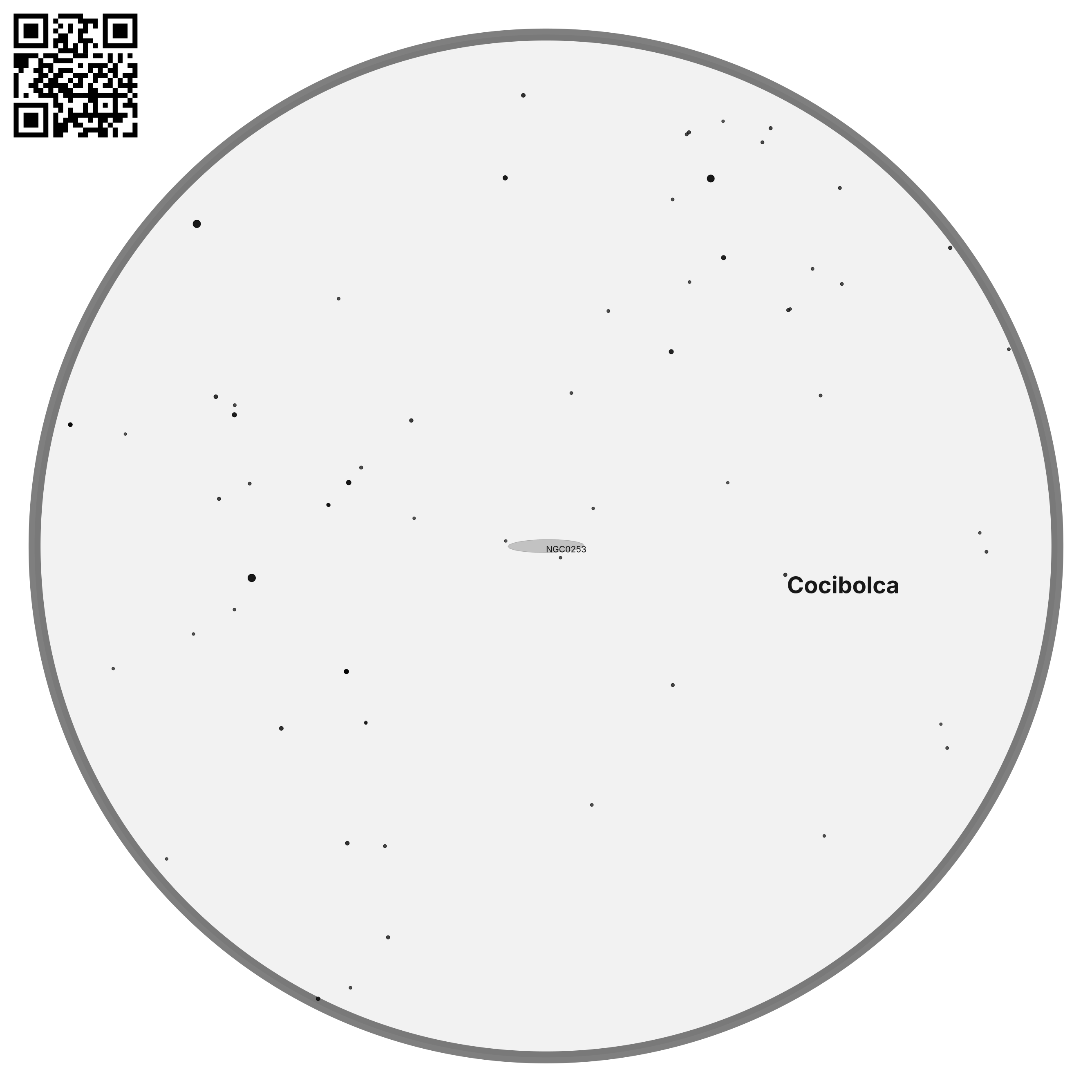
Finder scope & binocular view of NGC 253
| Property | Value |
|---|---|
| Common names | Sculptor Galaxy, Silver Coin Galaxy, Silver Dollar Galaxy |
| Catalog names | C 65, NGC 253, PGC 2789, ESO 474-29 |
| Type | Active Galactic Nucleus |
| Subtype | Seyfert Galaxy |
| Coordinates | 0h 47m 33.13s, -25° 17’ 19.68” |
| Season | September - November |
| Best month | October |
| Beginner friendly | Yes |
| Visual reward | High |
| Filters required | None |
| LP tolerance | High |
| Minimum equipment | Binoculars |
| Optimal equipment | Medium telescope |
| Magnitude | 8.0 |
| Size | 27.54 arcminutes x 6.75 arcminutes |
| Constellation | Sculptor |
Observation Notes
Naked Eye
Not visible for most observers; under exceptional southern dark-sky conditions, experienced observers may barely glimpse it as an extremely faint, elongated patch, but naked-eye detection is rare and uncertain.
Binoculars
Easily detectable from dark sites in 10×50 or larger binoculars as a large, elongated, diffuse glow with a bright central region.
Small Telescope
In 4–6 inch apertures, shows a bright, elongated central region embedded in a broad, diffuse halo. The galaxy’s overall shape is very distinct, but fine detail is limited.
Medium Telescope
With 8–12 inches under dark skies, the disk displays a mottled, uneven texture, and dark dust features become apparent as low-contrast lanes crossing the bright disk. The nucleus is bright but clearly non-stellar, and the galaxy fills a substantial portion of the field.
Large Telescope
In apertures of roughly 14 inches and larger, prominent dust lanes are clearly visible in silhouette against the bright disk, giving the galaxy a highly textured appearance. Star-forming regions appear only as subtle brightness condensations, and the core shows complex contrast variations rather than sharply defined structure.