NGC 3628
4-8 inch Telescope • Galaxies Structural
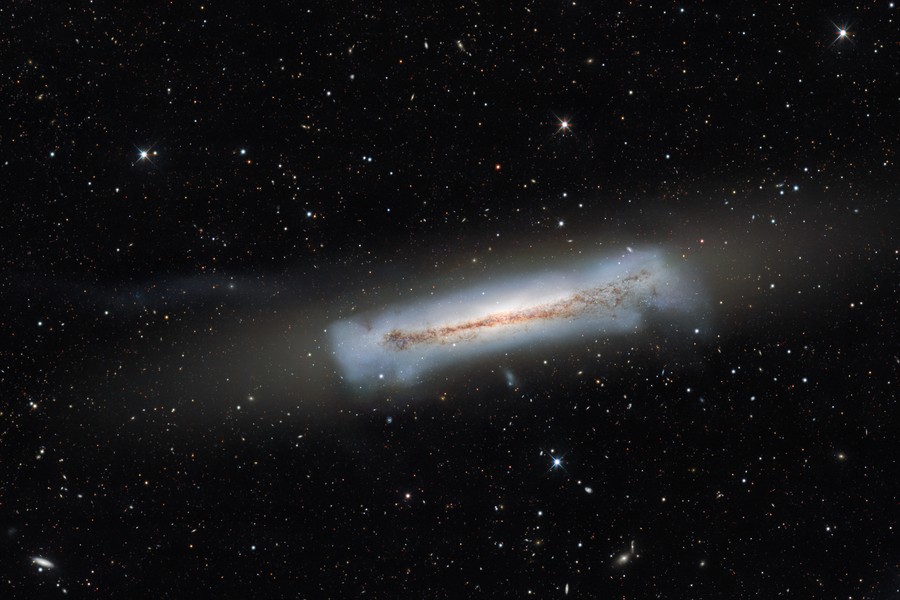
Image: CTIO/NOIRLab/DOE/NSF/AURA
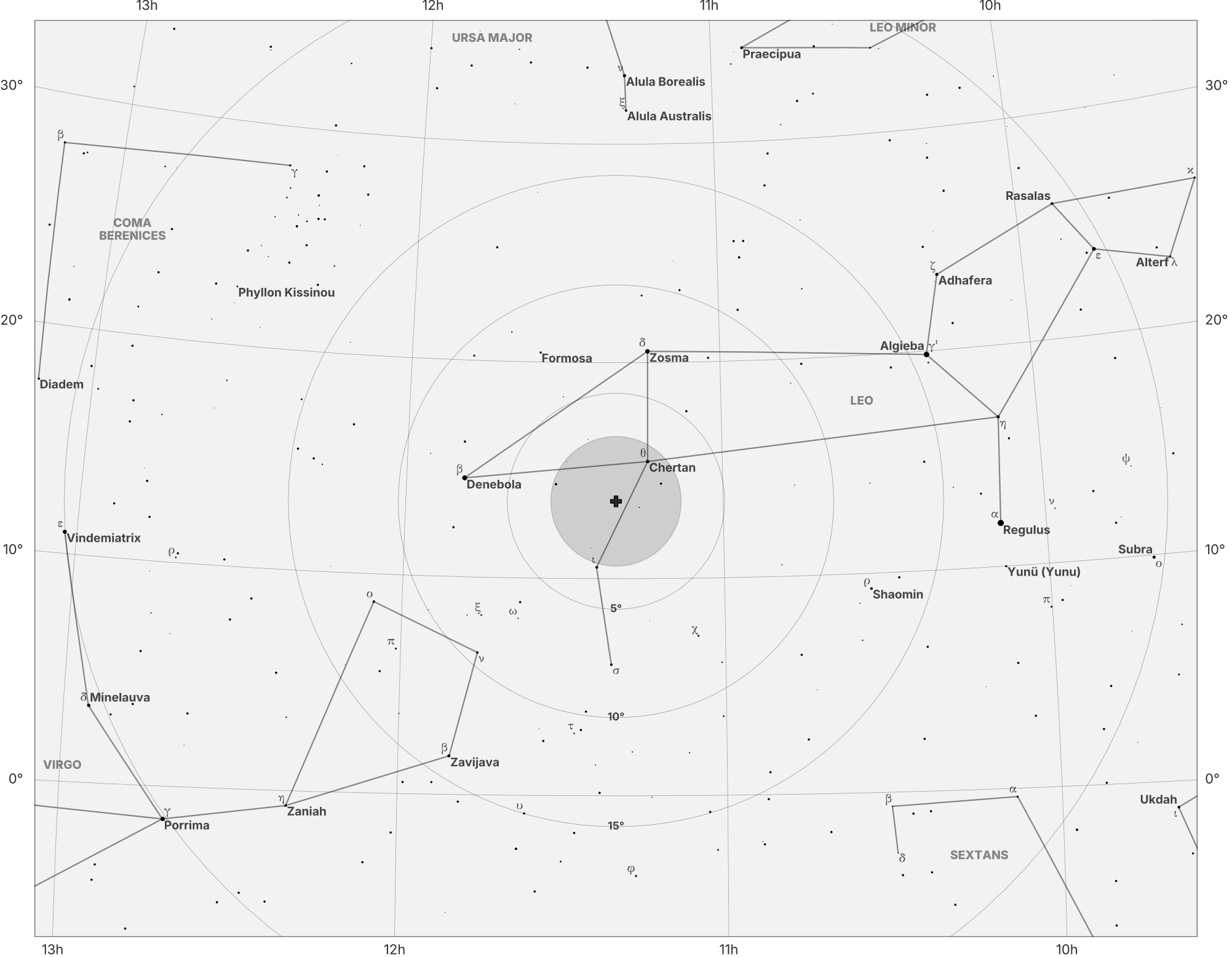
Finder map for NGC 3628
Widely known by its nickname, the ‘Hamburger Galaxy,’ it is one of the three cornerstone objects of the famous Leo Triplet, a premier showcase of galaxies for amateur astronomers during the spring season. Best observed when Leo is high in the sky, ideally above about 30° altitude, to reduce atmospheric extinction and improve contrast. In 4–8 inch telescopes, NGC 3628 appears as a long, edge-on galaxy, with the equatorial dust lane visible as a broad dark band or strong asymmetry under dark skies. The extremely faint tidal tail seen in images lies beyond the visual reach of this aperture class.
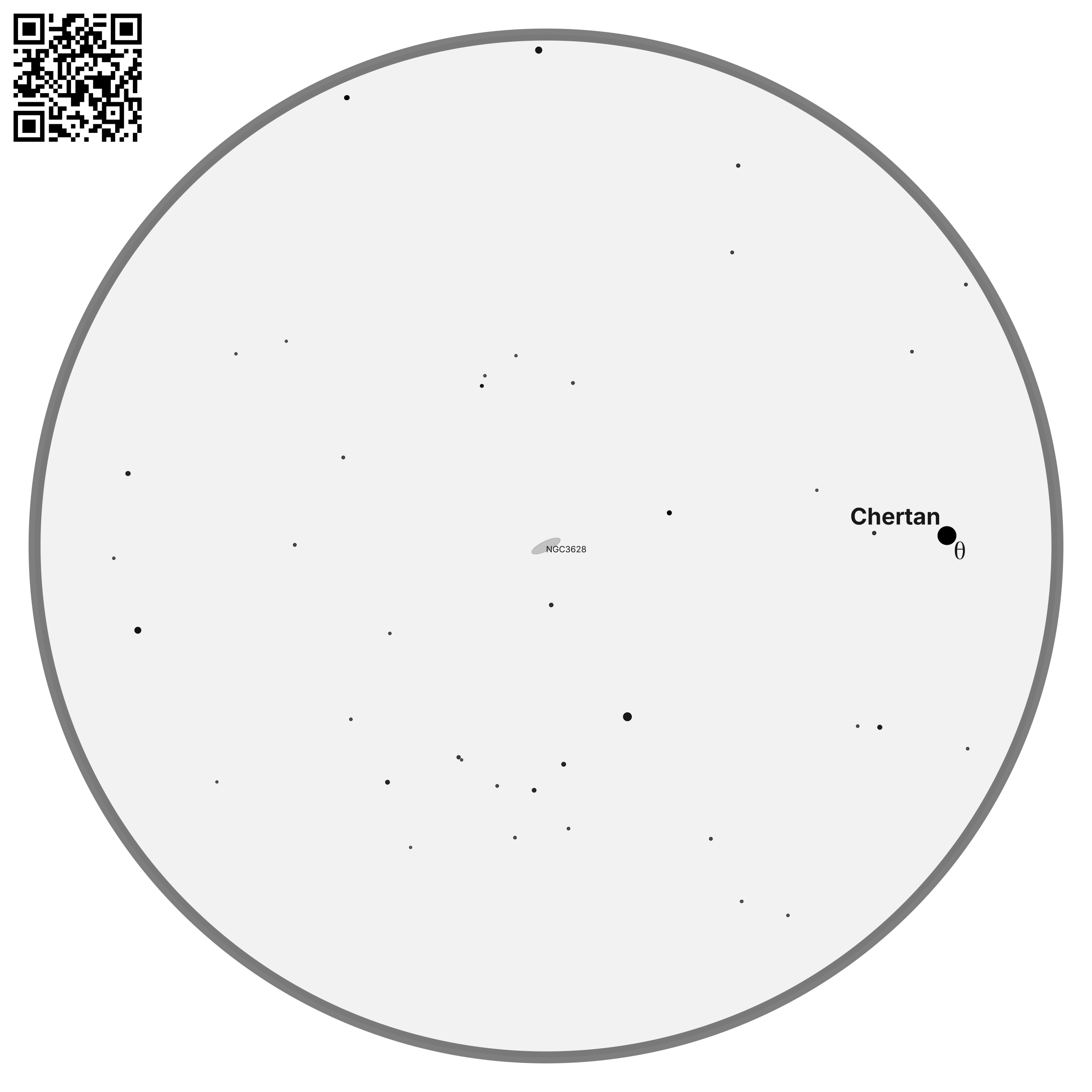
Finder scope & binocular view of NGC 3628
| Property | Value |
|---|---|
| Common names | Hamburger Galaxy, Sarah’s Galaxy |
| Catalog names | NGC 3628, PGC 34697, UGC 6350, Arp 317, VV 308 |
| Type | Active Galactic Nucleus |
| Subtype | LINER Galaxy |
| Coordinates | 11h 20m 17.02s, +13° 35’ 22.16” |
| Season | February - April |
| Best month | Mid-March |
| Beginner friendly | Yes |
| Visual reward | High |
| Filters required | None |
| LP tolerance | Low |
| Minimum equipment | Small telescope |
| Optimal equipment | Large telescope |
| Magnitude | 9.5 |
| Size | 14.79 arcminutes x 2.96 arcminutes |
| Constellation | Leo |
Observation Notes
Naked Eye
Not visible.
Binoculars
Generally not visible; under exceptionally dark, transparent skies and with very large binoculars (around 20×80 or larger), it may be suspected as an extremely faint, elongated smudge, but detection is uncertain and not routine.
Small Telescope
In 4–6 inch apertures, appears as a faint, elongated, diffuse streak of light with very low surface brightness. The dust lane is not visible, and the galaxy can resemble a tenuous wisp against the sky background.
Medium Telescope
With 8–10 inches under dark skies, the elongated edge-on form becomes obvious. The central dust lane may be glimpsed as a thin, low-contrast dark band bisecting the galaxy, producing the characteristic “hamburger” appearance under good conditions.
Large Telescope
In apertures of roughly 12 inches and larger, the dust lane is clearly defined and shows subtle texture with careful observation. The central bulge appears brighter, and under excellent transparency the slight warp of the disk may be suspected with averted vision; all detail remains contrast-based and seeing-dependent.