Epsilon Boötis
4-8 inch Telescope • Challenging Doubles
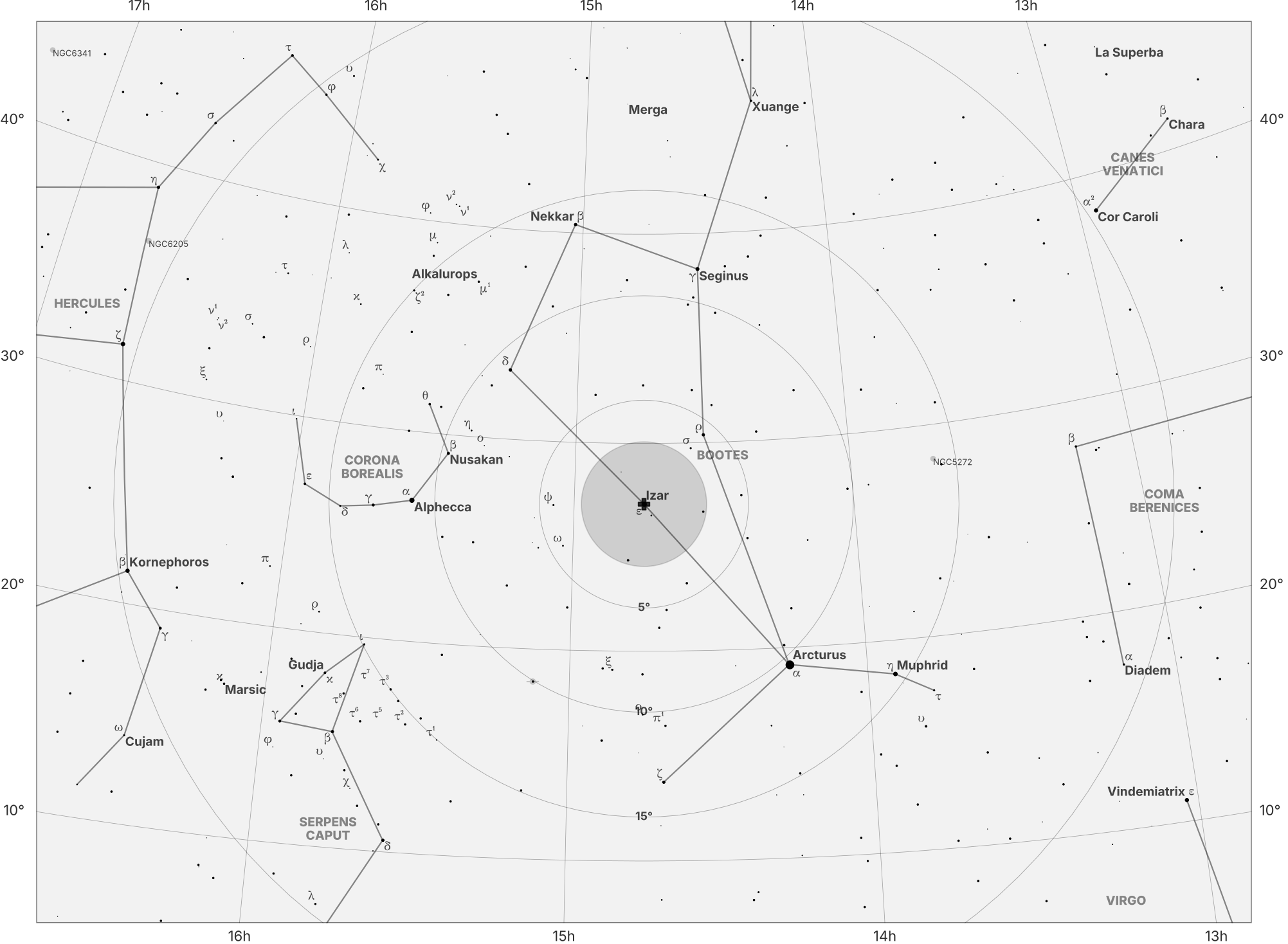
Finder map for Epsilon Boötis
The name Izar is from the Arabic ‘īzār’, meaning ‘veil’ or ‘loincloth’. The name Pulcherrima is Latin for ‘most beautiful’, bestowed by its discoverer to honor its telescopic appearance. High altitude is crucial to minimize atmospheric seeing, which blurs the two close components. Best observed when near the meridian. The close separation (2.8 arcseconds) and the significant magnitude difference (~2.5) between the primary and secondary stars make this a classic test of a telescope’s optical quality and atmospheric stability.

Finder scope & binocular view of Epsilon Boötis
| Property | Value |
|---|---|
| Common names | Izar, Pulcherrima, Mirak |
| Catalog names | - |
| Type | Star |
| Subtype | High Proper Motion Star |
| Coordinates | 14h 44m 59.22s, +27° 04’ 27.20” |
| Season | April - June |
| Best month | May |
| Beginner friendly | No |
| Visual reward | Low |
| Filters required | None |
| LP tolerance | Medium |
| Minimum equipment | Medium telescope |
| Optimal equipment | Medium telescope |
| Magnitude | 2.5 |
| Size | - |
| Constellation | Boötes |
Observation Notes
Naked Eye
Appears as a single, bright star with a warm yellow-orange hue, located northeast of the much brighter Arcturus in Boötes.
Binoculars
Remains unresolved as a single point of light. Binoculars are useful for locating the star but do not reveal the companion.
Small Telescope
Under excellent seeing conditions, a 3-inch telescope can split the pair at high magnification, revealing a very close and much fainter companion. A 4-inch telescope makes the split more reliable, with hints of color contrast beginning to appear.
Medium Telescope
In a 6–8 inch telescope, the separation is clean under steady seeing, and the color contrast becomes clearly noticeable, with a warm-toned primary and a pale blue-white secondary.
Large Telescope
Provides a wide and well-resolved split, but glare from the bright primary can be significant. Higher magnification is often helpful to darken the background sky and better isolate the faint companion.