NGC 6302
10+ inch Telescope • Challenging Planetaries
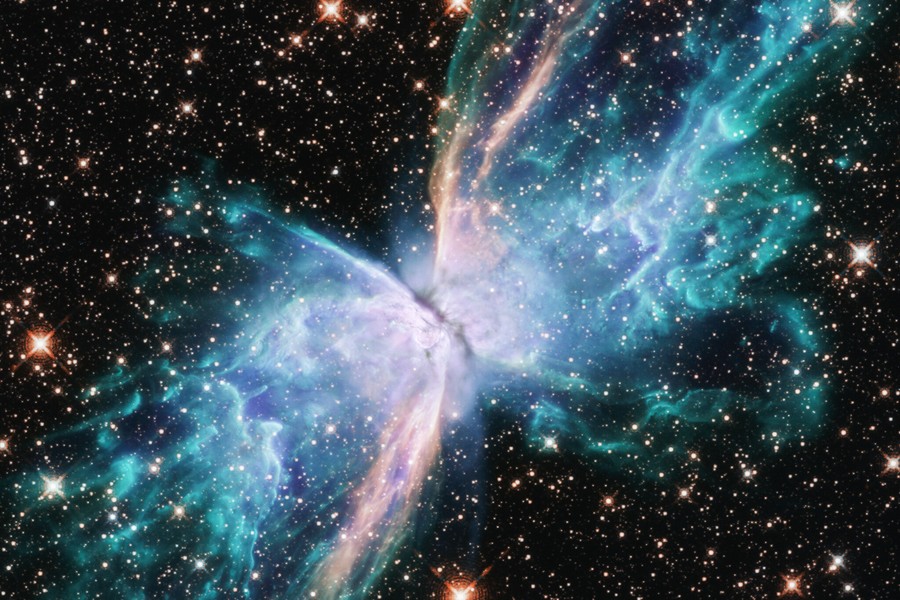
Image: NASA, ESA, and J. Kastner (RIT)
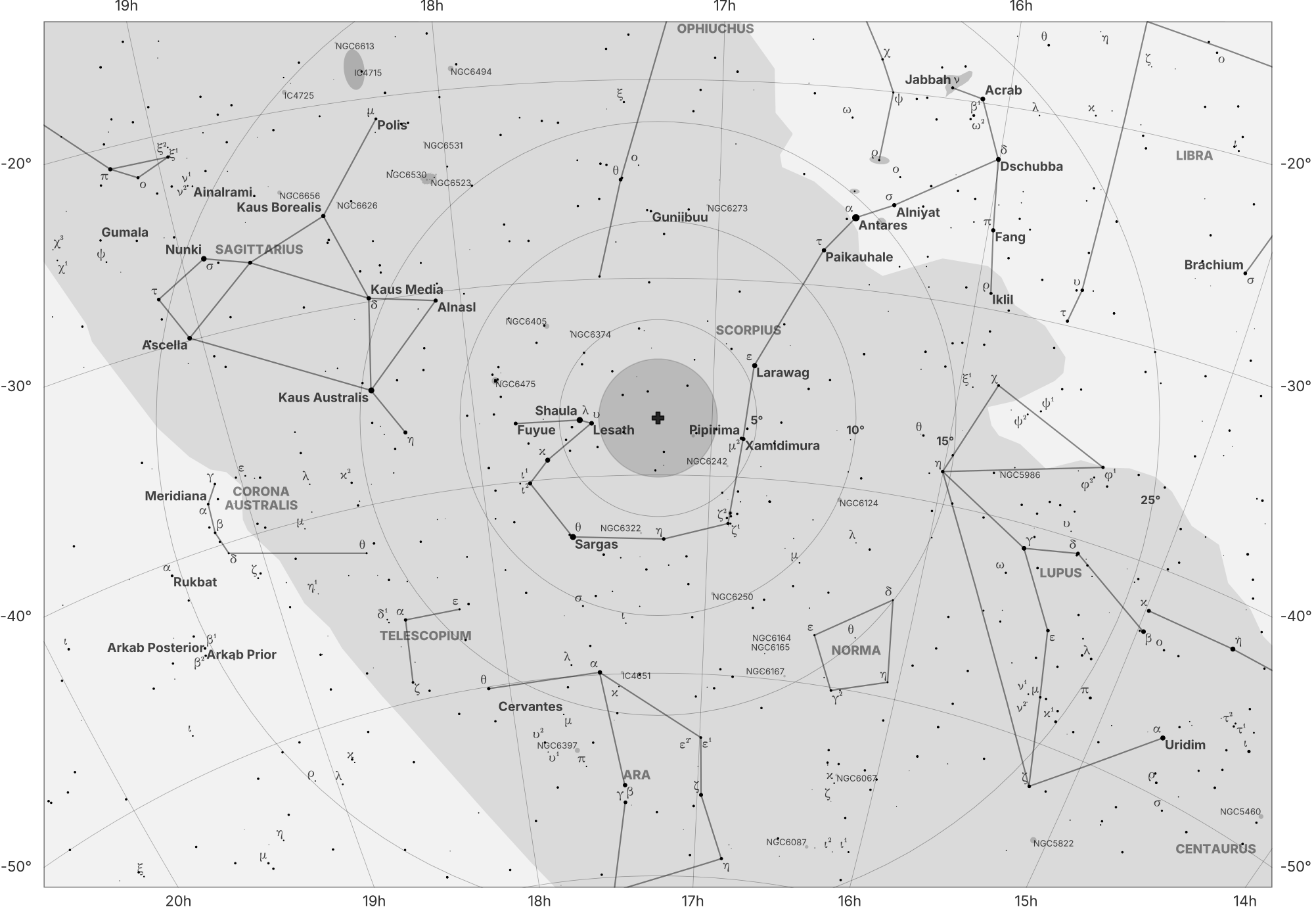
Finder map for NGC 6302
Its dramatic butterfly-like appearance in astrophotography has made it one of the most famous planetary nebulae in outreach and popular media, often used to illustrate the late stages of stellar evolution. This striking morphology, however, is far more apparent in images than at the eyepiece. Well placed for Southern Hemisphere observers. From mid- to high-northern latitudes it remains low on the southern horizon and requires exceptionally clear conditions. At the eyepiece, the nebula appears compact and irregular, with hints of asymmetry rather than a clearly defined butterfly shape. Tracing the faint extensions and internal structure requires large apertures, high magnification, and excellent seeing. The central star is extremely difficult and effectively beyond reach for most amateur telescopes.
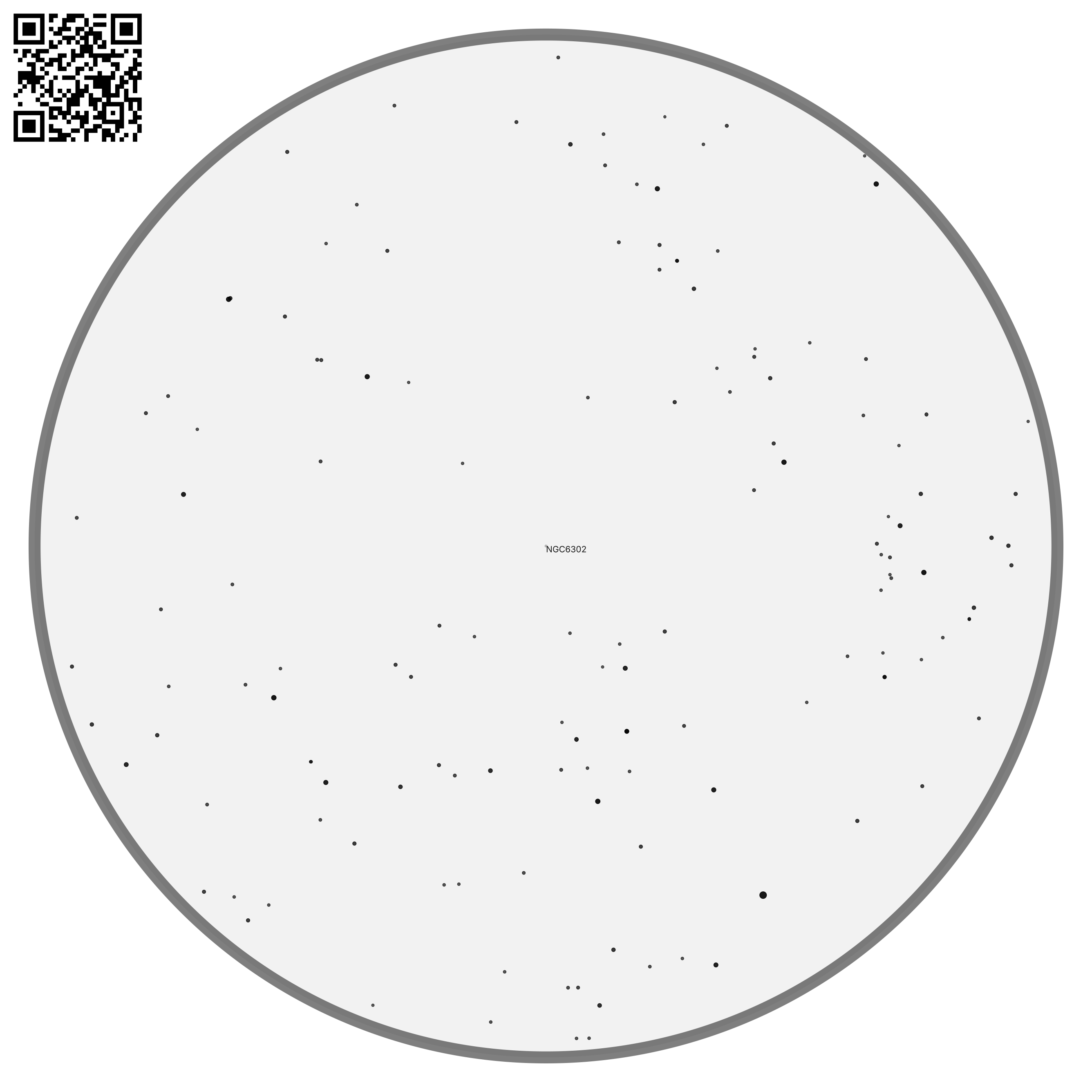
Finder scope & binocular view of NGC 6302
| Property | Value |
|---|---|
| Common names | Bug Nebula, Butterfly Nebula |
| Catalog names | C 69, NGC 6302, SH 2-6, RCW 124, Ced 139, … |
| Type | Evolved Star |
| Subtype | Planetary Nebula |
| Coordinates | 17h 13m 44.50s, -37° 06’ 11.16” |
| Season | May - July |
| Best month | Mid-June |
| Beginner friendly | Yes |
| Visual reward | High |
| Filters required | OIII, UHC |
| LP tolerance | High |
| Minimum equipment | Medium telescope |
| Optimal equipment | Large telescope |
| Magnitude | 9.6 |
| Size | 1.48 arcminutes x 1.48 arcminutes |
| Constellation | Scorpius |
Observation Notes
Naked Eye
Not visible.
Binoculars
Not visible.
Small Telescope
Very difficult. Appears as a tiny, high–surface-brightness object that is nearly stellar and easily overlooked. An O-III filter is strongly recommended to confirm its non-stellar nature, where it may show a slight elongation rather than a clean disk.
Medium Telescope
With an O-III filter and steady seeing, the nebula shows a distinctly non-stellar, elongated form. A brighter central bar may be apparent, but the full bipolar or “bow-tie” structure is subtle and not sharply defined.
Large Telescope
Under dark skies with an O-III filter, the nebula becomes strikingly irregular and strongly elongated. The opposing lobes are clearly suggested rather than crisply outlined, and brightness variations across the nebula give a strong impression of complex structure. Even in large apertures, details remain delicate rather than sharply resolved.