Sh2-71
10+ inch Telescope • Challenging Planetaries
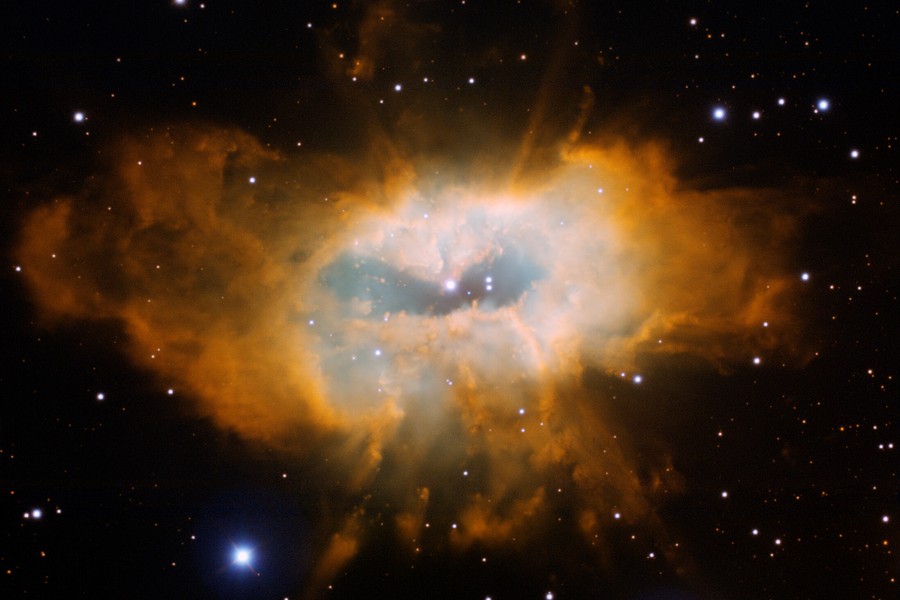
Image: International Gemini Observatory
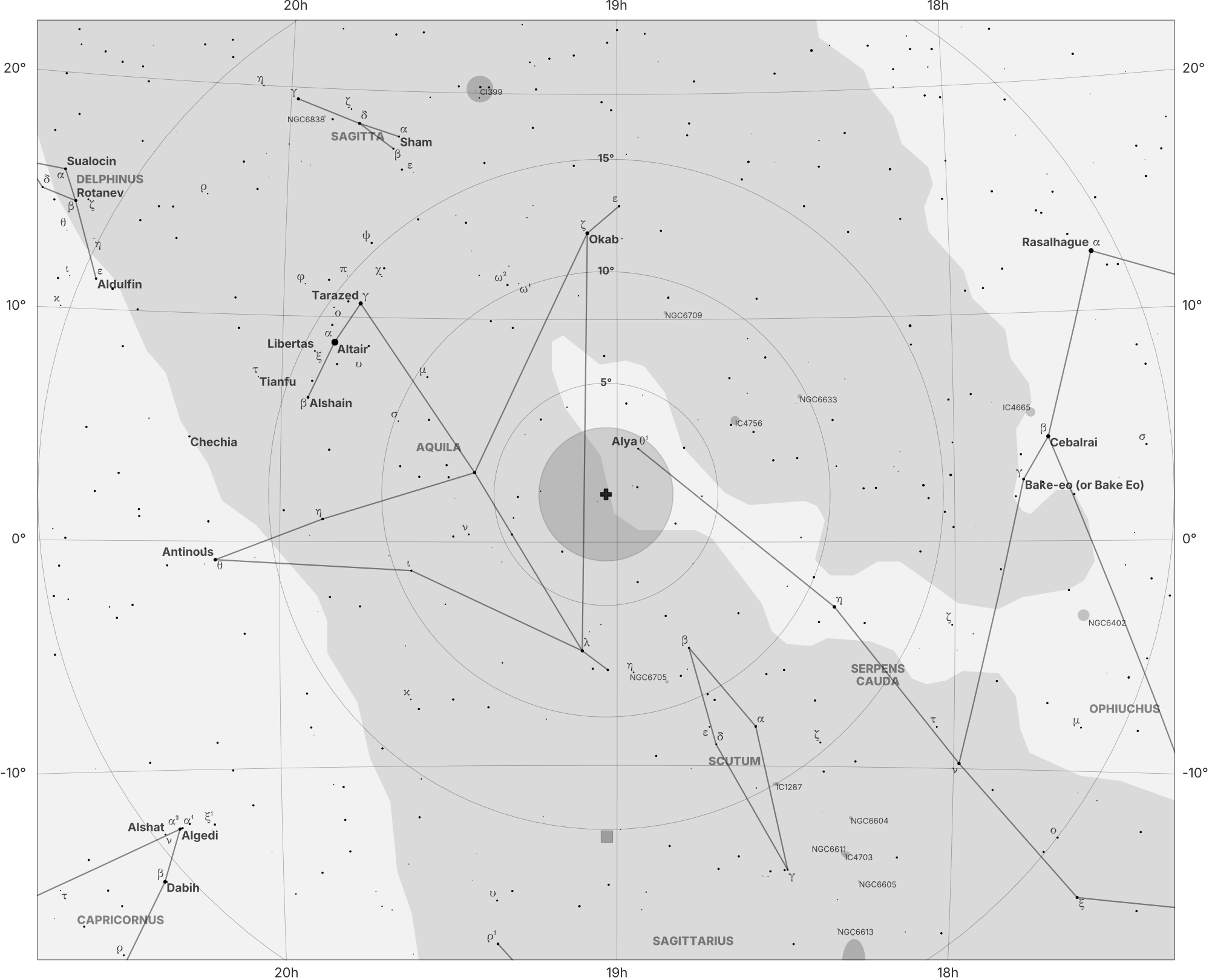
Finder map for Sh2-71
No known cultural, historical, or mythological significance. Sh 2-71 is a specialist target known primarily within professional and advanced amateur astronomy. Best observed when near culmination to maximize contrast, as its very low surface brightness makes it sensitive to atmospheric extinction. Accessible from both hemispheres, though it remains lower in the sky for observers at high southern latitudes. Its extremely low surface brightness makes Sh 2-71 a severe contrast challenge. Visually, it appears as a very faint, poorly defined glow, often requiring narrowband filters and excellent dark-sky conditions. Any structured or S-shaped appearance is primarily an imaging result and is not reliably perceived at the eyepiece.
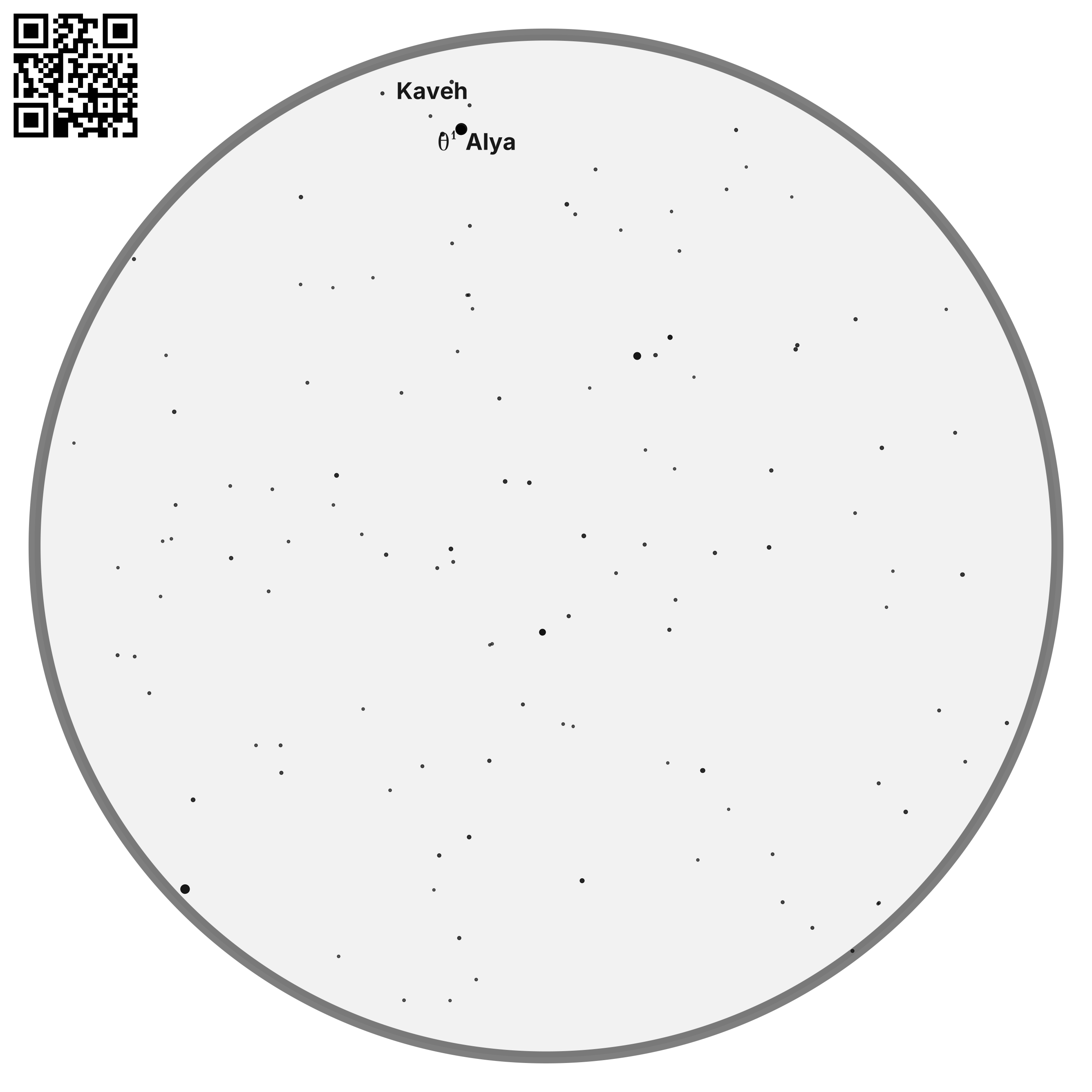
Finder scope & binocular view of Sh2-71
| Property | Value |
|---|---|
| Common names | Question Mark Nebula |
| Catalog names | SH 2-71, LBN 103, PK 036-01.1, PN G035.9-01.1 |
| Type | Evolved Star |
| Subtype | Planetary Nebula |
| Coordinates | 19h 02m 00.28s, +2° 09’ 10.98” |
| Season | June - August |
| Best month | July |
| Beginner friendly | No |
| Visual reward | Low |
| Filters required | OIII, UHC |
| LP tolerance | Low |
| Minimum equipment | Large telescope |
| Optimal equipment | Large telescope |
| Magnitude | - |
| Size | 2.5 arcminutes x 1.3 arcminutes |
| Constellation | Aquila |
Observation Notes
Naked Eye
Invisible.
Binoculars
Invisible.
Small Telescope
Essentially invisible. Even under pristine skies with an O-III filter, most observers will not detect this object at all in small apertures. At best, an extremely faint, ill-defined haze may be suspected, but this is not a reliable observation.
Medium Telescope
Very difficult. In apertures around 10–12 inches, an O-III filter and high magnification may reveal a tiny, very low-contrast, non-stellar glow, often without a clearly defined shape. Many experienced observers will still fail to see it.
Large Telescope
Under excellent transparency, large apertures (≈14 inches or more) with an O-III filter can make the nebula detectable as a faint, irregular patch. A subtle suggestion of its characteristic curved or “S”-like form may be suspected by highly experienced observers, but remains delicate and uncertain. The central variable star (V1513 Aql, roughly magnitude 14–15) is itself a challenge and is more readily sought without a nebular filter; it is typically suppressed when an O-III filter is in place.