NGC 884
Binoculars • Open Clusters
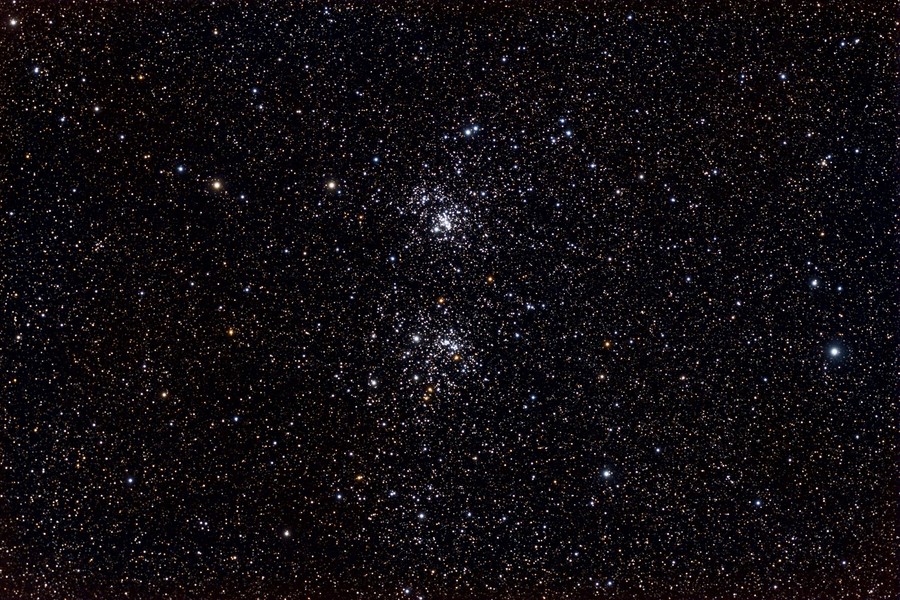
Image: Genuson
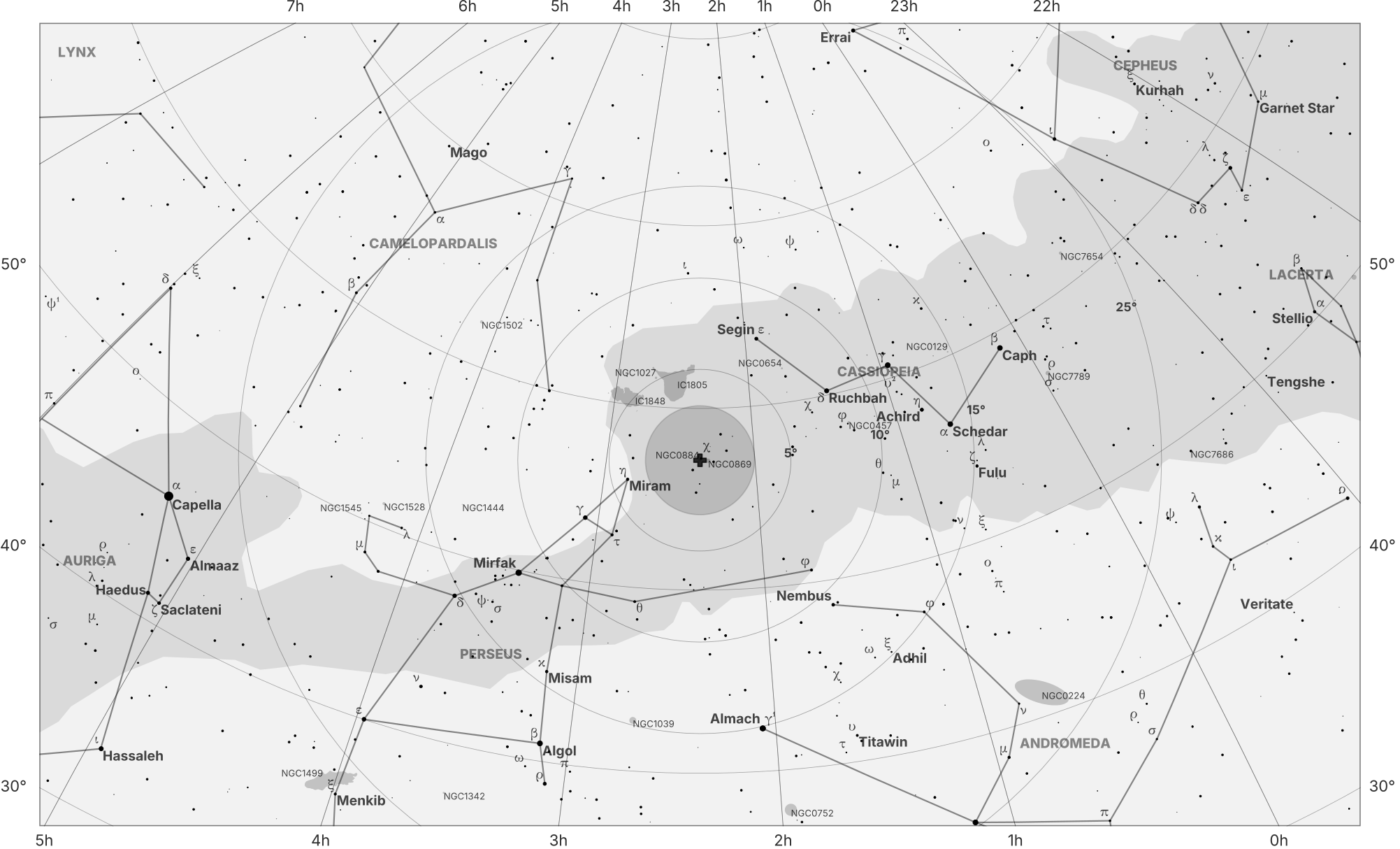
Finder map for NGC 884
As part of the famous Double Cluster, it is one of the most celebrated and beautiful binocular objects in the night sky. Located within the constellation Perseus, the pair has long been admired as a richly jeweled region of the Milky Way in both historical star charts and modern amateur astronomy. Best viewed when high in the sky to minimize atmospheric distortion. Circumpolar for most mid-to-high northern latitudes. Distinguishing the fainter cluster members from the rich Milky Way background and appreciating the subtle color contrast of the red supergiant stars among the numerous blue-white members.
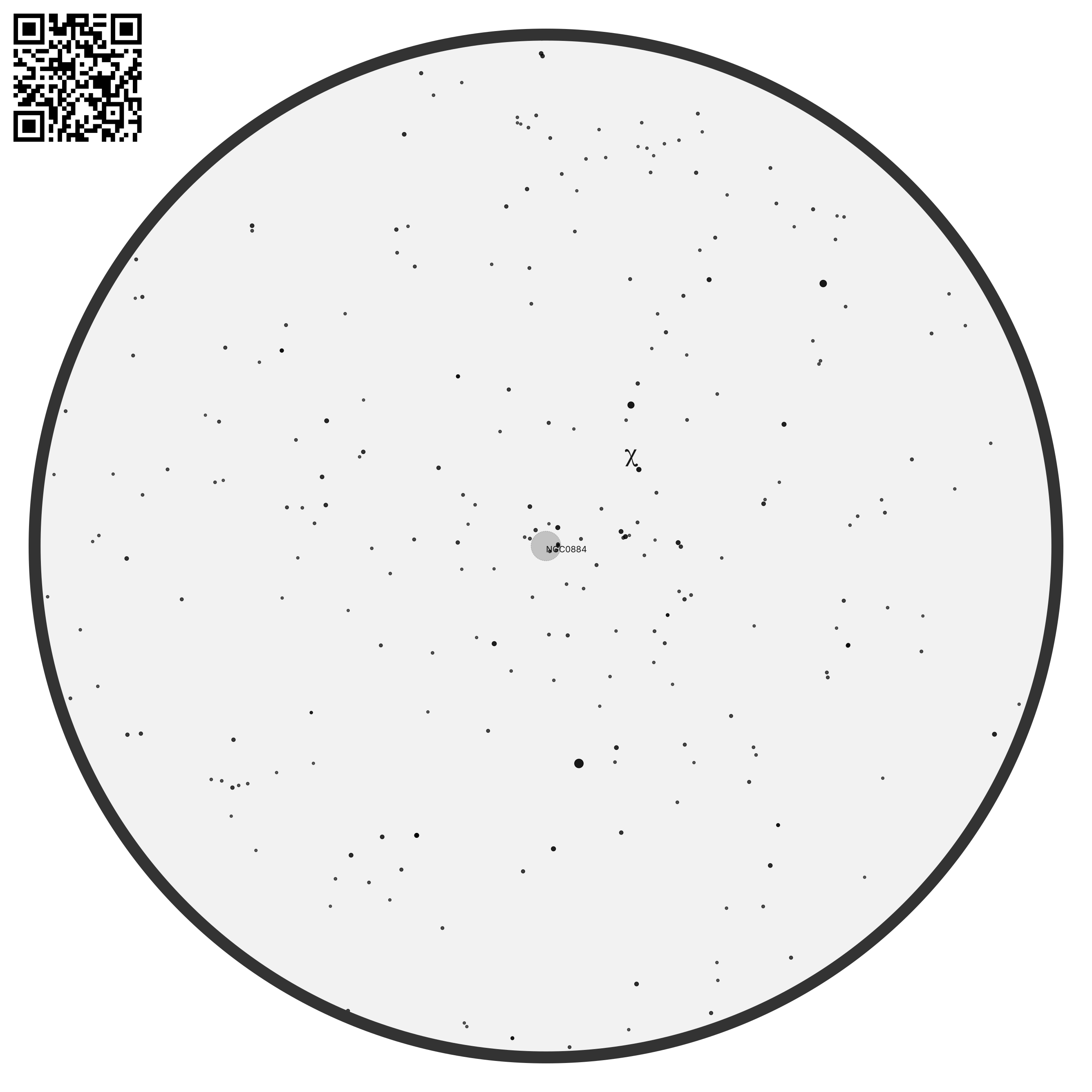
Finder scope & binocular view of NGC 884
| Property | Value |
|---|---|
| Common names | Chi Persei Cluster, Eastern Cluster of the Double Cluster, The Sword Handle |
| Catalog names | C 14, NGC 884, Cr 25, Mel 14 |
| Type | Stellar Cluster |
| Subtype | Open Cluster |
| Coordinates | 2h 22m 15.70s, +57° 08’ 59.00” |
| Season | October - December |
| Best month | November |
| Beginner friendly | Yes |
| Visual reward | High |
| Filters required | None |
| LP tolerance | High |
| Minimum equipment | Naked eye |
| Optimal equipment | Binoculars |
| Magnitude | 6.1 |
| Size | 18.0 arcminutes x 18.0 arcminutes |
| Constellation | Perseus |
Observation Notes
Naked Eye
Visible from dark skies as part of the famous Double Cluster, appearing as a faint, hazy glow adjacent to NGC 869. To the unaided eye, the two clusters are often perceived together as a single elongated or double nebulous patch.
Binoculars
A superb binocular object, resolving into dozens of bright stars. NGC 884 appears slightly looser and less centrally concentrated than its companion NGC 869, and viewing both clusters together in the same field is spectacular.
Small Telescope
At low power, reveals many dozens of stars spread across the cluster, with a rich but still open structure. A wide-field eyepiece is essential to preserve context or to include both clusters in the same view.
Medium Telescope
Resolves large numbers of stars across the cluster, producing a brilliant, sparkling field. Several orange and red supergiant stars become prominent, providing striking color contrast against the dominant blue-white population.
Large Telescope
Shows an extremely rich star field with numerous faint members and close pairs visible. Higher magnification is useful for examining individual stars and subtle color contrasts, though the cluster’s overall form is best appreciated at lower power.