Pleiades
Naked Eye • Clusters
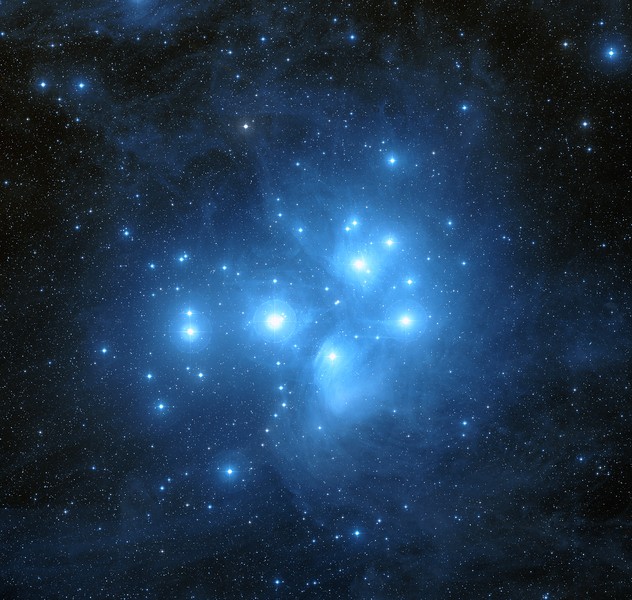
Image: Davide De Martin & the ESA/ESO/NASA
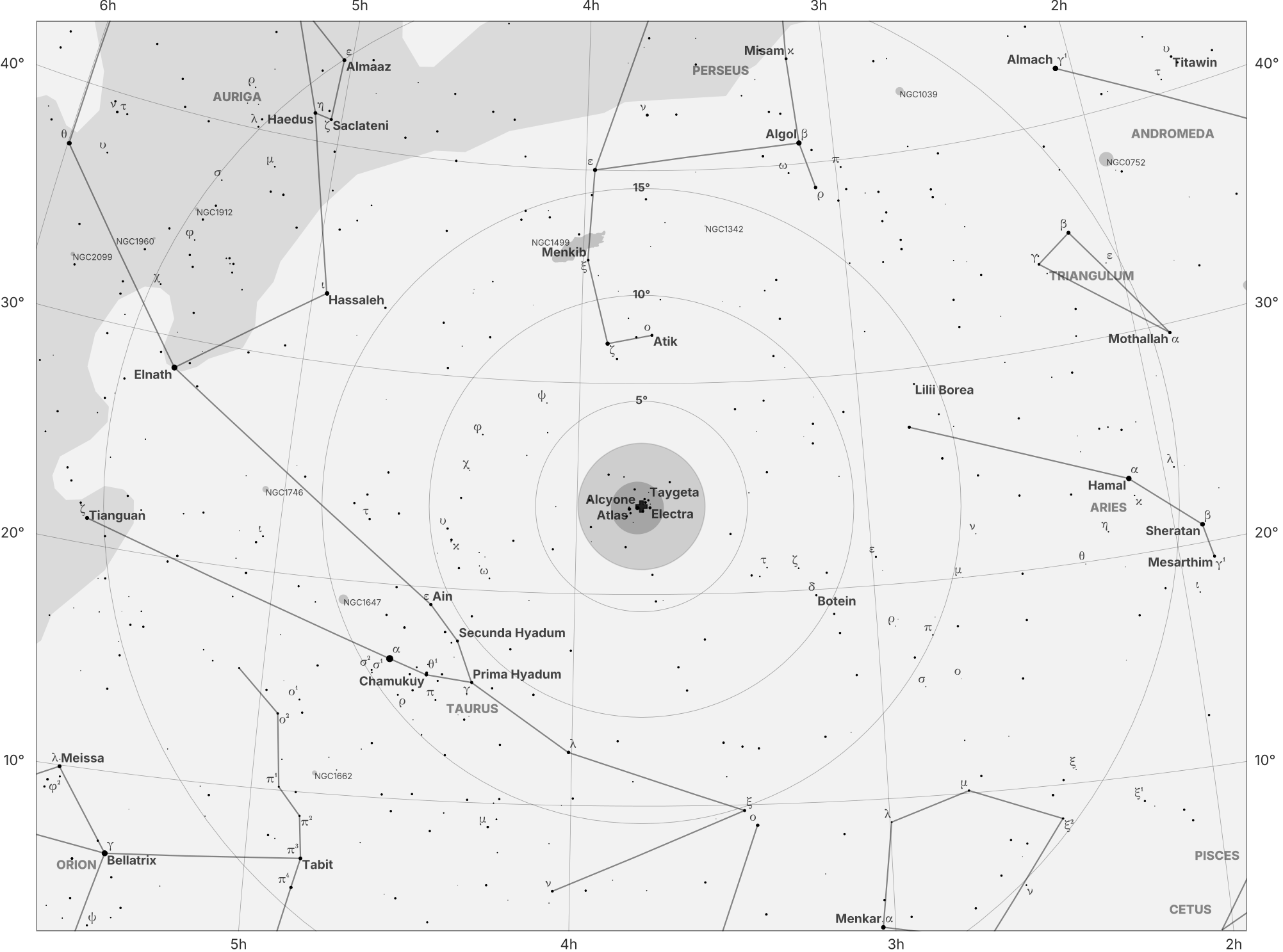
Finder map for Pleiades
ne of the most culturally significant star clusters in the sky. Known as Subaru in Japan—an association reflected in the automobile manufacturer’s logo—and as Matariki in Māori tradition, where its heliacal rising marks the New Year. Best viewed when high in the sky to reduce atmospheric extinction and haze, allowing its full brilliance to stand out. Under light-polluted skies, the cluster can shrink to only a few visible stars, and many observers are surprised by how few members are readily seen. Under dark skies, recognizing the cluster’s compact grouping and counting its brighter stars becomes the primary naked-eye challenge.
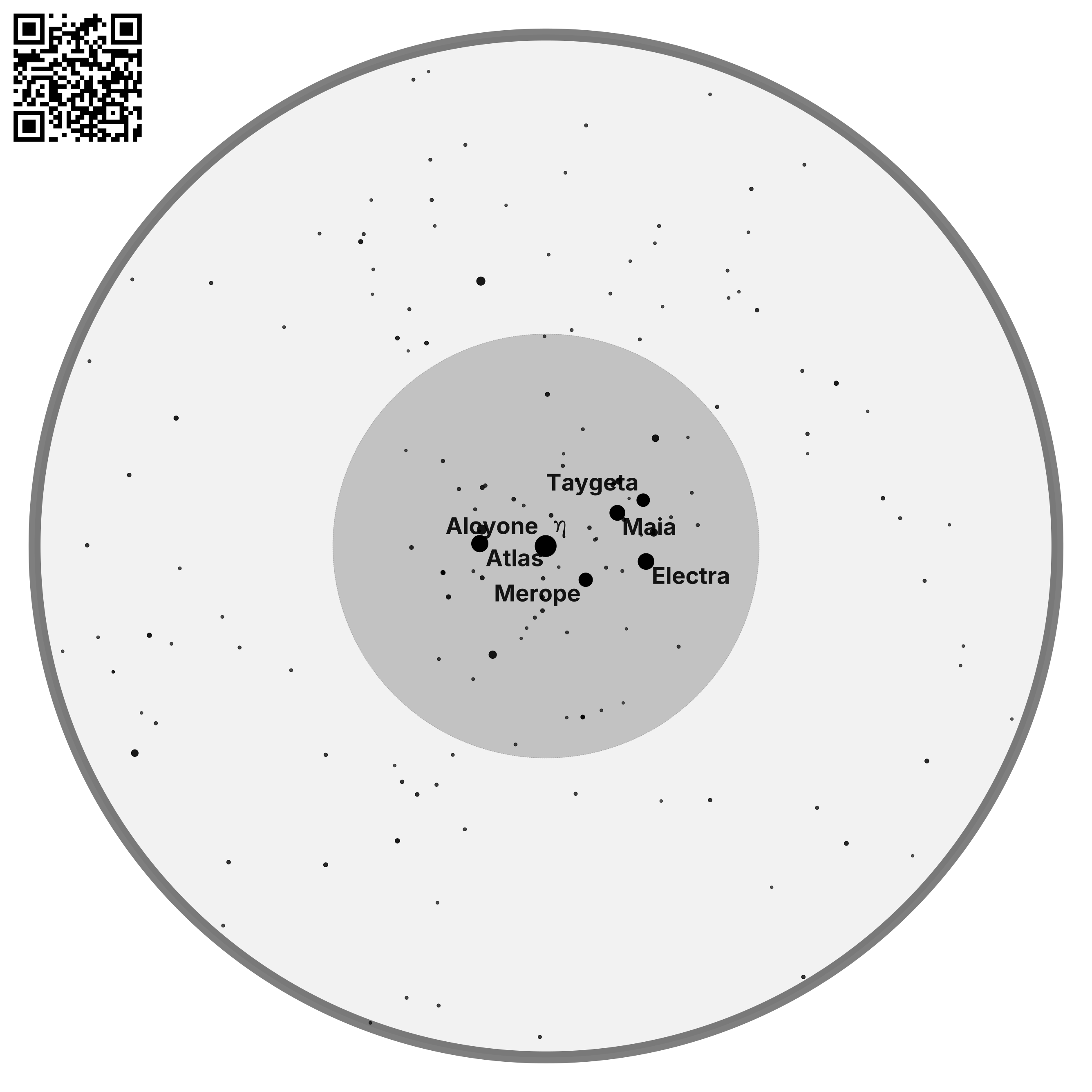
Finder scope & binocular view of Pleiades
| Property | Value |
|---|---|
| Common names | Seven Sisters, Subaru |
| Catalog names | M 45, Cr 42, Mel 22 |
| Type | Stellar Cluster |
| Subtype | Open Cluster |
| Coordinates | 3h 46m 38.00s, +24° 10’ 41.00” |
| Season | October - December |
| Best month | Mid-November |
| Beginner friendly | Marginal |
| Visual reward | High |
| Filters required | None |
| LP tolerance | High |
| Minimum equipment | Naked eye |
| Optimal equipment | Binoculars |
| Magnitude | 1.6 |
| Size | 120.0 arcminutes x 120.0 arcminutes |
| Constellation | Taurus |
Observation Notes
Naked Eye
Easily visible as a compact group of 6–9 bright stars forming a small, dipper-like pattern. It is sometimes confused with the Little Dipper by beginners, though it is much smaller and more condensed.
Binoculars
An excellent binocular target. Reveals several dozen stars concentrated into a tight, sparkling group. The familiar dipper-like outline is very clear, and the sense of a nearby stellar association is strong.
Small Telescope
Best viewed at the lowest possible magnification. Dozens of bright blue-white stars fill the field, though higher power quickly overfills the view. The cluster is too large and bright for detailed telescopic study.
Medium Telescope
Generally too much magnification for the cluster as a whole. Under very dark, transparent skies, highly experienced observers may suspect extremely faint, uneven brightening near Merope corresponding to the reflection nebulosity, but this is not a reliable observation.
Large Telescope
Not well suited to viewing the cluster as a whole. Under exceptional conditions, traces of the reflection nebulosity may be suspected near the brightest stars, but it remains an extremely subtle visual effect. Large apertures are better used for studying individual stars or close doubles rather than the cluster itself.