NGC 7789
4-8 inch Telescope • Open Clusters Rich
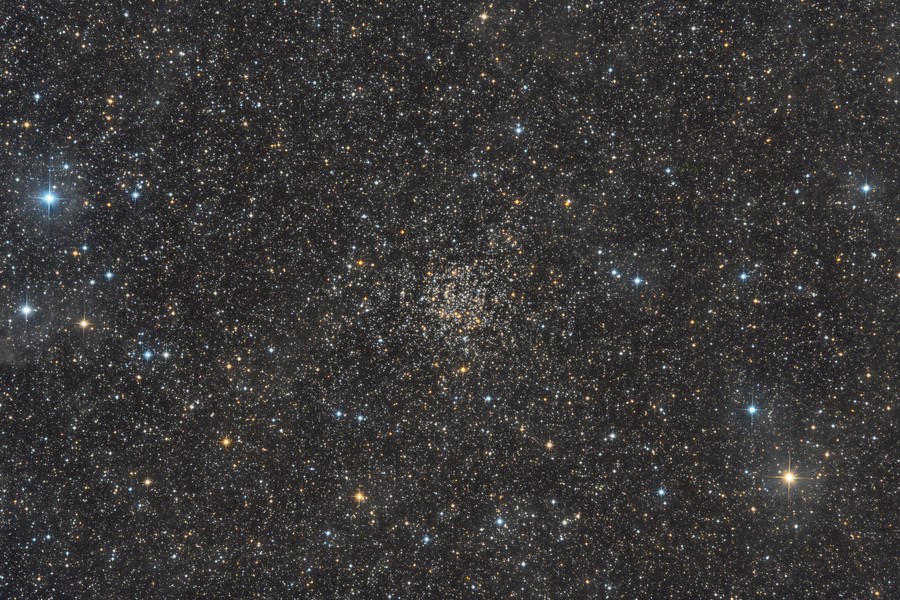
Image: Bortle7
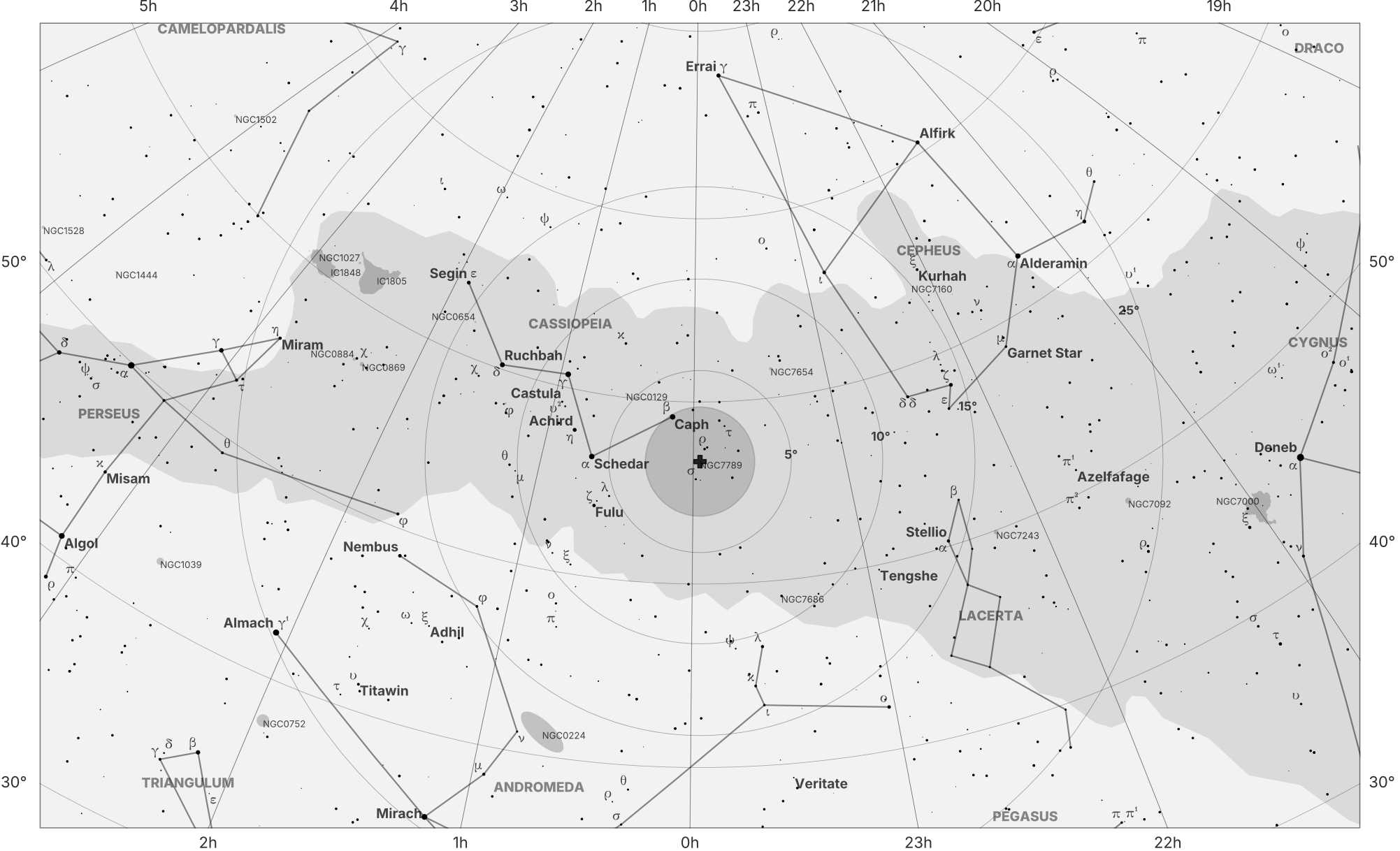
Finder map for NGC 7789
Commonly known as “Caroline’s Rose,” NGC 7789 was discovered by Caroline Herschel in 1783. The nickname, inspired by its appearance, serves as a lasting tribute to her important contributions to astronomy. High in the sky for most Northern Hemisphere observers and circumpolar north of about 34° N latitude. From the Southern Hemisphere it remains very low or is not observable from mid-southern latitudes. The primary challenge is resolving large numbers of faint stars in a very crowded field. In 4–8 inch telescopes, the cluster shows subtle variations in star density that hint at its “rose-like” appearance, but the pattern remains delicate and requires dark skies and careful viewing.
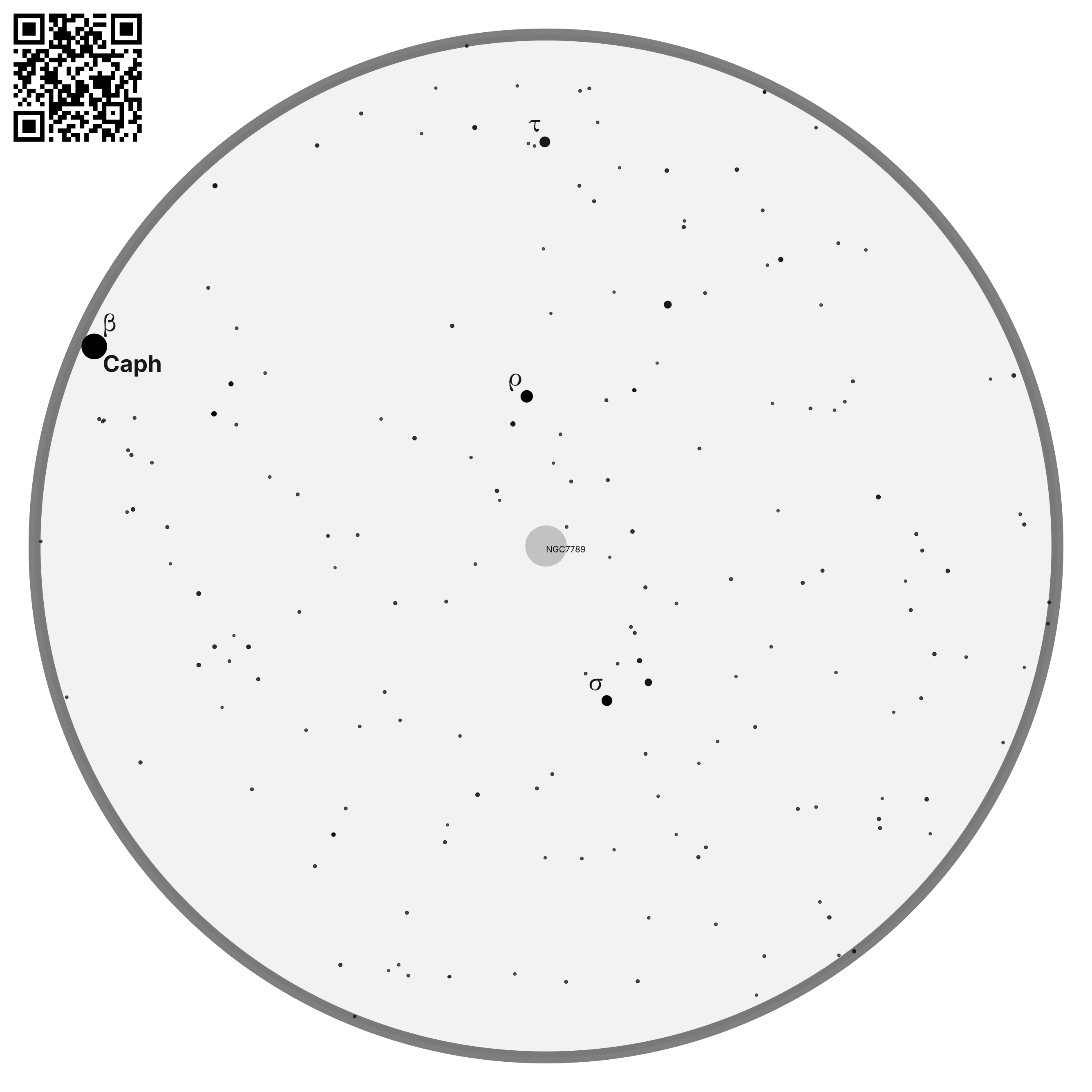
Finder scope & binocular view of NGC 7789
| Property | Value |
|---|---|
| Common names | Caroline’s Rose Cluster, The White Rose Cluster |
| Catalog names | NGC 7789, Cr 460, Mel 245 |
| Type | Stellar Cluster |
| Subtype | Open Cluster |
| Coordinates | 23h 57m 19.40s, +56° 43’ 28.00” |
| Season | August - October |
| Best month | Mid-September |
| Beginner friendly | Marginal |
| Visual reward | High |
| Filters required | None |
| LP tolerance | Medium |
| Minimum equipment | Small telescope |
| Optimal equipment | Medium telescope |
| Magnitude | 6.7 |
| Size | 25.0 arcminutes x 25.0 arcminutes |
| Constellation | Cassiopeia |
Observation Notes
Naked Eye
Generally not visible; under exceptionally dark, transparent skies a few experienced observers report a very faint, diffuse suspicion with averted vision, but naked-eye detection is rare and uncertain.
Binoculars
Appears as a large, soft, round glow of unresolved light that is clearly non-stellar, standing out as a diffuse patch against the surrounding field.
Small Telescope
In 4–6 inch apertures, resolves into a delicate, granular haze of countless faint stars, often giving a “spilled salt” or “star dust” impression across a dark background.
Medium Telescope
With 8–12 inches, many dozens of faint stars are resolved across the cluster’s full extent, creating a richly textured field. The cluster shows only a gentle increase in density toward the center rather than a sharply defined core.
Large Telescope
In apertures of roughly 14 inches and larger, the field fills with innumerable faint stars, producing a highly intricate appearance. Subtle dark patterns may be suspected as contrast effects between star-rich regions, and a few of the brighter giant stars may show faint orange or yellow hues under good conditions.