Messier 35
Binoculars • Open Clusters
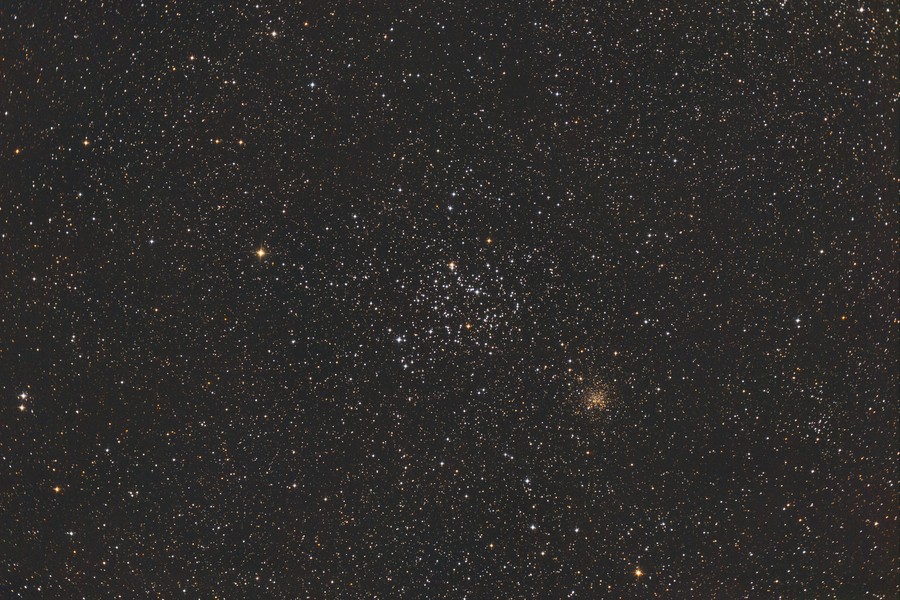
Image: Starhopper
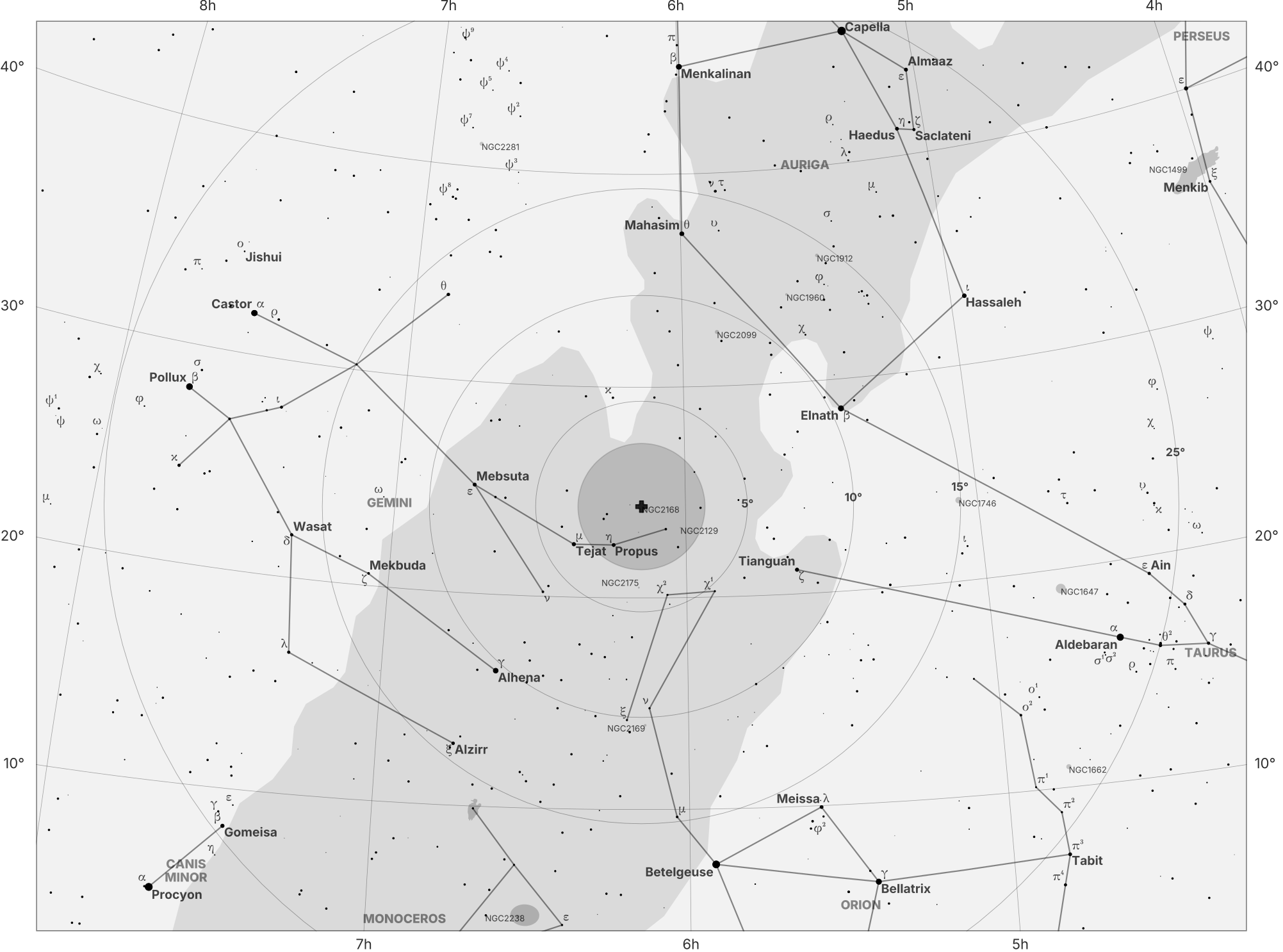
Finder map for Messier 35
A classic winter showpiece object for amateur astronomers and a frequent highlight of star parties. Sometimes called the ‘Shoe-Buckle Cluster’ due to its location near the foot of Castor. Best observed when high in the sky to clear atmospheric haze, ideally above 35 degrees. Observing and resolving the much fainter, more distant companion cluster NGC 2158, which lies about 22–25 arcminutes to the southwest.
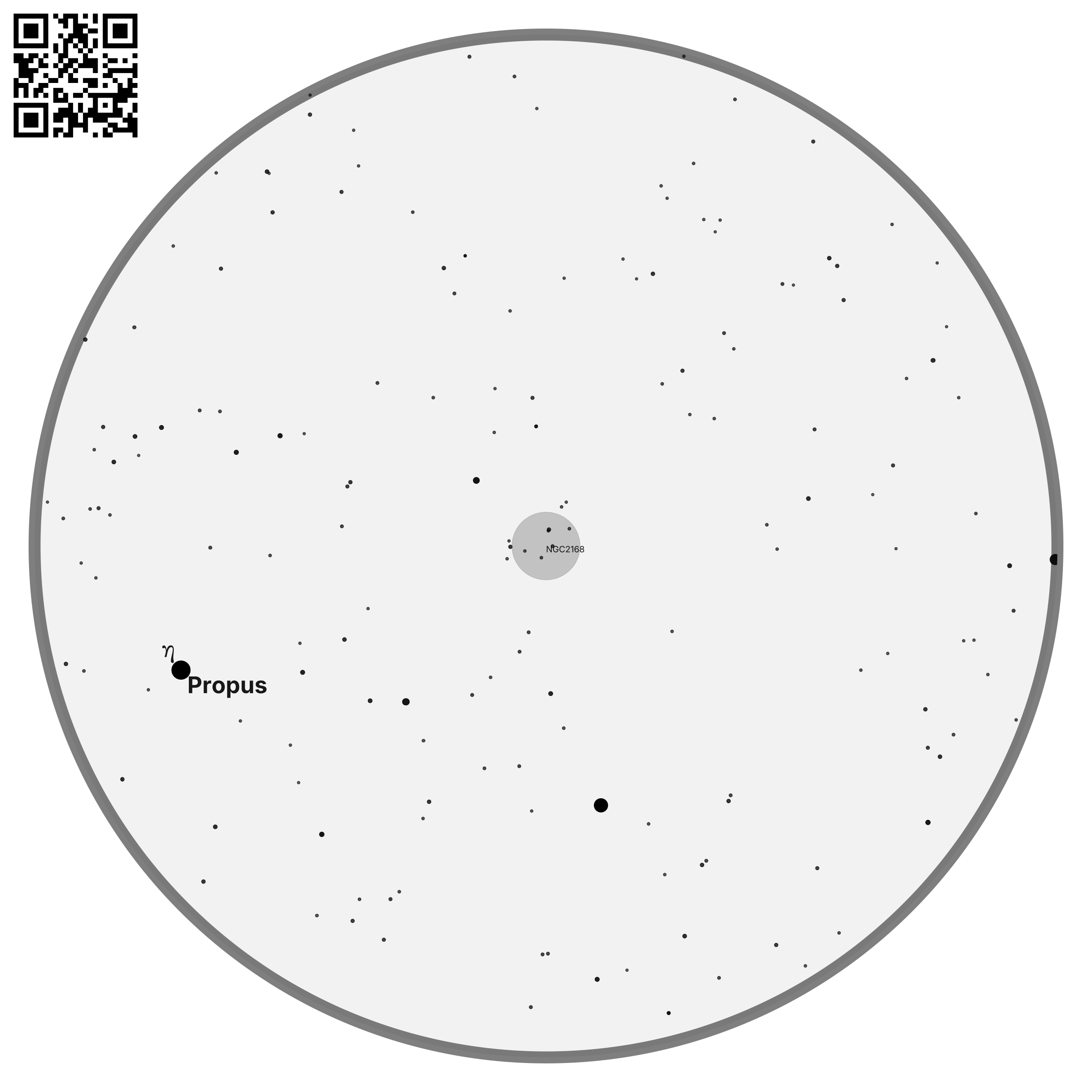
Finder scope & binocular view of Messier 35
| Property | Value |
|---|---|
| Common names | M35, Shoe-Buckle Cluster |
| Catalog names | M 35, NGC 2168, Cr 82, Mel 41 |
| Type | Stellar Cluster |
| Subtype | Open Cluster |
| Coordinates | 6h 09m 07.50s, +24° 20’ 15.00” |
| Season | December - February |
| Best month | January |
| Beginner friendly | Yes |
| Visual reward | Moderate |
| Filters required | None |
| LP tolerance | High |
| Minimum equipment | Naked eye |
| Optimal equipment | Binoculars |
| Magnitude | 5.1 |
| Size | 25.0 arcminutes x 25.0 arcminutes |
| Constellation | Gemini |
Observation Notes
Naked Eye
Not reliably visible to the unaided eye. Optical aid is required to detect the cluster.
Binoculars
An excellent binocular object, resolving into a wide scattering of dozens of stars spread across a field roughly comparable to the full Moon. Its rich yet loose structure is immediately apparent.
Small Telescope
At low power, resolves into many dozens of stars, dominated by bright blue-white members arranged in graceful chains and arcs across the field.
Medium Telescope
Reveals a rich star field with increasing numbers of faint members. The nearby cluster NGC 2158 is clearly visible as a small, compact, unresolved glow to the southwest, providing a striking contrast in age and density.
Large Telescope
Fills a low-power eyepiece with a dense but loose star field. The focus remains on M35’s stellar patterns, while NGC 2158 remains a compact, largely unresolved cluster that appears as a concentrated, granular patch rather than breaking cleanly into stars.